Why People Underestimate the Calories in Healthy Foods
The Dieter’s Paradox: The promotion of healthy foods can facilitate overconsumption, leading to weight gain instead of weight loss.

Obesity is increasing at an alarming rate.
According to WHO, since 1975, obesity levels have almost tripled, despite the extensive public policy efforts to promote the consumption of healthy foods and the public's growing concern with weight management.
This article explores the findings of a little-discussed 2010 study by Alexander Chernev, called "The Dieter's Paradox".
It identified that weight-conscious people, in particular, tend to mistakenly believe that adding a healthy option to an otherwise unhealthy meal will lower the total calorie count.
Let's discuss.
The Dieter's Paradox
The dieter's paradox is the misguided belief about the relationship between a meal's healthiness and its impact on weight gain, significantly contributing to the obesity trend.
“Promoting the consumption of healthy foods without providing a complete picture of the factors influencing weight gain might paradoxically facilitate caloric overconsumption, leading to weight gain rather than weight loss.” — Alexander Chernev
Chernev's study asked its 934 participants to estimate the caloric content of several meals.

The first food options in the study were high-calorie unhealthy meals such as a burger or a bowl of chilli. The second options were the same unhealthy meals, with a side of a healthy meal, such as a salad or celery sticks.
On average, with all meal types, the study participants estimated that the unhealthy plus the healthy option had fewer calories than the unhealthy option alone.
For example, the chilli alone was estimated at 699 calories on average, but when combined with a green salad, it was estimated at 656 calories, a reduction of 43 calories.
Yes, participants believed there would be fewer calories with the addition of a healthy side, even though that doesn't make any sense.
Any food item added to a meal will inevitably add calories to the total.
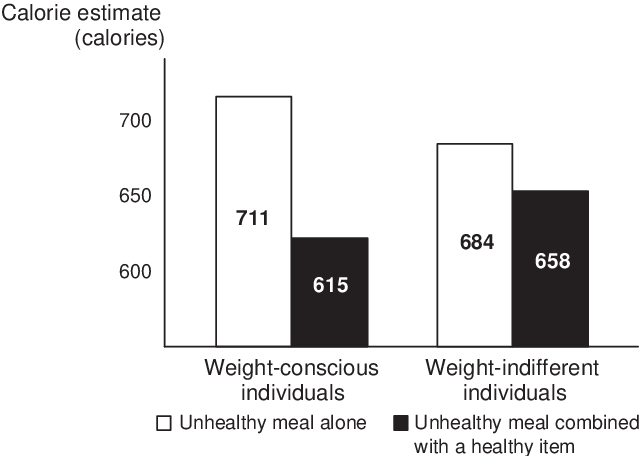
Chernev compared the results for weight-conscious individuals to those who weren't. Interestingly, he found that individuals most concerned with managing their weight, i.e. overweight people, are most likely to underestimate the calorie content of meals containing both healthy and unhealthy items.
A person with greater motivation to lose weight and monitor eating led to more biased judgments about calories.
The Negative-Calorie Illusion
The study suggests the negative calorie bias is more pronounced for more involved/ motivated individuals.
Firstly, what are negative calories?
Healthline explains negative calories as foods that "supposedly require more energy to digest and process than they actually provide to your body. Fruits and vegetables with high water content and few calories are often marketed as negative-calorie."
However, it's a myth, as there is no evidence supporting this notion that these super low-calorie foods require more energy from our bodies to digest than they provide.
Do people really believe in negative calories?
There's no evidence that the study's participants know the concept of negative calories. Instead, they are more likely to underestimate the caloric content of meals containing a healthy option.
Psychotherapist Blogger James Lawley refutes the idea that the study participants believe in negative calories. It just defies logic, as adding more food to a meal will always increase the calories.
He believes a more logical explanation is an individual's self-deception — a person's ability to "fool themselves" in the moment and over time. It's a form of self-sabotage that seems easier to the person than realising their mistake and making necessary changes — i.e. eating less food.
“Dieters probably know that a cheeseburger and salad has more calories than a cheeseburger alone; but wish it didn’t. To act on that knowing would require them to change their behaviour — and eat less — so rather than have to face the consequences of changing their behaviour they find a way to convince themselves otherwise.” — James Lawley
Discussion
As stated in the introduction, the study's findings have had very little discussion by the scientific community or online.
The researcher, Alexander Chernev, is a professor of marketing, which is perhaps why the findings haven't had much recognition or follow-up studies exploring its findings.
In saying that, the version published in a 2011 edition of the Journal of Consumer Psychology has 221 citations on Google scholar, so the academic community has shown some interest. But there's little mention in mainstream media such as fitness and health blogs.
I learned of the study from a Jeff Nippard video — a prominent YouTuber in the fitness niche. He has a lot of science-backed content based on training methodology, nutrition and the like.
When I Google searched "the dieter's paradox", the first page of results are all of the original study. I'm surprised there weren't any prominent blog articles on the idea.
Maybe the assertion that study participants believe adding a healthy snack to an unhealthy meal creates "negative calories" is offputting to many in the health and fitness community, as it's so illogical.
We've got a problem here
Chernev's findings suggest people have a misguided belief about the relationship between a meal's healthiness and how many calories it contains. This illusion can lead to overconsumption, facilitating weight gain and an increased chance of obesity.
“People rely on their evaluations of a meal’s healthiness to determine its calorie content…” — Chernev
The study categorises food according to a good/bad dichotomy — as healthy ("virtues") and unhealthy ("vices"). People saw a good food option plus a bad one as healthier than a bad option alone.
Adding a healthy side might be healthier in terms of adding nutrition, but it also increases the calories.
The lack of general knowledge people has about how the quantity of energy in food affects weight loss and weight gain is a problem.
“The bottom line here is that motivating people to lose weight without educating them on how to monitor their caloric intake might not be enough to combat obesity. As the dieter’s paradox shows, motivation without knowledge can be counterproductive.” — Chernev
Almonds are a great example of "healthy" food also high in calories.
Hyped as a superfood that we should eat more of, not many of us probably realise almonds are calorie-dense, meaning there are a lot of calories relative to serving size. A handful of almonds weighs about 30 grams but has just under 200 calories. Two hundred calories might not sound like a lot, but one handful can quickly turn into two or three.
We're bombarded with conflicting dietary advice
In a Linkedin article by Michael Rogowski (PhD.& Sr. Nutrition Scientist), he discusses that many people fall into the pitfall of choosing a "little bit of this, and a little bit of that" when it comes to dieting.
People pick up dietary ideas from various sources, and then halfheartedly incorporate them into their diet.
For example, a person might hear that "carbs are bad for you" and then make a small effort to reduce their carbohydrate intake. They may then hear, "cranberries are good for your kidneys", so they start drinking cranberry juice.
But, they don't remove something else from their diet to negate the extra calories added to their diet from the cranberry juice — Ocean Spray 100% Cranberry Juice has 140 calories per serving, for example.
These people are just adding extra carbs and, therefore, calories to their diet, negating the other piece of advice they were "following" to reduce their carb intake.
Another example of this is the gluten-free trend. I have friends who follow a gluten-free diet and consciously try to lose weight by exercising and eating "healthy foods" — many of those options from the gluten-free section of the supermarket. Because the media tells us gluten-free is better for us. Sure, if you're the small minority of celiac people and others genuinely gluten intolerant.
The marketing of many diets focuses on removing or restricting certain ingredients or types of foods from our diets, largely ignoring the energy content in food.
Then, people on diets get disillusioned because they're not losing weight or might gain weight. Why? Because they don't track calories.

In certain fitness scenes, they don't educate people about how the energy in food works. The typical dietary advice is that this food is good or bad. We don't learn to monitor calories, and many healthy foods are high in calories.
Overconsumption of high-calorie foods, healthy or not, causes weight gain and potential obesity.
Obesity then increases our risk of chances of contracting many illnesses and injuries, as well as it decreasing our life expectancy.
A New Focus for Health and Weight Loss: Energy and Calories
The idea of a diet focusing on calorie restriction is nothing new to some fitness niches — the bodybuilding community, for example, takes it to the extreme, reducing calories to get to very low body fat levels.
Yet limiting calorie intake is a foreign concept to other fitness communities. Instead, health and fitness marketing often celebrate the latest "superfood" and why we should add it to our diet.
Understanding the energy in food must become the focus of most health and fitness industries, especially for those trying to lose weight.
Yet, despite our increasing public awareness of the growing obesity epidemic, and increased efforts at public outreach in health and lifestyle education, this study found many weight-conscious individuals are poor at accurately gauging their energy consumption.
We need to change that.
Portion Control
Chernev recommends the focus of current public policy marketing campaigns shift focus from "good" and "bad" foods, as this moves people's attention away from the quantity of food consumed.
Portion size is the most easily modifiable determinant of energy intake.
Large portion sizes lead to increased energy intake, regardless of the content of the meal. Many studies, such as this one, recommends portion control as the key to weight management.
The Twinkie Study
A professor of human nutrition at Kansas State University, Mark Haub (41 years old), lost 27 pounds (12 kg) in just ten weeks, on a "convenience store diet".
Overweight before his test, he wanted to monitor the changes in his health after following the critical rule of weight management, restricting energy intake. Haub disregarded the nutrition of the food he ate, eating snack foods, and instead focused on portion control, known in bodybuilding and fitness circles as "If it fits in your macros" (IIFYM).
Haub's diet consisted of a Twinkie bar (sugary snack) every three hours and other snack foods such as Doritos chips, sugary cereals, and Oreos.

Haub avoided eating meat, whole grains, and fruits to reduce his calories. However, Haub took a multivitamin pill and drank a protein shake daily to consume a healthy amount of protein and essential vitamins and minerals. He also ate some low-calorie vegetables, like green beans and celery stalks.
Instead of the usual 2,600 calories required to sustain his body weight, Haub consumed 1,800 calories a day, 800 calories less than maintenance. He maintained his normal level of physical activity.
His BMI dropped to 24.9 from 28.8, and his body fat dropped from 33.4% to 24.9%.
Other key healthy indicators observed were Haub's "bad" cholesterol( LDL), which dropped by 20%, and his "good" cholesterol (HDL) increased by 20%. The diet also reduced the triglycerides (fat in the blood) by 39%.
So on a diet of mainly junk food, but in a calorie deficit, he lost weight, and many key health indicators improved as he lost body fat.
Final Thoughts
This article has explored the concept of the "Dieter's Paradox" and other findings of a 2010 study by Alexander Chernev.
His findings suggest that people concerned about their weight are more likely to overestimate the number of calories in a meal containing a healthy side in addition to an unhealthy meal.
Some people could believe that eating healthy foods in addition to unhealthy ones can decrease a meal's calorie count.
Promoting the consumption of healthy foods to help manage one's weight might facilitate calorie overconsumption, leading to weight gain rather than weight loss.
Therefore, promoting a healthy lifestyle should also include educating people about the energy content in food and how this affects weight management.
Thank you for reading.
If you enjoyed the content, you might be interested in this article about 7 common mistakes people make in the gym when trying to build muscle.
Read More Medium Articles
Non-Medium members can only read 3 articles a month — become a Medium Member for unlimited access.
If you would like to read more articles like this one, sign up to become a Medium member for only $5 a month.
Subscribe to be notified when I publish new content.