
The Descent and Ascent of Humanity — Evolution and Collapse (Part 1 of trilogy)
Have Outdated Moral Guidelines Hijacked our Evolution?
Could our conception of morality be our Achilles’ heel?
“Give to him who asks you, and don’t turn away him who desires to borrow from you” — Matthew 5:42
Since the birth of inks and papers, we know that morality centers around humans i.e., helping people is the gold standard of moral behaviors. By satisfying the needs of fellow humans proactively, we are praised, and believe that we have fulfilled our moral duties. Rarely has morality been mentioned without humans as the direct beneficiary. This deep-rooted paradigm is what I call “anthropocentric morality”.
However, we have gained new knowledge since the old days of philosophers pondering about how best to create an ideal, stable society from small, agrarian communities. Reality is far from ideal, we are now confronted with the harsh reality that: we, as a species, rely on resources out of our own bounds i.e., from the bigger Mother Nature, and they are not unlimited and come with a price to obtain. Dwelling on the guidance of anthropocentric morality puts us inside an isolated black box because of our uncertain relationship with Mother Nature.
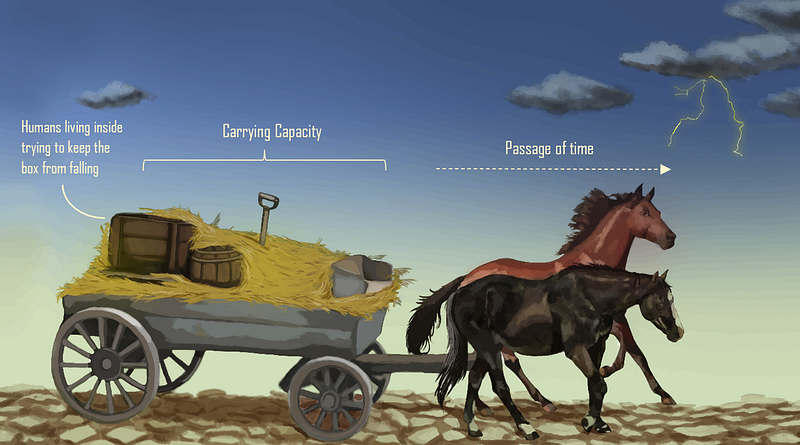
Human is a “blessed” species, we hold great powers enabling us to transform our planet. However, we are also “cursed” — humans are heterotrophs¹, which means we must depend on and take something from other organisms to survive. The only class of organisms that manages to thrive through eons while having radically changed the chemical make-up of the whole planet (aka. “pollution”) is the ancestral cyanobacteria and bryophytes, which are autotrophs¹ i.e., they make their own food out of thin air and dissolved rocks. As such, they have the power to ignore what most other lives have a say about their existence. Along their world domination journey, they in fact have caused some of the most massive extinction events ever, until the evolution of new intricate metabolisms that neutralize the chemical imbalance (check out the Great Oxygenation Event, Paleoproterozoic glaciation, and the Late Ordovician extinction for more details).
Human beings have far less bargaining power, we must take good care and stewardship of other lives if we decide to expand into and extract from their living space as a means of survival. Deep-rooted beliefs such as “We are made of God’s image”; “We are the masters above all non-human lives”; “We own whatever we put our labor on”, going far back to values in monotheistic religions e.g., Judeo-Christianity, to the relatively modern John Locke’s theory of property taught in every philosophy class, were formulated from the perspective of relatively small communities who just began figuring out Mother Nature is exploitable with an apparently low cost, which justifiably no longer have any bearing. Unless “humans” successfully edit their genes to make themselves autotrophic, our ecological responsibility is stone-carved into our fundamental fate, unlike ever-changing cultural agreements within the human-sphere that have inherently far lower moral weight and inertia if we are willing to admit². It is time to poke through our black box of anthropocentric habits and honor ecological facts and reality³. Paradigm must shift.
Peer pressure and validation form a crucial part of our behavioral motivations. Together with the perpetuation of the idea that “helping others can bring one happiness” (as with the Chinese cliché “助人為快樂之本”), the paradigm of anthropocentric morality has solidified its status without much questioning. A great sum of people are driven to act “moral” because they want to be happy by doing so, as opposed to helping out of necessity. We try to give a few bucks to the homeless week in week out instead of pushing for changes to address societal poverty problems, an issue far more complex than simple monetary charity. We feel good about donating money to the third world through an intermediary without realizing our material possessions and economic systems are a result of exploiting cheap labor in these same countries. We are pleased when we rid our homes/beaches/wherever of garbage but we rarely think about how we can avoid producing garbage in the first place. Nobody would doubt these are just fast-food remedies to evade from doing the “right” things.
The “if I do something -> then I will be praised and happy” condition only fosters a fixation on short-term dopamine surges, resulting in the tendency of short-term solution-seeking, displacing true complex cooperative strategy of helping (i.e., very often, “fast solutions” involve the use of materials or substances, and henceforth the birth of consumerism). Instead, happiness or a general sense of contentment should be a by-product of doing the right, moral things, not a subject of pursuit itself⁴(recommended reading: La Cinquième promenade, Les Rêveries du promeneur solitaire by J.J. Rousseau). Evolutionarily speaking, I would go far to say that Mother Nature by principle does not allow a species that indulges in habitually chasing happiness, rather than plowing through survival challenges to persist. And the clock is ticking.
Without question, humans have in part been biologically selected to be helpful to close companions instinctually, in order to endure the harsh ancient landscape as a collective. But this harsh landscape is largely gone and we are left with a new set of challenges, one that takes more than giving someone right next to you a little meat. In fact, evolution cannot be conceived to occur without the abandonment of certain old instincts and habits.
By no means I am arguing to actively avoid all forms of habitual help to others as a way to escape the black box. I am simply arguing that, over-valuing these habits as the “gold standard” is futile, as there are more sensible, arguably more moral ways to do good deeds in our finite life, which could at the same time indirectly help the whole species to truly cooperate and evolve for a better future.
What should we do/encourage then? To look outside the “black box” of anthropocentrism, we need to reconnect with the life-giving resources we depend on. When we understand and work in harmony with our resource base (aka. Mother Nature), our fate will be less shrouded by uncertainty. Every thought, action, and movement of us requires certain resources, the goodies on the shelf of grocery stores — No, it is the nutrients and energy originating from healthy soil, clean water and air (which also create other lives and nourish us heterotrophs via the food chain). The relationship between our society and vital resources is best visualized by balancing Maslow’s hierarchy of needs on top of an “erodible” resource base. It is clear that without a motivation of behaviors that maintain our life-giving resources, all the upper needs that can seemingly be fulfilled are ephemeral i.e., there can only be a smaller and smaller subset of fellow humans as beneficiaries (hence why inequality intensifies), else the system wobbles and collapses.
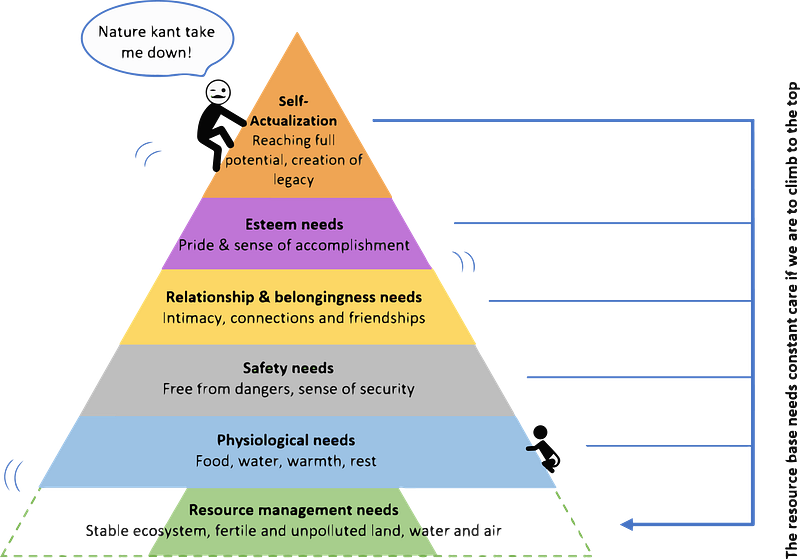
As such, the ability to truly help others can only come from a ground of abundance, it is thus worthwhile to take a step back from the human-sphere and pay more attention to the changes in our once-abundant vital resources. In fact, some of us already did and are continuously doing it, all that is left to do is to unite as a norm, rewire our mindset, and re-prioritize what behaviors constitute a higher moral weight based on the “first principles” laid down so far.
Next time, show your care by practicing frugality, bringing your own reusables to shop if necessary, hanging out with friends by helping in a copious, biodiverse community garden, making ethical products that do not linearly deplete/pollute natural resources, supporting ethical jobs that monitor, enforce and educate about the conservation of natural resources, and most importantly don’t forget to praise others for their newly adapted moral behaviors. In the end, this may speak of a “typical eco-warrior”, but consider the arguments leading to this very conclusion, as in what matters in morality is the rationale behind why a priority should exist, not the mere physical act per se. This enables morality to be adaptive and evolvable, rather than a monotonic anthropocentric paradigm.
Consider morality as doing the “right” things, not just doing “OK-ish”, ”peer-accepted” things, should our moral teachings and duties guide us to a better future with Mother Nature (perhaps a bit of consequentialist view)? Or should it be a separate concept from ecological responsibilities? What then is moral guidance for if it fails to lead us to a better future? Leave me a comment!
Read a post-script about some contentious implications here and check out Part-2 and Part-3!
If you like this story, please clap, subscribe to me and share it out! Support me here and join Medium membership here.
Footnotes:
1. Heterotrophs are organisms that obtain their energy from other organisms to maintain their own life, whereas autotrophs derive their energy from either the sun or inorganic chemical reactions.
2. Since long ago, prominent naturalists like Charles Darwin had recognized there are all sorts of “strange” cultural traditions and superstitions (that people ought to follow by peer pressure) emerging relatively recently in the evolutionary timescale and Darwin referred to these as “lower form of morality”, distinct from the higher form of morality he called “social instincts”, which are endowed directly by biological selection occurring in social animals, and these two forms of morality can be in conflict. This line of thought is apparent in his famous book “The Descent of Man, and Selection in Relation to Sex”.
3. Here I argue that both the immediate social instincts and the ritualistic, habitual cultures should bear low importance in the debate of morality. These two categories of behavioral motivation are ingrained in our subconsciousness, as opposed to a motivation derived from conscious understanding and reasoning based on concrete ecological reality, which in my opinion is the only form that liberates us from ruthless, passive natural selection and takes control of our own path for the better.
4. “Happiness is for opportunists. So I think that the only life of deep satisfaction is a life of eternal struggle, especially struggle with oneself. If you want to remain happy, just remain stupid. Authentic masters are never happy; happiness is a category of slaves.” — Slavoj Žižek.


