
The Descent and Ascent of Humanity — Evolution and Collapse (Part 2 of Trilogy)
Slow Down, Humans
Speed underpins every phenomenon of our Universe, and our problems too
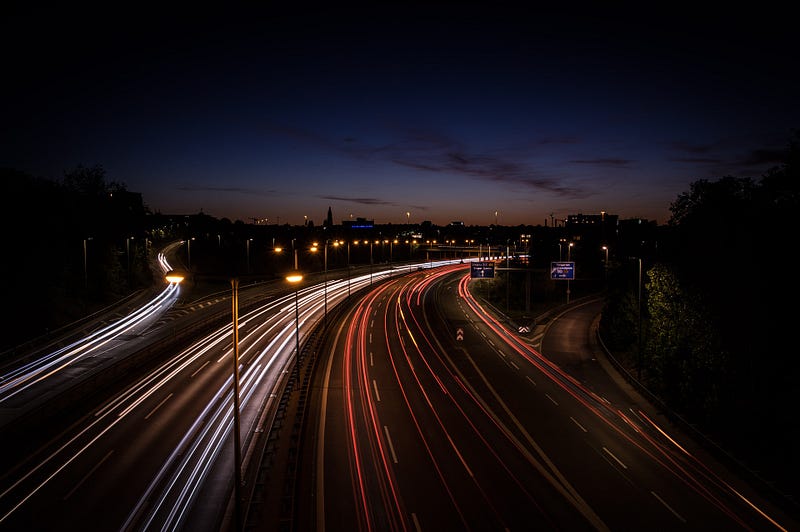
If anything, the most important thing I have learned all these years, through school, through physical experience, through the exploration of self and beyond, is that humanity needs to slow down and be patient.
We seem to be caught in a hustle of solving one problem while creating another, all the while being “busy” and always in a hurry. In the hope to eradicate the traditional “bads” (e.g., material poverty and labor-intensive work), the world has experienced rapid growth of economy and convenience in the last two centuries. Individually, we strive in exams, rush to reopen schools to complete more exams, work 9–5 to earn bread, buy a car to go to work faster, buy coffees and take-outs to fill our brains and stomachs, swipe through dating apps, rush to have kids when the biological (or cultural?) alarm rings. But then new “bads” arise, global pandemic, unprecedented pollution, climate change, growing inequality, machines taking over our jobs, sedentary lifestyle, a whole generation of social discontent etc. Right now, we are trying all our wits and methods to “quickly eradicate” these new bads. One cannot help but notice, it seems we are in a similar rat race again.
Why couldn’t we be content with a slower, less demanding cycle? And are we content with the current economy-driven, fast and “productive” lifestyle? There is something fundamentally different about the scenario of reducing the “bads” at source, versus maintaining a scenario of high impact compensated by high offset. If we focus on a singular, isolated goal metric (e.g., achieving net-zero CO₂ emission), the two scenarios might look the “same” at some point. Of course, reality does not work that way, the path towards the state (goal) matters. One can of course decide to eat mountains of food but at the same time work out like a maniac to stay “physically” fit or at least avoid weight gain, but that can’t be equated to eating and exercising moderately. An awful lot of facets are missing aside from maintaining weight or a certain physical metric, the food has costs (not just your money, the land and resources used to produce the food), the opportunity cost of spending vast time to work out, your body could suffer in other aspects than physical fitness etc.
Take another example, planting trees is often lauded as one of the best mitigation options to tackle climate change. However, “raced” afforestation often involves planting monoculture conveniently, at unsuitable locations and times (see also here), which are prone to pests and need constant replanting, plus create other tradeoffs left out by the singular goal metric (more trees), such as the deterioration of biodiversity and soil quality. You cannot replace a poorly-planted forest without incurring further costs. To go one further level down, thermodynamically speaking, any work done (more work in the high-impact-high-offset scenario) would offload some energy as waste heat or oftentimes carried in certain gaseous or liquid molecules to its environment¹. We would be extremely lucky if that molecule off our radar is inert and non-toxic at any concentration i.e., there is always yet another “pollutant”, hence the race mentality towards achieving certain limited and isolated metrics almost always create another problem.
Nature evolves at a certain pace that humans can better tune into. There is a reason nature does not magically cut down or plant hectares of trees overnight, both tree mortality and establishment, as well as succession², are gradual processes happening at a “slow” pace. There is also a reason why the countries that rushed to resume “normal” activities whenever the pandemic situation looks slightly better are suffering the biggest rebound. This is not to say we should slow down and wait regardless of what is at stake. Of course, acutely dangerous activities (e.g., large-scale deforestation, fast-accumulating pollutants such as CFCs that cannot be biologically cycled) have to be banned outright; life and death problems faced by an individual, you make your own swift decision no mistake. My take is, for “pervasive” problems that are integral in the biological/human cycle (e.g., too much GHGs, the spread of disease, misinformation, or even widening inequality), the primary driver is likely we are simply racing too fast i.e., the best solution is we slow down our pace back to bare essentials to actually reduce the activities that cause the problems, and then let them be solved by evolution gradually.
Evolution means that: at any level (be it at the atomic or planetary scale), nature will always tend towards a relatively stable state of existence, such is the telos of nature, an inalienable end to reach. But evolution does not happen overnight, it entails the gradual accumulation of diverse (i.e., no single success metric) adaptations and innovations, which inevitably dampens undetected tradeoffs simultaneously. Fast, unidirectional changes cause extinction, as introduced in Part-1 where early cyanobacteria singularly maxed out their carbon-sucking/oxygen-producing capacity and wreaked the climate and biosphere. It is important to mention that nature can still travel the detour and reach a stable state later, just at a substantial cost that humanity probably does not like to take.
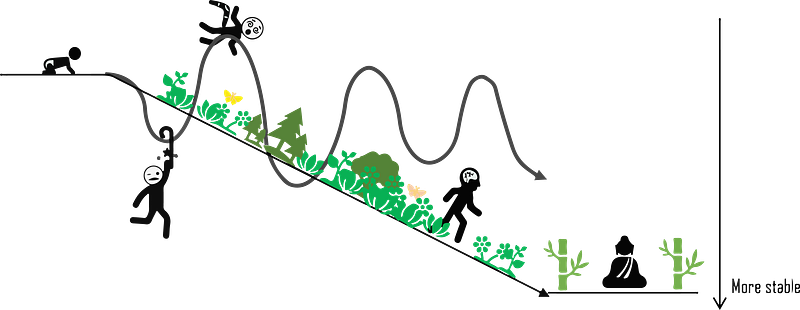
This is not to say we should stop pursuing any active technological innovation, just that the path and mindset (i.e., no race mentality) towards creating and adopting an innovation matter, especially when there is known “in-compensable” cost (e.g., non-renewable resources are depleted irreversibly). Otherwise, it seems one can always make the case that the embodied system-wide footprint (not just carbon footprint) in the whole arms race of R&D, production, disposal and marketing is far greater than what the winner of the race is being able to “offset” later on i.e., individual isolated pockets of efficiency does not translate to system-wide efficiency.
Rapidly popularizing and implementing an innovation (e.g., a mega-energy infrastructure) also means we might suffer from scale-dependent problems that we have yet to know, we will also have to live with whatever short-comings/sub-par performance this lucky technology has compared to other innovations that may just be a little bit later to the race. If we are willing to look past survivorship bias, there are indeed countless system-wide failures “hidden” in plain sight — if you have ever wondered why there are more and more trash in the world even as environmentalism and “green” business become increasingly popular since decades ago. Examples are ample: many large dams demolished after proven “eco-unfriendly”, mountains of food waste, waste electronics, vehicles, solar panels and even bike graveyards left behind by the race to the “green” bike-sharing market. As ironic as it might sound, there could even be adverse climatic impacts when supposedly climate-friendly solar farms are sprawled at a large-scale on barren deserts. Failures -> raced “solution” -> more failures appear to be the unyielding norm in any society who raced to “solve” problems.
I get the idea that slowing down may be associated with negative connotations like laziness, low productivity etc. But consider an alternative perspective, slowing down actually means eliminating unnecessary and unproductive works that are incongruous with natural pace i.e., this is not to advocate “no action”, “no change”, but to act free of nimiety. In the midst of crises created by our fast, competitive lifestyle, in fact, slow-pace is itself an innovation (aka. beneficial mutation), essential to propel evolution.
Had we slowed down the rate at which our economy and fossil consumption grow in the past two centuries, who knows if economic growth, capitalism and having children would have garnered the current negative connotation. Should we go back to a more agrarian or bioresource-based society? I don’t know, it may be worthwhile (given that our ecological knowledge has advanced so much) or it may not (given our population size, culture and everything have changed so much). But one thing for sure is that to work with nature, any transition has to be done at the right pace, minimizing the wasteful work and tradeoffs generated by an unrestrained race mentality. As counter-intuitive as it may sound, the one crucial “swift” action we can all take right now is to “slow down”. So remember, it is not always about what we can do, but rather, how hastily we are doing it. Just as drinking 3 litres of water in one go vs. taking smaller sips throughout the entire day — no one needs to tell you which one is a better idea.
If you like this article, consider subscribing to me and sharing the article. This would mean a lot for a new writer like me! And check out Part-3 here!
Support me here and join Medium membership here.
Footnotes:
1. When any system does work (a transformation of energy from one form to another), some of the energy is inevitably converted into “useless” heat that easily disperses to the surroundings, causing a rise of “Entropy”. Also, the production of entropy from work/chemical reactions is often accompanied by a change of phase of matter from an ordered (e.g. solid) to a dispersed phase (e.g. liquid or gas).
2. Succession in Ecology means a sequence of gradual species replacement and evolutionary changes which lead to a different combination of species and niches at the end.


