
The Day Diana Died
August 31, 1997
24. In every generation, there is a historical moment (sometimes there are several) that everyone remembers so deeply that they can tell you every detail of the day that it happened. What is your personal historic day? What made it so impactful? Tell us about that day. What did you do? Where were you when the historic thing happened and what was your response? Go into as much detail as you like and if you have more than one of these days, feel free to describe as many as you’d like. Ruby Noir 😈
I didn’t ever think that I would be affected by the death of Princess Diana 26 years ago.
After all, I didn’t even care for the hoopla that surrounded her marriage in July 1981, the summer before I entered college. As far as I was concerned, she happened to be a pretty woman who attracted the attention of a prince and future monarch of Great Britain at the right place and right time.
Not to mention that even at the edge of eighteen, I loathed the idea of monarchy — long before I had ever read the works of Thomas Paine or leaned all the way to the left. And apart from my interest in Fleetwood Mac, Abba and a few other pop groups, I was anything but a celeb worshipper. Heck, my teenage crush, Wolfgang Amadeus Mozart, was already dead!
So it surprised me when I reacted the way I did to the sudden death of Princess Diana on the morning of August 31, 1997.
I still remember eating breakfast sometime around 11 am when my upstairs neighbor, another graduate student, rang my buzzer. I noticed she was carrying a newspaper along with some items from our local newsstand. She was crying. Oh, God, I hope her mom is OK, I thought to myself.
As I opened the door, she wept. “Did you hear Princess Diana died?”
My jaw dropped. “No way.”
And so it was my turn to rush to the newsstand to buy my own copy. Yes, alas, it was true. (I guess I hoped against hope that my friend was somehow mistaken.)
I remember feeling the urge to tear up–and yet an equally opposite determination to not give into tears. After all, who was Diana to me? I didn’t know her personally. I had nothing in common with her at all. Why should I feel upset?
But the fact is, I couldn’t concentrate for the rest of the day. I felt far more disturbed than I had ever anticipated. Try as I did, I couldn’t focus on the chapter I was writing for my dissertation. So I decided to read, but lost all concentration when I got to Princess Caroline, the all but abandoned wife of George IV.
I again found myself thinking about Diana. Was it because she was only two years older than me, and a reminder of my own mortality? To know that we can all drop dead at any moment? Was it because she had begun to feel “familiar,” if only because her face was plastered on just about every newspaper and magazine on a daily basis in England? (I joked that I knew her face better than my mother’s or my friends’ at this point!)
There had to be more than this. I thought of her last sixteen years. That she had just begun to find love after a bitterly disappointing marriage — a marriage that turned out to be the very antithesis of a fairy-tale-like “happily ever after” ending that so many women dreamed of. And that so many of her efforts to please or impress Charles proved fruitless–such as her dancing to Billy Joel’s “Uptown Girl” onstage. Could it be that so many women similarly trapped in unhappy relationships were thus able to commiserate with her claim that ”[He] made me feel so inadequate in every possible way, that each time I came up for air he pushed me down again?”
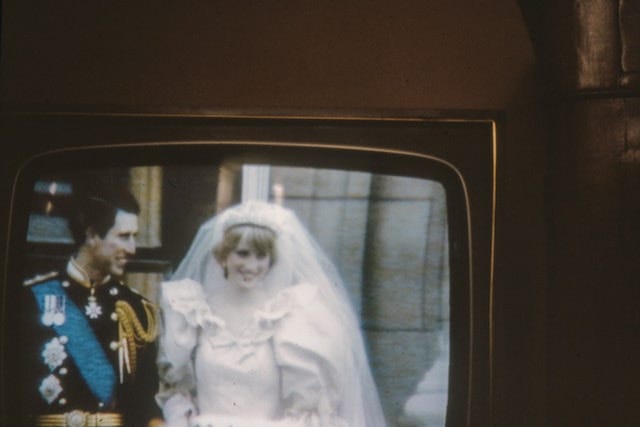
Here was damning proof, it seemed, that the rich and beautiful cannot buy marital happiness. She was now “one of us.”
Yet, as I reflected on her tragedy throughout the day, listening to the radio, I realized there was something much, much more. It was her important contributions to the world, contributions that revealed a warmth, empathy, and open-mindedness so rare, especially among people of her class. Or really, ANY class.
You see, despite all of her problems–or perhaps because of them–Diana did not retreat to a corner and mope even if she allegedly made attempts at suicide. She could easily have descended into Diana, the Princess of Wails, but she went out to help others who were far more unfortunate. For unlike other royals and wealthy people who almost exclusively devote their charitable contributions to the arts, sports, or entertainment, she paid the closest attention to health-related issues–and not just in Britain but around the world.
More striking still, however, was the depth of her involvement as she reached out physically to the most vulnerable. Who doesn’t remember Diana hugging children with AIDs or severely disabled children, as she went around the world visiting hospitals, attempting to de-stigmatize the condition? It was, she after all, who famously said:
HIV does not make people dangerous to know. You can shake their hands and give them a hug. Heaven knows they need it. What’s more, you can share their homes, their workplaces, and their playgrounds and toys.
Diana then proceeded to open a Landmark Aids Centre in South London in 1989 and Grandma’s House in Washington DC in 1990. She also visited the London Lighthouse, a facility for HIV patients, on a regular basis. It is said that Her Majesty, the Queen did not approve of these efforts, advising her to get involved with “something more pleasant.”
Diana’s efforts extended to the Leprosy Mission, an organization dedicated to providing treatment and support to victims of the disease, as she visited hospitals in Indonesia, India, Nepal, Zimbabwe, and Nigeria. Here, too, she was not afraid to touch those affected, explaining that
“It has always been my concern to touch people with leprosy, trying to show in a simple action they are not reviled, nor are we repulsed.”
Not least, I thought of those last famous photos of Diana decked out in a ballistic helmet and flak jacket in Angola, raising awareness of the dangers posed by landmines. Her active involvement with the HALO trust was enough to unleash carping remarks from an an official in the British Ministry of Defence, complaining that she was a “loose cannon.”
I then realized I was grieving the loss not of a mere royal, but a woman who had contributed so much to the world–regardless of her detractors. Was Diana motivated by sheer selfishness and exhibitionism? Perhaps. But who among us can say we are never, ever motivated by selfishness? And even if she was, didn’t she bring greater benefits just by introducing greater sensitivity to causes that so many others dismissed or overlooked? As the UK Institute of Charity Fundraising Managers has stated, “Her overall effect on charity is probably more significant than any other person’s in the 20th century.”
That’s pretty damn significant if you ask me!
And so, I made the effort to not only buy a TV to watch the funeral of Princess Diana the following Sunday, but purchase a TV license (required in the UK for anyone planning to watch the telly). I found myself admiring these words of praise spoken by her brother, the Earl of Spencer. Diana was:
Someone with a natural nobility who was classless and who proved in the last year that she needed no royal title to continue to generate her particular brand of magic.
Indeed.
© Frances A. Chiu, August 27, 2023. All Rights Reserved.


