
The Dark Side of College
The “best 4 years of your life” can be much more demoralizing than you anticipated.
A friend of mine from college messaged me the other day, suggesting I write about the oft-overlooked bleaker aspects of college. When I asked her to elaborate, she gave me a detailed description of how at a certain point, the excitement of being a college student is shrouded by the endless difficulties and problems that come with the experience. And honestly, she’s not wrong.
Most college students undergo a period when everything feels a little bit hopeless. It’s a feeling only college students are privy to, as older, established adults often view college as a relaxing time for partying and “finding oneself.” While there is certainly time for doing so, it can be challenging when you’re struggling to muster up the motivation to even attend lectures.
One could write a book on the different trials faced by college students, but here I’ll focus on three particular issues, inspired by the words of my friend. My target audience is twofold: 1) if you’re a college student, I hope you understand that you’re not alone, and 2) if you’re years out of college, I hope you realize that it’s much harder for students than it seems from the outside looking in.
The pretense of a meritocracy
There is a myth that the education system is designed to be fair. Attend class, study hard, ask good questions, and do well, right? Unfortunately, this reliable process crumbles away in college.
Especially during the initial years, there is an emphasis on weeder courses — courses designed to be difficult to drive out students who aren’t “cut out” for a certain major. There are myriad issues with this, but perhaps the most blatant is that the rubric for success is not structured to identify the best students.
Take the computer science program at my own undergraduate university. In order to declare the major, students need to earn a 3.3 GPA (a B+ average) across three introductory courses. At first glance, it appears to be a mostly fair process.
This falls apart when one looks at the individual process of earning grades in these three courses. The primary metric used to assess student competence is exam performance — however, these exams often do not reflect the rest of the class material. Students describe them as “timed puzzles” which test obscure concepts or emphasize unreasonably hard techniques.
As such, a student might attend every lecture, ask insightful questions, and excel at projects — but still end up doing poorly in the class simply because they were unable to function under the pressure of a timed, cryptic exam.
In the end, the student who actually has marketable software development skills is snubbed in favor of a talented test-taker who enjoys puzzles. I’m not saying the latter student doesn’t deserve to succeed, but it is certainly not within the bounds of a meritocratic reality if the former fails.
What makes this whole process particularly lamentable is the otherwise stimulating experience of the classes — they are filled with inspiring professors, talented TAs, intriguing projects, and helpful classmates — but all of that fades into the background of a picture dominated by intricately structured exams designed to limit student admission into the major.
There is a famous quote (often falsely attributed to Albert Einstein) that is rather fitting for this situation.
“Everyone is a genius. But if you judge a fish by its ability to climb a tree, it will live its whole life believing that it is stupid.”
When someone spends four years in an environment that obscures their potential instead of lighting it, it’s not surprising that they eventually start to feel like an impostor.
The nightmare of funding
Funding is not a palpable issue in all schools (particularly private institutions), but it tops the list of problems at most public ones. Even at the most prestigious universities in the world, there’s simply never enough money.
It’s a vicious cycle. Because there’s no money, departments can’t hire enough faculty for a healthy teacher:student ratio. As a result, students struggle to find help when they’re falling behind in class, which in turn feeds into negative self-talk and constructs an illusion of inadequacy—all of which ultimately devastates a person’s mental health.
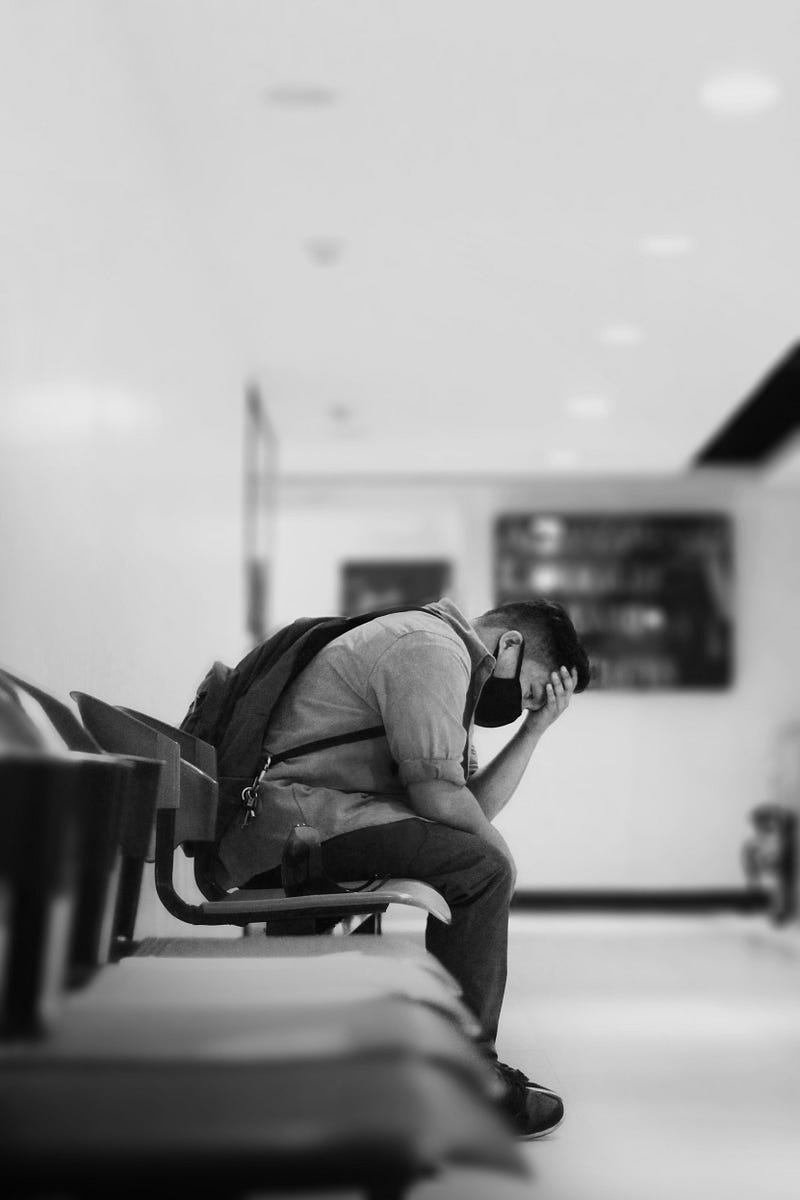
Here’s the real kicker. My friend, a TA for introductory computer science at a public school, confided that one of the most disheartening parts of her job is receiving emails from students about their poor mental health and having to send them to CAPS — Counseling and Psychological Services. However, CAPS itself is an underfunded department with overworked staff, and it is difficult to schedule an appointment that can provide genuine, long-term assistance.
The situation is heartbreaking. Student mental health suffers because of an environment fostered by the university’s lack of funding — and when those same students are forced to seek out help to maintain their health, there’s no money for that either.
And people wonder why college students are so tired and anxious all the time.
The slow dimming of the light in their eyes
In my last week of high school, my history teacher printed out a piece of paper for each student which had nothing but their name on it. She passed the papers around in a circle and asked everyone to write a word or phrase describing the person whose paper they had.
I’ll never forget what she wrote on my paper: visionary.
It was especially meaningful because of a conversation we’d had earlier that year. I’ve always been a bit idealistic, and I went on a long tirade in class once about all the issues with the International Baccalaureate (IB) Program at my high school and insisted on going to the district level to fix them. My teacher sat me down and earnestly told me to take a step back. The gist of her message was the following:
“Go to college. Learn what you need to learn, establish your credibility, make something of yourself. Then, when you’re ready, go fix all this.”
And so that’s what I did. At least, I tried to. I went to college, and I vividly remember I was convinced I would change the world. As my roommate and I walked through campus back to our dorm room, I told him that one day the students walking through these halls would remember my name.
A fire burned within me those days, and it was visible to others as light glinting ever so subtly in my eyes.
But over time, that light started to flicker and fade. It began with painfully difficult classes and brilliant fellow students contributing to a steady development of impostor syndrome. My difficulties then extended beyond the classroom, accentuated by internship rejection letters and frustrating research group experiences.
I eventually learned to accept and move beyond that, but then the onslaught of personal problems began. Depression, anxiety, and hopelessness dominated my days — particularly after COVID took education online. There were mornings when I questioned my ability to even get out of bed, much less change the world.
Other students deal with differing but equally debilitating circumstances. It’s especially hard when standing on the bridge between college and the world; internships, clubs, and other opportunities provide a glimpse into the harsh, unforgiving reality that cares little for college students’ honorable goals and grandiose visions.
Creativity and ingenuity suffer at the hands of greedy companies who desire money from their mathematicians at the expense of society’s well-being.
Morals and ideals fall flat in the face of managers who blackmail talented business graduates without a second thought if they report abuse and toxicity in the workplace.
Ambition and hope dissipate in the shadows of a world which purports to take everything students have except the authentic, passionate selves they actually long to give.
In the words of my friend, “I want to change the world” languidly devolves into a shell of itself, eventually disappearing altogether. By the time college ends, the belief many students hold is somber.
“Maybe this is just how the world is.”
But — please don’t lose hope
At this point, I don’t need to say anything further regarding the darker side of a college environment. But if you’re reading this and you’re going through a mid-college crisis of sorts, there is something I need you to know.
You can’t always see the light in my eyes these days, but I never let the fire inside me extinguish completely. My vision, my zeal — my desire to make things better — is still there. And when I teach an excited class of students or learn a fascinating graph algorithm, or design an imaginative visualization, my eyes gleam brighter than ever.
College and life will test you, and there will be moments when it feels like everything is falling apart. You’ll look around and find yourself alone, and when you look in the mirror for solace, you’ll instead find a stranger staring back at you. In those moments, remind yourself of your own passion and vision. Remind yourself of the potential the 17-year old version of you saw in the world. Remind yourself that if society is flawed, you may as well improve it rather than giving up and becoming a part of it. Remind yourself of all this — and use it as fuel.
But whatever you do, don’t you dare let anyone put out your fire.


