

Bitcoin
The Dark Side Of Bitcoin
Blockstream’s Bank-Compliant BTC Version
“If you can control the information, you can control people”
-Tom Clancy
Until 2013, Bitcoin was expanding rapidly, and adoption was expected to reach exponential levels.
Bitcoin was on the verge of becoming a leading payment method in e-commerce, and it was only a matter of a few more years.
And just like any other independent disruptive technology, a plan was devised to halt the rise of Bitcoin by those who felt threatened.
First, there had to be some form of control.
Satoshi Nakamoto was already a ghost, but he had left the whitepaper and directions regarding the course of the Bitcoin financial revolution, instructions that would place Bitcoin as a competitor next to top payment facilitators: Visa, Mastercard, American Express, and Paypal.
Subscribe (for free) to get email notifications whenever I publish:
Control The Information
When the banks and legacy finance determined they were facing a disruptive competitor with a decentralized approach expanding so rapidly that within just a couple of years could become a threat to traditional finance and fiat currencies, a more careful approach was required.
Can anyone consider that banks and states were going to just allow Bitcoin to take over part of the e-commerce market and become a threat to the dollar?
Since 2010, when WikiLeaks adopted Bitcoin for donations on its website, Bitcoin became a target for the legacy financial establishment.
However, you can’t ban or assume control of a decentralized network and this was understood soon enough, so the plan had to be different.
They had to delay the rapid increase in merchant adoption by making the network unusable.
Bitcoin had one weakness. With an update in 2010, Satoshi applied a blocksize limit of 1MB in the code. Bitcoin wasn’t that decentralized in the early days, and Satoshi had absolute control over developments.
Yet, developments are not that decentralized today, either.
In June 2013, Adam Back appeared in the Bitcoin scene (source), although he had already been designing his arrival since 2012, with Wikipedia edits regarding his role in the Bitcoin’s protocol with Hashcash (Adam Back is referenced in the whitepaper for Hashcash, a reference that extensively assisted him in his plans).
Back immediately pointed out arguments about the Bitcoin code, his experience as a cryptographer, and how important his previous work with Hashcash had been for Bitcoin.
He wrote lengthy articles that would instantly constitute him an authority in the bitcointalk forum and the Bitcoin community.
Blockstream was formed a few months later, and the plan slowly unfolded.
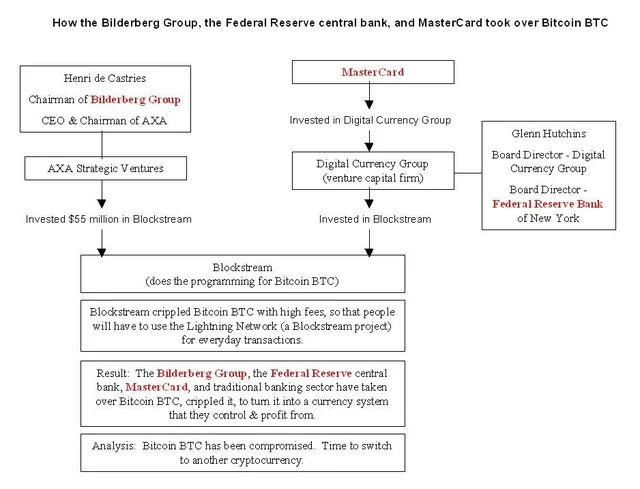
Adam Back was talking about a payment system too, although the intention was private side-chains that would create the impression of decentralization but would eventually create controllable and censorable networks, running on top of a problematic layer-1.
Control by Confusion
Most of the BTC maximalists are already confused on their own, therefore instruments of those in control of the narrative (Core/Blockstream).
Because of the lack of clarity, people need to continue to look to that person to try to gauge if they’re going in the right direction.
They become dependent and off-balance, continuing to need to come back to that leader to interpret reality for them. Continuing to confuse people can be a subtle but effective means of control.
Source: Logan Leadership
During the blocksize debate, supporters of small blocks were constantly sending out mixed messages to generate confusion and obfuscate true intentions.
There was no intention of increasing the blocksize limit.
We’ve discussed previously the tactics Back employed (link), and how he used passages from articles published by Core devs and influencers under Blockstream’s payroll to support the 1MB block argument.
It is all part of the gaslighting tactics enforced by this group.
They will try to confuse everyone with the swift change of position about what Bitcoin actually represents and mostly target those with limited knowledge of finance.
The responses and the arguments made today by the BTC side entirely contradict the whitepaper, Bitcoin fundamentals, and logic itself.
Some of these influencers are YouTubers and traders like Tone Vays, with frivolous TA drawings and trading methods that make little sense (while also selling expensive trading courses).
Censorship
Propaganda by influencers is just one of the tactics Blockstream enforces.
Censorship is a second one.
A practice so common within the BTC community that we encounter daily.
Controlling the information is about controlling the narrative, with the ulterior motive to control developments and stagnate scaling progress.
Blockstream hijacked the project and ousted all devs that did not align with their version of Bitcoin (Gavin Andresen, Maik Hearn, Jeff Garzik).
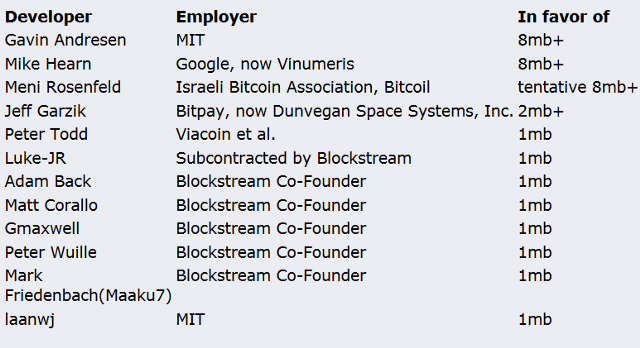
Software or networks without development do not last, but those that constitute the BTC community today, rally behind Blockstream, a for-profit company funded by financial institutions like Mastercard and AXA, which has under its payroll Core developers that hold the most important spots, with total support from the individual(s) that control bitcointalk, r/bitcoin, bitcoin.org and other major websites (information centers of Bitcoin).
A free crypto press would have been detrimental to Blockstream’s plans, therefore, controlling the flow of information was important. Blockstream found support from the legacy finance forces that had entered Bitcoin in 2011, and these forces are in possession of major cryptocurrency online news websites and magazines (Coindesk, Cointelegraph, Bitcoin Magazine, Decrypt, etc).
However, back in 2015, the two most used sources of information about Bitcoin at the time were the Reddit r/bitcoin community and the Bitcoin forum Satoshi created, bitcointalk. Surprisingly, both these Bitcoin communication channels were controlled by one anonymous person under the alias Theymos after Satoshi’s departure in 2010.
Also read:
Both these communication centers of Bitcoin initiated an information war, by censoring and shorting Reddit comments in dubious ways, having those with the most downvotes appear first while burring at the bottom the top articles supporting change of blocksize.
At bitcointalk, a crusade began, and accounts supporting bigger blocks and Bitcoin Cash were red-flagged as untrusted.
They managed to obliterate any opposition, censor any debates, and create a cult of BTC supporters with religious devotion and military discipline.
Ad hominem is still a common practice by the BTC maximalists.
Anyone asking questions on these platforms will meet censorship and the fury of a mob of angry keyboard warriors who somehow think this toxic approach will assist the price of BTC.
The price was the only reason they were in Bitcoin anyway and ignorance of the disruptive fundamentals of Bitcoin will be the downfall of the BTC version.
One only has to see the outcome of all of the above to understand the reasons Core/Blockstream surrendered Bitcoin to the banks.
Who is using BTC today, in which way, and what plans are there for the future?
Is El Salvador a successful example?
Even by forcing the acceptance of BTC through the Lightning Network, no adoption is visible in El Salvador.
LN is not a viable solution. The only way the end user can use Lightning is through custodial wallets ( custodial and KYC-compliant LN wallets), that already dominate transactions (Strike, Chivo, Wallet of Satoshi, Bitcoin Beach, etc).
When was it that Satoshi suggested Bitcoin would require trusted third parties to control the transactions?
The whitepaper specifically explains how Bitcoin renders all trusted third parties obsolete. Yet, it is the maximalists that brought them all back.
All custodial wallets are censorable. They can freeze any amount and exclude any individual from the financial system.
How is this supposed to be providing censorship resistance and a response to the failures of the banks?
Decentralization secures a tamper-proof network and transactional censorship resistance.
Yet, with Bitcoin (BTC), censorship resistance becomes a luxury only a few can afford. Why do BTC maximalists promote that everyone should run their own node while Satoshi never intended this?(https://twitter.com/Panterabch/status/1721569065523720197…)
The reason is to choke the network and make it unusable (with a low blocksize limit forcing high fees), aiming to reduce Bitcoin’s disruptive monetary potential (and Core succeeded in that).
Bitcoin in the BTC version is opposing financial freedom. Under Blockstream, Bitcoin submitted to the banking system. Saylor suggests that we should not upset the banks and BTC maximalists cheer.
Other bankers involved will always tell you it was never about payments, never a cryptocurrency, never aimed for mass adoption as P2P Cash, and was not for the people who live with less than $2 per day.
How will Bitcoin not upset the banks? By rendering it unusable on a massive scale with bottlenecks like RBF, 1MB limit, and custodial mechanisms that strip Bitcoin from its revolutionary features.
Bitcoin Cash Fixed This:
- FOLLOW ME ON X.COM
In Conclusion
Custodial Lightning is not Bitcoin and Lightning is unable to scale either without a larger blocksize limit (133MB per the Lightning Whitepaper). Users of custodial LN services don’t have access to private keys.
Furthermore, running an LN node is not practical, and high on-chain fees do not allow opening and closing channels.
Custodial Lightning does not allow extracting private keys and will soon demand full KYC.
LN is no different from using a mobile bank application or PayPal, yet, even these apps are more efficient and user-friendly today than Lightning. Financial hubs are already controlling the Lightning Network.
Saylor promotes regulations, KYC/AML compliance, and custodial wallets, and the BTC fanbase is cheering, waiting for the final price pump and “institutional” liquidity to offload their bags one last time.

Also Read:
👉Follow me on YouTube:
My Links:
Originally published at https://read.cash in 2021 (rewritten)
Don’t forget to Subscribe and Like if you enjoyed this article!


