
The Cycle Of Death: Why You Don’t Stick To Your Projects And Habits

Imagine, for three days in a row I’ve been sticking to my good habits, i.e. going to the gym, meditating, not eating anything, etc. On the fourth day, I’m feeling a bit less motivated, and I tell myself it doesn’t matter, I’ll do my exercise tomorrow anyway and make up for it. Then the next day, it’s the same thing, but I tell myself that I didn’t go yesterday anyway, so screw it, I’ll keep going. Until I finally got my act together at the end of the week.
Maybe you’re like me in the Cycle of Death, a vicious circle that prevents you from sticking to your habits. Fortunately, I’ve managed to get out of it, or at least minimize its impact, so let me present you with this chart and the ways to avoid getting out of this cycle.
The Cycle of Death
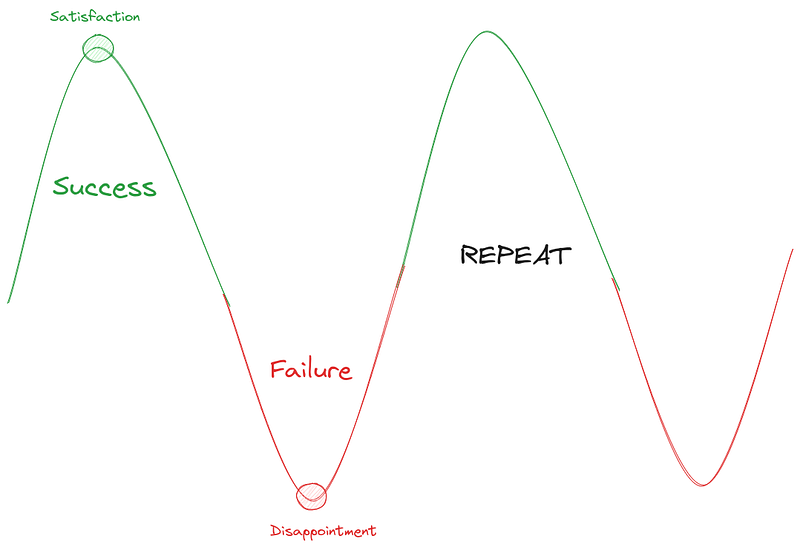
The Cycle of Death is simply the failure to be consistent in your habits or success. Basically, here are its stages:
- You’re highly motivated and manage to stick to your habits or make good progress on your projects.
- Motivation gradually decreases.
- You’re no longer motivated and feel you’ve done enough, so you let yourself go.
- You carry on the way you’re going because it’s all over anyway.
- You pull yourself together because you’re too disappointed in yourself, and go back to step 1.
The Binge Fallacy
An important first concept in understanding the Cycle of Death is the Binge Fallacy, which means that when you make a mistake, you tend to keep on making it. This concept is particularly common in the context of habits, i.e. when I want to create a good habit but can’t stick to it, or when I want to break a bad habit.
This fallacy can be explained by the fact that we tend to attach our future decisions to recent events, even if there’s no connection. Let’s imagine I’m at the casino and realize that the zero has just fallen three times in a row. Strangely enough, I’m tempted to play the zero even though the probability of it falling hasn’t changed.
If yesterday I didn’t manage to stick to my habit of going to the gym, for example, today is a completely different day from yesterday, and there’s nothing to stop me going. However, I can tend to be demotivated, and a good remedy for this lack of motivation is to start the day well.
Why you need a good morning routine
A study conducted by researchers Nancy Rothbard from the Wharton School at the University of Pennsylvania and Steffanie Wilk from the Fisher College of Business at Ohio State University on sales representative has shown that the emotions you experience immediately after getting up have a huge impact on your mood for the rest of the day.
And I think you can confirm that. Imagine you have to go to work, but your bus doesn’t come, or your car won’t start. It’s a bad start to the day. But apart from that, it’s just another day. You may arrive late for work, but that’s it, nothing serious. You see evil everywhere and feel as if fate is working against you.
On the contrary, if you start the day with something pleasant, or at least something that gives you pleasure or that you think feels good (like playing sport, which doesn’t necessarily give you pleasure first thing in the morning, but makes you feel good afterwards), you’ll feel good for the rest of the day. And if there’s a problem in the afternoon, it seems less serious than if it had happened in the morning.
That’s why it’s important to have a good morning routine, to get your day off to a good start, which is crucial for the rest of your day.
Now, what is a good morning routine? That’s for you to decide, but in short, I think it’s a routine in which you only perform habits that are good for you. Because if you perform a bad habit first thing in the morning, it will break your good momentum, so absolutely avoid it!
Don’t expect results from your actions
Most good habits involve not seeing results right away. The best example is obviously sport: you go for a 30-minute run, but after that nothing has changed apart from the fact that you’re now out of breath. On the other hand, after several weeks and months of running every day, you feel healthier, more enduring, etc…
And there are plenty of other examples, for example if you start a blog, a YouTube channel, or want to write on Medium, it will take time before your content is read.
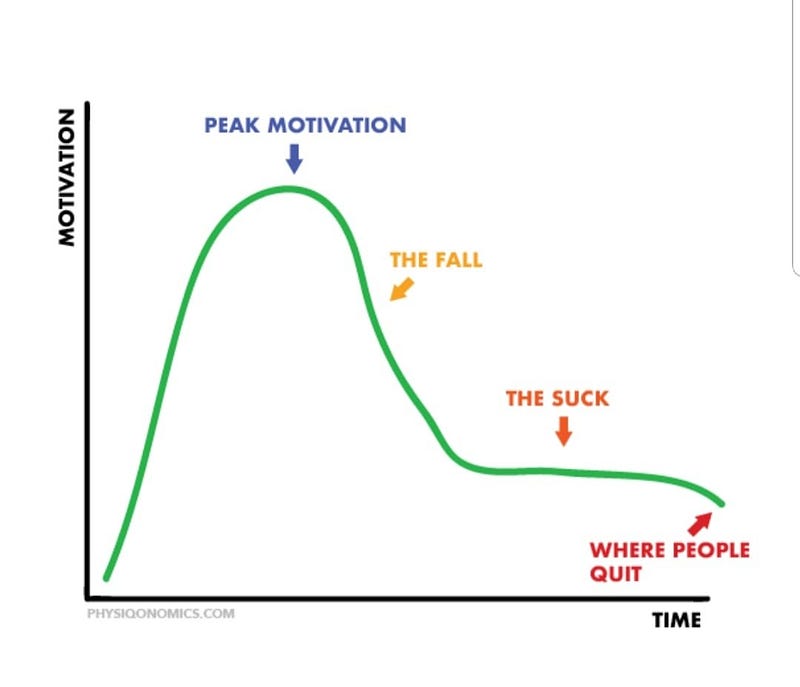
The problem is that when we don’t see the results of our actions, it’s hard to keep going. At first, everything’s going well, and you can go on without seeing the results because you’re in the euphoria of the beginning, but soon this euphoria runs out of steam and you lose your motivation. Then you remember why you’re doing it, so you start again, motivating yourself even if it’s hard. And then we relapse. We return to the Cycle of Death. Until we finally stop, because the desert crossing is too complicated. And yet, we weren’t that far from starting to get results…
How to fool your brain
Imagine you set out to run 10 km, but then you get lost along the way and have to run another 2 km. Those kilometers are going to seem abominable, whereas if you’d set out to run 12 kms, you’d have run them easily.
By the same token, one study showed that flight attendants prepared for a 3-hour flight that ended up lasting 10 hours had a stronger urge to smoke than flight attendants prepared for a 10-hour flight.
The way we are prepared for an event inevitably influences our perception of its difficulty, time and effort.
When you have a goal, you need to know what to expect in order to maximize your chances of success.
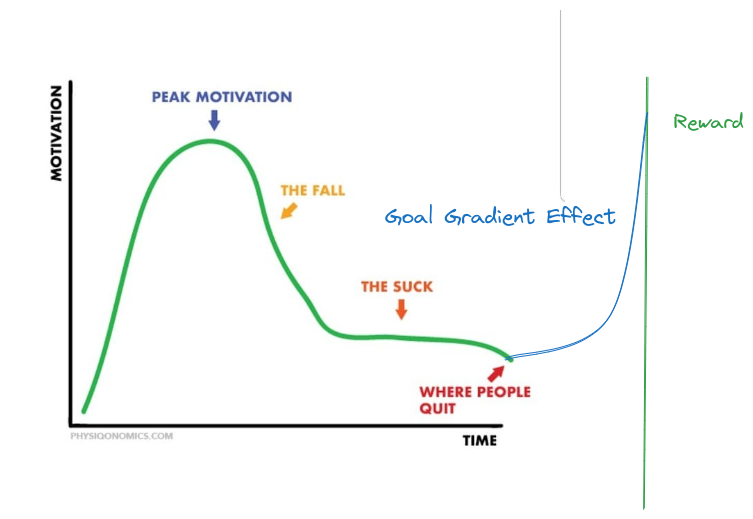
Let’s go back to our example of the race. As you see the end, you regain your motivation and speed up. Having run a marathon, I know what I’m talking about: even when you feel like you’ve run out of energy, the announcement of the last kilometer instantly invigorates you. This is what one researcher called the Goal Gradient Effect.
The Goal Gradient Effect
According to Clark Hull, the closer we get to our goal, the more effort we tend to put into getting there.
In fact, after so much effort, seeing the reward motivates us all the more to go after it. It’s quite simple to understand: we’re simply attracted by the reward.
Now, we can take our previous diagram and include this Goal Gradient Effect
Short-Term Goals
If we go back to our previous graph, we can see that the time when our motivation is at its lowest is only the time between our motivation peak and the Goal Gradient Effect.
For most projects, habits, etc., this graph extends over long time horizons, say several months. For example, if you start your blog, don’t expect results for at least six months.
The trick is to reduce the time horizon of this graph. Because if your journey through the desert lasts 6 months, yes, it’s very complicated and you risk quitting. If, on the other hand, it only lasts 3 days, it’s perfectly surmountable.
To do this, set yourself shorter-term goals, such as weekly targets.
How to get out of the cycle of death
Finally, I can summarize a few solutions for getting out of the Cycle of Death, or at least smoothing out its curve to make it look like this:
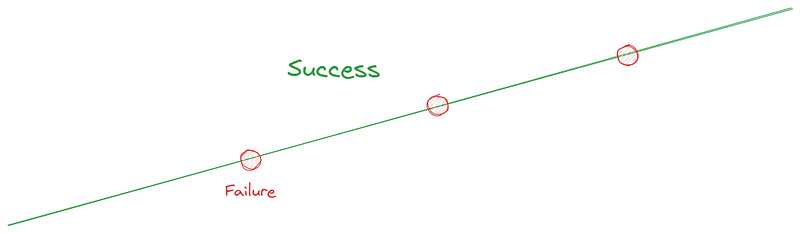
In other words, a straight line, albeit with the occasional miss, because we’re not machines.
So, to sum up the article:
- It’s normal that a lot of the good things you do won’t do you any good right now, because the results can take a long time to come. Detach yourself as much as possible from these results. It’s easier to stick to a habit or project if you don’t expect any short-term results.
- Set yourself shorter-term goals. That way, there’s less time to lose motivation.
Final Note
Perhaps you don’t function according to this Cycle of Death and didn’t find yourself in this article. We’re all different, and I don’t know how everyone works. On the other hand, I hope the advice I’ve given has been useful to you!
Thanks for reading! Here are some links that may interest you: