
What Life Looks Like for the Super-Smart
Life kinda sucks for geniuses.
Geniuses are cursed.
Specifically, the optimistic ones.
Their entire life centres on the notion that things can always be better. Because they can, and their conviction is stronger than any other walking person. If they don’t solve the biggest problem in the world themselves, they fear no one else is capable enough to take on the task.
The weight of the world, on the shoulders of simple (or not so simple) men (or women).
I desire nothing more than…
In mid last year, I was fortunate enough for the opportunity to ghostwrite a piece about a CEO of a conglomerate who managed over 15 brands across Asia. 18 now!
It was a feature piece for a magazine, so we both agreed to dig deep into his personal life rather than asking those cliche “To what do you owe your success” questions.
On the day of our appointment, he showed up on our Zoom call at 9 pm on the dot, as agreed prior. He looked like he has been through hell and back. (You know it’s bad when you can see it through a 480p webcam.)
I was quite surprised to find him still very alert, super polite, and answering all my questions thoughtfully. My last question to him was: “I guess, since I’m the interviewer today, I need to ask you this… So, where do you see yourself in five years’ time?”
I took him an entire 20 seconds to ponder before replying:
“I don’t know. For now, I desire nothing more than one deep, restful sleep.”
Highly ambitious people aren’t scared of failures. Their nemesis is not doing enough. Their fear is hearing the echoes of, “This could have been better if you had just worked harder.”
They got to be the manager today, and they’re eyeing for a C-suite already. They got to be the CEO, now they crave immortality. They’ve achieved immortality, now they want the guarantee of a martyr.
Their minds won’t let them rest until they’ve left that indelible mark on this universe. It’s hard for them to rest, hence they channel all of it into their work. Eventually, getting sick and leaving us before their time — like Steve Jobs and Jonathan Larson.
But thanks to them, they’ve brought an extensive contribution to society.
The curse of successful creators
You can ‘make it’ just by being a likeable person.
Paris Hilton, also labelled as the ‘billion-dollar-bad-ass-boss-babe’ of the early 21st century, was one of the most followed around personalities in those years. This was pre-Instagram days, where followers equated to paparazzi with their camcorders, flashing lights, and dangerous road manoeuvring on the road to get that photo.
Today’s influencers call her the pioneer of the influencer era.
Yes, her great-grandfather’s hotel chain, Hilton, already placed spotlights on her in her younger days, but it was her personality that gave her the attention.
Giving people what they want
The portrayal of this perfect American girl, living the glamourous life, never wearing the same dress twice, the rhinestones on them, a ‘Hollywood girl’ voice, and the extravagant lifestyle altogether, all came at the expensive cost of acting like another person.
It’s a stroke of genius to create a persona, or a fantasy world, as Paris described it, that generates money. Paris’s mother admits it too. But slowly, it feeds the fear of vulnerability in a person.
Especially for creators/influencers, there are only two choices at this point — whether to start from scratch again or accept that nothing will change. Both paint the imagination of a day in the future dark and gloomy.
20 years later, in 2020, Paris admitted she didn’t give a f*ck about any of those things (pointing to her heels and dresses) while in her sweatpants. And all of it was just for ‘the character’.
This wealth-generating persona often draws a line around a person and rules that cannot be broken. In the end, they end up in a cage they artfully created for themselves.
Nobody will understand you until you’re dead
Would you believe it if someone told you the iPad, yes the one from Apple, was first conceptualised in 1968?
Arthur C. Clarke was claimed to be the pioneer of our modern-day iPad, as we saw it in his 1968 film 2001: A Space Odyssey. It wasn’t just the stunning accuracy of the form factor, Clarke also added a clip of what seems to be a Late Night Talk Show on the supposed iPad.
This clip, from over half a century before the iPad was even launched, feels like watching me watching James Corden during dinnertime.
This description was so accurate that Samsung used this story as proof that Apple stole the design from the movie.
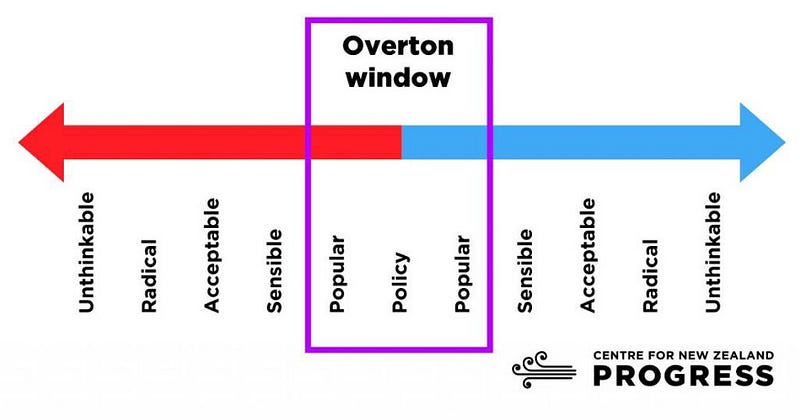
Overton Window describes the tiny window of ideas the public is willing to consider and accept. The outlandish and unconventional ideas are usually regarded as foolish and simple-minded.
Extraordinary people are said to be born in the era ahead of them, or that their minds have far outgrown the advancements of society.
In other words, if you’re that person who gets all the weird stares after expressing your ideas, you might be way above average. Average minds simply, and scientifically, don’t have the capability to comprehend what you’re saying. Ergo, the lack of understanding.
This is also why so many geniuses in history are lonely people who can’t seem to build good relationships.
Nikola Tesla preferred the company of pigeons to people. Beethoven lived “almost alone, like an exile.” There is hardly any mention of another human in any stories about Einstein.
“The only thing that we can be sure about the future is that it will be absolutely fantastic. So, if what I say now seems to you to be very reasonable, and I would fail completely. Only if what I tell you appear absolutely unbelievable having any chance of visualising the future as it really will happen.” — Arthur C. Clarke
Recap
For reasons I have yet to discover, many people desire to be in the top 5% quartile of intelligence level. They don’t realise being a normal person is much happier than being a super person in society.
- Super people’s minds are generally too much for their vessel.
- A short-term stroke of genius can turn into a long-term cage.
- Sadly, humans aren’t programmed to embrace radical change.
If you liked this piece, you’ll love my new e-book, The Fight. Check it out, it’s free. Get your full access to Medium to read a gazillion more exciting stories.☺