
35 Concepts of Life We Should Always Be Reminded Of
The invisible forces that govern our actions.
1. Inversion
Avoiding stupid mistakes is much easier than trying to be brilliant. You don’t have to create a revolutionary product for your business, you just need to avoid the thing that is hurting your company the most. Identify the weakest links and steer clear of them.
You don’t have to always eat the healthiest food, you just need to cut the junk food. You don’t need to find the next Apple in the stock markets, you just need to not invest in shitty stocks.
2. Doublespeak
Most people would often say the opposite of what they really mean, especially in politics. It usually exists in euphemisms such as “downsizing” for layoffs, “reducing costs” for cutting your salary, “negative cash flow” for broke, “contribution” for a bribe, or “re-educate” for forcing someone to change their political and religious views.
3. Theory of Constraints
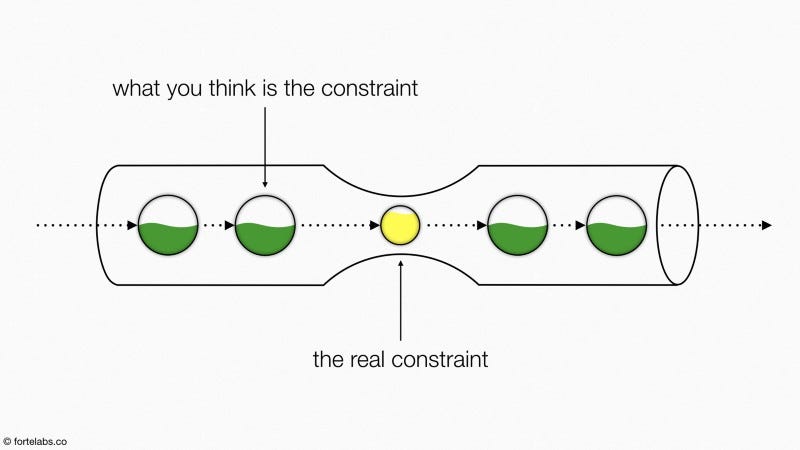
A system is only as strong as its weakest points. If you break down your entire system or your routine and optimize each component independently from one another, you’ll most likely lower the effectiveness and efficiency of the system. Look at the entire system as a whole instead and make sure there are no bottleneck points.
4. Preference Falsification
People lie about their true opinions because their true opinions aren’t really socially acceptable and they just want to “fit in”. In private, they will say one thing but another while in public.
Think about how many people secretly votes for that selfish politician because of their promises while saying another on Twitter or Instagram.
5. Faustian Bargain
The deal made when one trades their soul or personal values for short-term benefits or materialistic gains such as money, sex, or power. In other words, a person traded something that is far more valuable for a fleeting sensation.
For instance, cheating on your partner for short-term pleasures while sacrificing lifelong happiness. Won the battle but lost the war.
6. Mimetic Theory of Desire
The herd mentality. Humans are like sheep and we don’t really know what we want. Often, we need to be told what we really want. For most people, instead of deeply understanding themselves, they would choose to want the same things as others. The entire marketing and advertising industry capitalizes on this idea.
If you want to break free from this, try the things that nobody wants and avoid the things that everybody goes for.
7. Mimetic Theory of Conflict
The potential for fights is greatly increased when two people are similar. That’s because people who are different don’t really have much to fight over because opinions and behavior have too much of a gap. Whereas similar people love to fight over who is better. Hence the common occurrences of family feuds.
8. Competition is for Losers
Don’t try to imitate what others did. If you’re trying to write for a living, don’t copy others’ style, build your own voice. If you’re running a business, focus on problems that you have the ability to fix. It is much better for your physical and mental health when you don't compete.
(Hint: Don’t start another mineral water company.)
9. Talent vs. Genius
Our society is not suited to cultivate geniuses. Talent can be trained whereas a genius can see the problems that other’s can’t. These are different types of excellence and one cannot exist without the other. Geniuses are people such as Mark Zuckerberg, Steve Jobs, and Travis Kalanick where they completely changed the world with their ambitions.
10. Secrets are Hidden in Plain Sight
People think of secrets as Easter eggs. They take for granted free information and expertise while assuming the expensive courses have to be good. In most cases, these expensive courses are just compilations of information that the buyers are too lazy to find out themselves.
11. The Never-Ending Now
We live in this crazy social media society where we are all always connected. It may sometimes be good to keep in touch with old friends, but the detriments such as information overload and the ephemerality of content consumption have impeded us from enjoying the simple things in life.
Switch off your phone on weekends, or at least toggle the wifi off. Think of it as scheduling a short period of time to spend with myself. You don’t have to always be accessible to everybody at all times. Nothing too bad will happen.
12. Supply and demand
This can be applied to every single aspect of our lives. The harder something is to do, the fewer people will do it. but if you succeed in doing that, you cannot be replaced.
Vice versa, if you’re doing what everybody else is doing and the supply is plenty, the prices you can charge are capped. So look to do the things nobody else is doing. In other words, be the best at a low-supply market.

13. Look for Things That Don’t Make Sense
The world always makes sense. But it can be confusing. When it is, your model of the world is wrong. So, things that don’t make sense are a learning opportunity. Big opportunities won’t make sense until it’s too late to profit from them.
14. The Wisdom of Paradox
Logic is the key to scientific truths, but paradoxes are the key to psychological ones. In life, and especially being humans, the deepest truths are often if not always counter-intuitive. When you find two opposites that are both true, become curious and start exploring.
Example:
- The best things in life are free.
- Stop looking for happiness if you want to find it.
- The best ideas come about when you’re not thinking about it.
15. Law of Shitty Click-Through Rates
As marketing tactics become outdated, matured, and cliched, click-through rates eventually decrease. In other words, conventional marketing strategies are doomed to fail. To illustrate, the first banner-ad had a click-through rate of more than 70%. Now everybody wants to avoid them and install an ad-blocker.
16. Russell Conjugation
Journalists, writers, and reporters often change the meaning of a sentence by replacing a word with a synonym that implies a different meaning.
- The politician you support decided to reconsider a matter in light of new findings, but the politician you don’t support flip-flop.
- You might consider yourself detail-oriented, but you call others a nit-picker.
17. Opportunity Cost
By spending 7 minutes to read this story, you are choosing not to read other writer’s works or do other things. Opportunity costs occur at any point in time as you need to give up one task in order to do the other. Everything you do, every action, every minute counts, pick wisely.
18. Overton Window
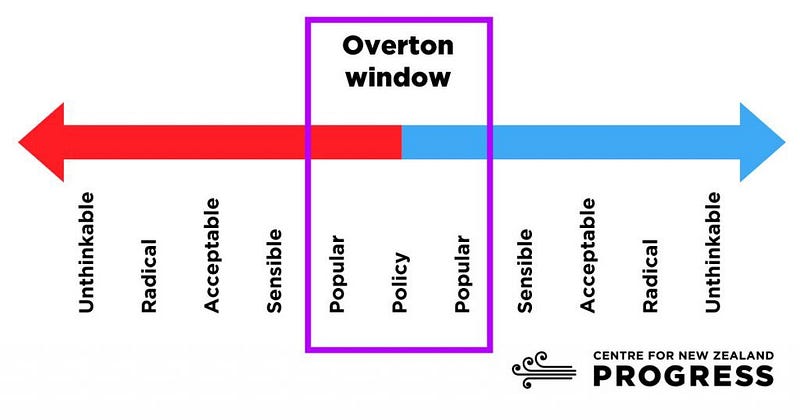
You can strictly restrain thoughts without limiting speech by defining the limits of acceptable thoughts. News channels such as Fox News and MSNBC only allow acceptable political opinions and shun out outlandish opinions. Same goes for debates as unconventional ideas and opinions are often regarded as foolish and simple-minded.
19. Table Selection
This concept originated from poker. You don’t have to compete against the best. Choose your fights and opponents carefully. You don’t have to get stuck at doing difficult things if you can avoid them.
Just like starting a business, you don’t have to try and beat the biggest company in the world, you just need to have a specific niche that preferably has easier competition. Become the best at that and you will thrive.
“I fear not the man who has practised 10,000 kicks once, but I fear the man who has practised one kick 10,000 times.” — Bruce Lee
20. Goodhart’s Law
When a measure becomes a target, it ceases to be a good measure. For example, one hospital was faced with the issue that it took too long for patients to get admitted. The manager then decides to issue a penalty for wait times of 4+ hours. In response, the ambulance drivers were asked to drive extra slowly so they could shorten the wait times.
Simply put, the target set does not solve the root causes of the problem.
21. Gall’s Law
A complex system that works is repeatedly found to have evolved from a simple system that worked. The chances of a complex system that is fabricated from scratch that works are infinitesimal despite patching up the inefficiencies along the way.
It is always better to start over with a simple working system and then build from then on. Or better yet, just don’t fix what is not broken.
22. Hock Principle
An extension to Gall’s Law, simple, clear purpose and principle allow room for complex and intelligent behavior. On the juxtaposition, complex rules and messy organizations allow for stupid and irrational actions.
23. Parkinson’s Law
Work delays and expands as time available increases. People don’t want to look like they are doing nothing so they search for extra and trivial tasks to tackle.
If you are given 1 week to complete an assignment, it will take the entire week to complete even though the task can actually be completed in 3 days. Have specific goals and set deadlines accordingly.
24. The Paradox of Specificity
In this epoch of information where everybody has access to Google and various social media, differentiation is marketing. Specify your goal and you’ll open doors to more opportunities.
Look at all the phone companies out there now. Apple, Samsung, Huawei, Oppo, OnePlus, LG, Vivo, XiaoMi, and Motorola. Are they really that different? They are mostly just a slab of technology with customization of internals. The main difference lies with how the company brand looks and sounds, not how different the phones are.
If you’re writing about a certain topic, narrow down your focus into a small niche. There are endless trails that you could chase in one story and too many to tackle. Don’t be vague, be specific and deep.
25. Occam’s Razor
If there are multiple reasons for why something is the way it is and are equally persuasive, assume the simplest one is true. Always remove unnecessary assumptions when searching for the truth.
By the rationale that the more assumptions are to be made, the less likely that the reason is true. Ergo, always trust the lowest-complexity answer.
26. Hickam’s Dictum
As contrary to Occam’s Razor, Hickam’s Dictum assumes problems usually have more than one cause. For exemplar, a person can have many diseases at one time. So if medicine A does not solve disease A, there may be other conditions that are preventing medicine A from working.
27. Hormesis
A low dose of something may have the exact opposite effect of a high dose. The right amount of stress is healthy and pushes you forward, whereas a lot of stress may lead to other problems. A little bit of wine at night can help you sleep better but getting drunk greatly diminished the quality of your sleep. Stretch yourself, but not to the point where you break.

28. Legibility
Humans are blind to what we cannot measure. Not everything that counts can or should be measured. And definitely, not everything that can be measured, counts. But most people only manage what they can measure and ignore what cannot be measured.
We don’t need to be reminded of all the unfortunate events that happened in 2020, all the lives that were lost and the reasons behind the decisions that were made.
29. Horseshoe Theory
Extreme opposites tend to look the same and most commonly used to describe political perspectives. The far-left and the far-right groups can be equally violent or desire a similar outcome but they don’t realize it. On the other hand, the people in the centre will have a much different mindset when compared with the far-left or the far-right groups.

30. Availability Cascade
A self-reinforcing cycle that creates collective beliefs. An idea or a way of doing things will gain traction once it goes mainstream. It then triggers a chain reaction and more people adapt to it. But this idea may or may not be true as people adopted it merely because it was popular. Just like superstition.
Another example relates to the academic world. Let’s say a professor from Cambridge University wrote a journal article and it was published. Without checking the accuracy of the information, a student cites this professor’s article. Once there are enough people citing the professor’s article, the information is considered true because many others have cited it.
31. The Copernican Principle
We only started our space exploration recently. And the more we learn about astrology and the universe, the less special Earth seems. We are only a small community of species in one corner of the universe. We barely understand the concept of the space-time continuum. There are even scientists that have proved that alternate realities and alternate timelines do exist.
I am only one person who lives on one planet at a certain short period in time.
32. Build a Personal Monopoly
The Internet rewards people who are special and one of a kind. If you work in the creative industry, aim to be the only person who can do what you do. Find your own voice and style, and then double down on it. This is the intellectual real estate that nobody can steal from you. Nobody can be better at being you than you.
For example, nobody can tell a Quentin Tarantino story better than Quentin Tarantino. So don’t try to copy others, you won’t make it very far.
33. The Paradox of Consensus
Under Jewish law, if a suspect was found at fault by every judge, they were deemed innocent. The rationale being, too much agreement implies a systemic error that leads to bad decisions.
I use this concept every time I invest in the stock markets. If everybody and their grandfathers and grandmothers are saying that they want to buy a stock, I will be selling. And vice versa. After all, only about 5% of people make money from the stock market, so definitely don’t do what the majority is doing.
34. Circle of Competence
Accept the fact that you only know certain areas and don’t know others. Being an expert in one field doesn’t make you an expert in others. Define the limits of your knowledge but keep learning. In other words, just stay humble.
35. The Paradox of Abundance
The average quality of content and information is getting worse and worse. But, the best content is getting better and better. Markets of abundance are concurrently bad for the median consumers but great for conscious consumers.
Be smart about your time while consuming content, you may end up spending hours and hours on low-quality content while skimping through high-quality content.
36. Baker’s Dozen
Surprise your customers with more than what they expect. The key to good hospitality is to surprise your guests with a serendipitous gift. If you run a hotel, leave a box of chocolate on the bed. If you’re selling computers, throw in an extra mousepad. If you’re writing a compilation of concepts, share an extra idea.
Hey, since you’re here, why not join my mailing list for occasional cool stories in your inbox or consider becoming a member to read all my stories! ☺