
The Curious Case of “The Book of Boba Fett”
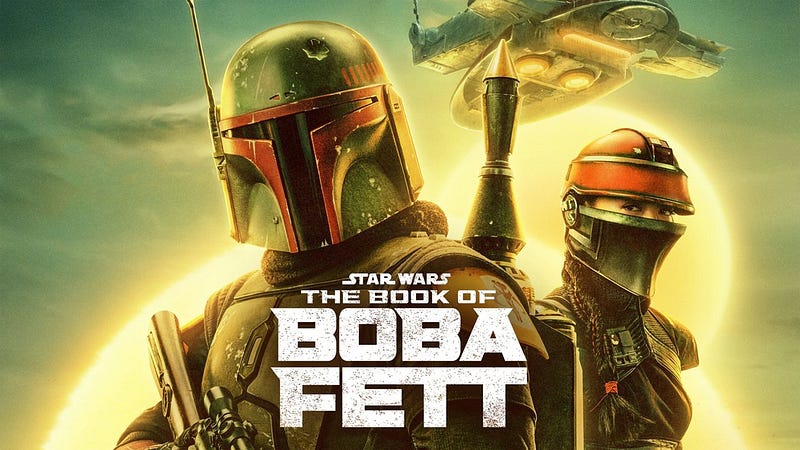
Disney+’s latest foray into the Star Wars universe wrapped its 7-episode run last week. The Mandalorian spinoff was a wildly unfocused journey that nevertheless had enough visual wonder, exciting action, and fan service to justify its existence. But what does The Book of Boba Fett mean for the future of the Star Wars universe?
[Author’s Note: This article contains major spoilers about The Mandalorian and The Book of Boba Fett. If you are not up to date on both series, I strongly recommend you bookmark this article and return to it when you are.]
Disney’s Takeover of Star Wars
When Disney announced a $4.05 billion deal to buy Lucasfilm, thus giving the company control over the Star Wars universe, many were skeptical. And, for some, the skepticism was justified. Some fans were enraged over plot twists in the long-awaited sequel trilogy that was commissioned. Some griped about Disney’s redefinition of what movies, specials, and books are now considered to be “in canon” in the Star Wars universe. Some remain weary that Disney’s involvement will continue to overly sanitize and commercialize the brand.
I, for one, have been generally thrilled with the results of the takeover. I found The Force Awakens (Episode VII), The Last Jedi (Episode VIII), and Rogue One (the prequel to Episode IV) to be among the finest of all Star Wars films and did not feel nearly the antipathy for Solo (the other prequel to Episode IV) or The Rise of Skywalker (Episode IX) as others did. I have also generally been a fan of the reinvigorated and rapidly expanding literary universe, which has been consistently entertaining and told some truly fascinating stories. And the quality of the work they have done integrating Star Wars into the Disney Parks has also been generally top-notch.
For me, though, one of the most exciting aspects of the new Star Wars era ushered in by Disney is the proliferation of Star Wars streaming series produced for Disney+. In addition to gaining access to terrific animated series like The Clone Wars and Rebels, Disney+ has now given us two Emmy-winning seasons of The Mandalorian and, now, the first of its several planned spinoffs.
(Note: There’s still no word regarding whether long-lost Star Wars content like the infamous and spectacularly awful 1978 Star Wars Holiday Special will ever make its way to Disney+, but I hold out hope.)
Disney+ Enters the Star Wars Universe with The Mandalorian
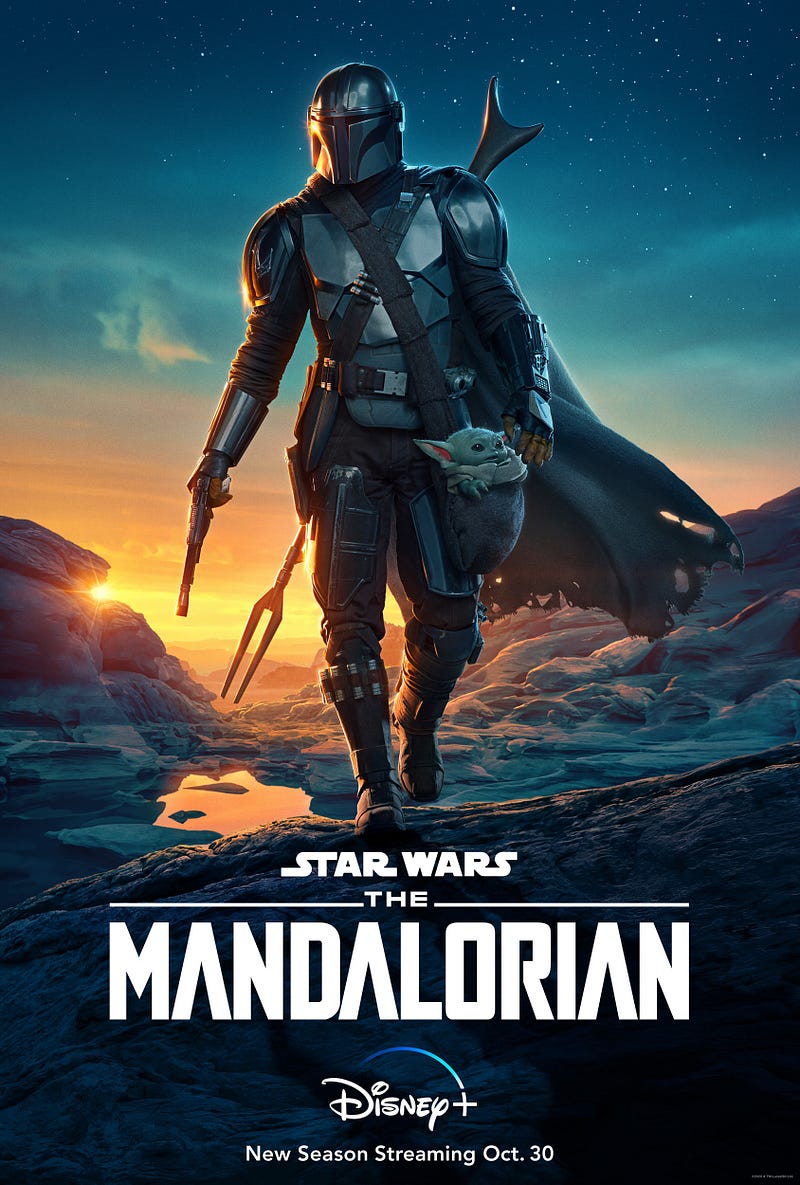
When Disney’s mega-hyped new streaming service Disney+ launched on November 12, 2019, its main attraction was the pilot episode of a new Star Wars series entitled The Mandalorian. New content from Marvel, Pixar, and other high-profile Disney partners would eventually arrive, but Disney doubled down on Star Wars enthusiasts fueling the launch of the streamer. And they did.
The Mandalorian has been an extraordinary success so far. Over the course of its two eight-episode seasons (the second of which aired from October to December 2020), the series became an undeniable pop culture phenomenon (particularly “Baby Yoda”) and managed the challenging feat of winning the admiration of both die-hard Star Wars fans and critics simultaneously. Despite being a genre series on a brand new streaming service, the first two seasons have amassed an astounding 39 Primetime Emmy Award nominations and 14 wins.
The series was created by Jon Favreau (who directed the blockbuster “live action” retellings of The Jungle Book and The Lion King for Walt Disney Pictures) and counts among its executive producers Kathleen Kennedy (the current president of LucasFilm) and Dave Filoni (the creator of the well-regarded Star Wars animated series Clone Wars and Rebels). For those unfamiliar with the plot, the show centers on a mysterious bounty hunter named Din Djarin (Pedro Pascal) who dons Mandalorian armor and goes through the galaxy taking on morally questionable jobs. His life is upended when he is thrust into the role of caretaker for a force-sensitive, non-human baby named Grogu (nicknamed “Baby Yoda” by fans because he is clearly of the same unnamed species as that beloved character from the original trilogy).
A large part of what made the first two seasons of The Mandalorian work so well is how unexpected and even daring it was. In both genre and format, the series is largely a throwback to the Western television series that dominated television for much of the 1950s and 1960s, as it features a primary recurring character who is sent to new settings to meet new characters and go on new adventures in each episode. In addition to resisting the modern tendency to jam pack each episode with subplots and serialize them with cliffhangers, the show also dared to go at a slower and more deliberate pace.
Throughout its first two seasons, we were introduced to new Star Wars characters like the villainous Client (German director and actor Warner Herzog) and Moff Gideon (Breaking Bad’s Giancarlo Esposito, who has already snagged two Emmy nominations for his performance); bounty hunter Fennec Shand (Mulan and Agents of SHIELD star Ming-Na Wen); the heroic Greef Karga (Rocky star and NFL player Carl Weathers) and Cara Dune (the since-fired MMA fighter Gina Carano); comic relief Pelli Motto (comedienne Amy Sedaris) and IG-11 (voiced by Oscar winner Taika Waititi); and alien characters like Kuill the Ugnaught (Oscar nominee Nick Nolte) and the Frog Lady (Misty Rosas). But of the large cast of recurring supporting characters on The Mandalorian, none generated as much buzz as the return of bounty hunter Boba Fett.
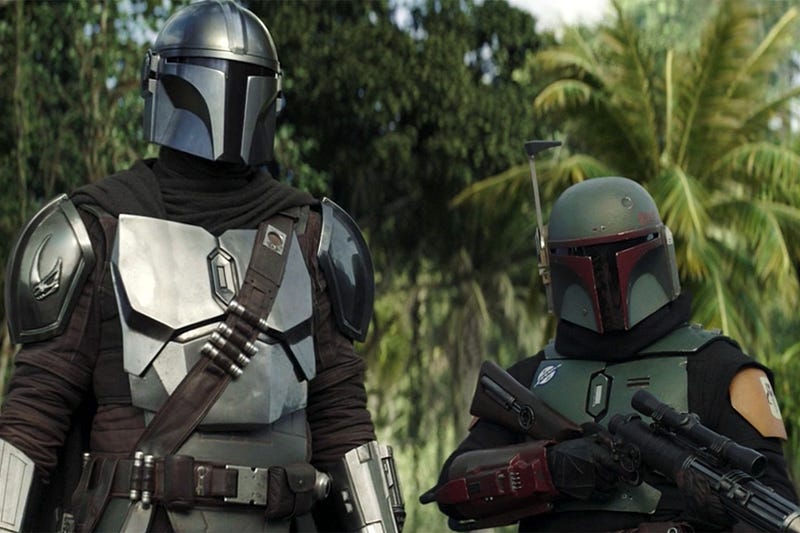
The character of Boba Fett has appeared numerous times in the Star Wars universe. He made his debut in an animated short that is often cited as the only redeeming aspect of the disastrous Star Wars Holiday Special. He made brief but memorable appearances in The Empire Strikes Back (Episode V) and Return of the Jedi (Episode VI) where he was in the service of the Galactic Empire and crime lord Jabba the Hutt, respectively. His origin was fleshed out in Attack of the Clones (Episode II) where he was revealed to be the son/genetic clone of Jango Fett, a bounty hunter from whom the clone army was duplicated. He was also featured on the animated series Clone Wars and in various novels, comic books, and video games.
After being foreshadowed in a Season One episode, Fett made his first appearance on the Season Two premiere and appeared in a total of four of the season’s eight episodes. (Given that The Mandalorian takes place five years after the events of Return of the Jedi, where Fett was seemingly killed after being consumed by a sarlacc, his appearance required a bit of retconning that would be saved for his spinoff. Fett reluctantly forms an alliance with Fennec and Din and spars with Mandalorian Bo-Katan (Battlestar Galactica’s Katee Sackhoff) over the purity of his lineage. The second season culminates in the ragtag band of reluctant heroes rescuing Grogu from the evil Moff Gideon and delivering him to Luke Skywalker for training. (The appearance of a young Luke Skywalker was an even bigger shock than the return of Boba Fett earlier in the season.)
The finale ended with a post-credits sequence that showed Boba and Fennec returning to Tatooine and assassinating Bib Fortuna, Jabba the Hutt’s former assistant who took over his criminal empire him after Princess Leia killed him in Return of the Jedi. The scene ends with Boba and Fennec taking over his crime syndicate as a title card appeared stating that a series entitled The Book of Boba Fett would premiere in December 2021.
It was an undeniably thrilling bombshell for Star Wars fans, but it left a number of burning questions that would not be resolved for a long time. Would this take the place of or delay a third season of The Mandalorian? Would we finally learn how Boba Fett survived the sarlacc? Would other iconic Star Wars characters show up?
The Curious Case of The Book of Boba Fett
Like The Mandalorian, The Book of Boba Fett was shrouded in secrecy with virtually no information about its plot, casting, or number of episodes revealed until it dropped on December 29, 2021.
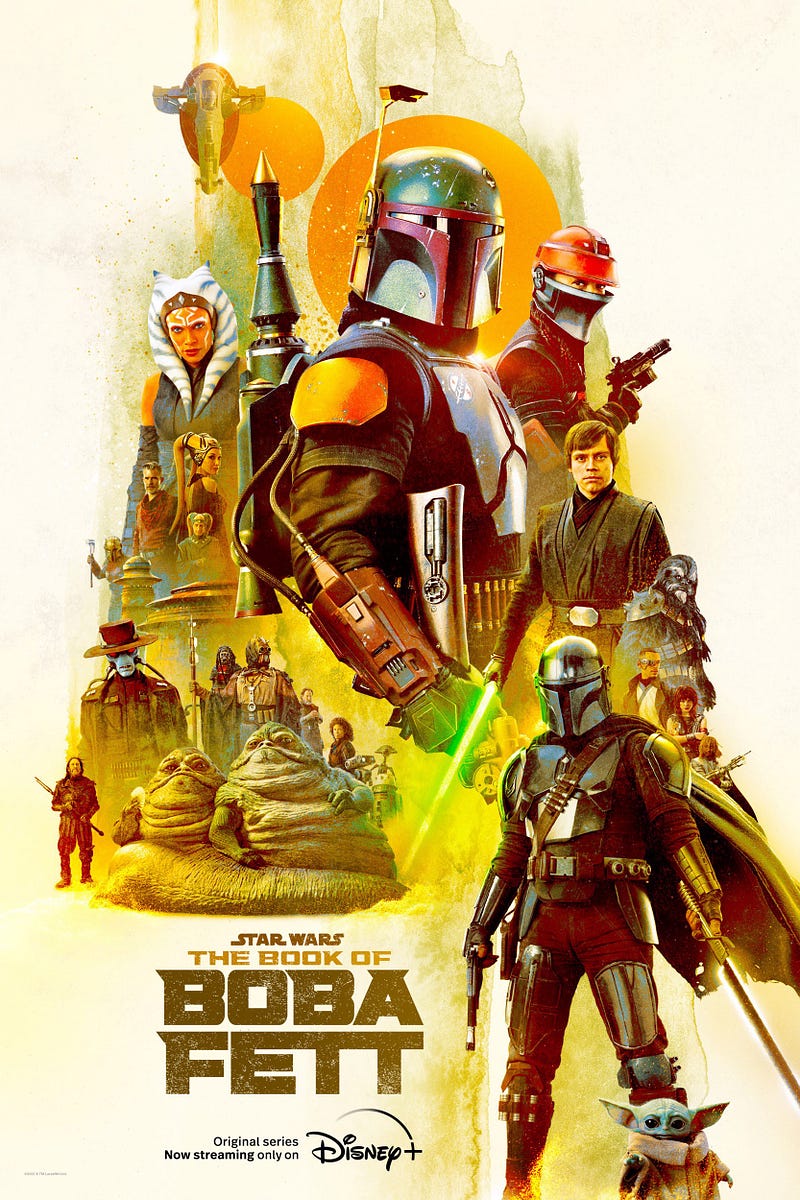
The first four episodes of the series were undeniably entertaining, but also narratively clunky. The major reason for this is the framing device used in the first half of the season. Each of the first four episodes, which range from 39 to 53 minutes in length, follows two storylines set in separate time periods. In the “present,” we follow Boba and Fennec trying to take control of Jabba’s empire through sparring with corrupt mayor Mok Shaiz, bribing cantina owner Garsa Fwip (Flashdance star Jennifer Beals), employing a rebellious street gang, and standing up to the twin cousins of Jabba the Hutt who think they are entitled to Jabba’s territory. While this is all unfolding, Boba repeatedly rests in his bacta tank to heal his various wounds and is haunted by dreams of what happened from the time he supposedly died in Return of the Jedi to when he appeared in the second season premiere of The Mandalorian. In these flashbacks, we see how he broke free from the sarlacc’s stomach, got taken in by a gang of Tusken raiders, avenged the murder of his adopted gang, and rescued and befriended Fennec.
These four episodes have some undeniably impressive elements. In particular, the action sequences involving the speeders and the desert train in the second episode is a jaw-dropping technical feat and the arrival of the Hutts to gift Boba a rancor in the third episode is a CGI spectacle that is a delight to those who grew up on Return of the Jedi (like me). But nevertheless, the production values feel a bit below the lofty standard set by The Mandalorian and the episodes are confusingly edited, narratively muddled, and — most problematically — focus on characters that just aren’t that interesting. Rather, they focus on characters that have the potential to be made interesting if they were given more sharply defined personalities or compelling motives.
Despite these gripes, I undoubtedly enjoyed the first four episodes enough to keep with the show until the end. And I am glad I did, because things shifted radically in the second half.
The fifth episode (“Chapter 5: Return of the Mandalorian”) perplexingly does not feature the title character at all, nor does it feature any of the characters from the series (save a brief, but critical appearance by Fennec Shand in the final scene). Rather, it chronicles the return of Din Djarin. He makes good on a bounty, reunites with the surviving Mandalorians (and gets subsequently banished), scores a new ship from Peli Motto (with Amy Sedaris reprising her role), and agrees to help Boba Fett defend Tatooine in the forthcoming battle — but only after he goes to visit Grogu. The episode is brilliantly directed by Bryce Dallas Howard and features a strong script by Jon Favreau and terrifically engaging performances by Sedaris and Pedro Pascal that highlight just how underwhelming Boba Fett’s characters are.
The sixth episode (“Chapter Six: From the Desert Comes a Stranger”) is even more surprising as it continues Din’s saga and barely features Boba and Fennec. Din goes to the planet where Luke Skywalker is training Grogu and is convinced by Ahsoka Tano (a key Star Wars character making a surprise appearance) that he should not interfere with Grogu’s training. He leaves a gift for Grogu with her and in the episode’s final scene Luke offers the gift to Grogu, but tells them that if he accepts the gift he is choosing to return to Din and is renouncing his Jedi training. Meanwhile, Din returns to Tatooine and meets with Cobb Vanth (Justified’s Timothy Olyphant, reprising his role from the Season Two premiere of The Mandalorian) to get help defending Tatooine in the forthcoming battle. The episode is well-executed fan service, complete with the return of Grogu, Luke, Ahsoka, and Cobb; the live action debut of Cad Bane (a villain from the animated series); a Jedi training montage; and a thrilling cliffhanger.
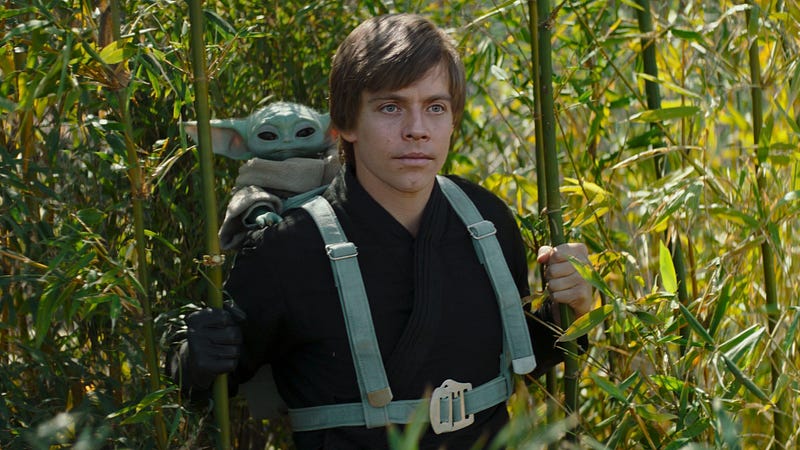
Things return a bit more to normal in the season’s seventh and final episode (“Chapter Seven: In the Name of Honor”). Grogu arrives on Tatooine and reunites with Din, having renounced his Jedi training to be with his father figure. He arrives in the midst of an epic battle in which Din, Boba, Fennec, and the ragtag army they have assembled fight high-tech droids and sharpshooters. By the end of the episode the good guys have won, the bad guys have lost, and everyone is off on the next step of their journey. The visual and sound effects are terrific, as are the editing, cinematography, and (of course) Ludwig Gorranson’s award-winning score. But, frankly, I never was particularly interested in the evolution of Boba and Fennec from assassins to heroes or whether or not Tatooine would be saved.
The fact that I was so much more interested in Din and Grogu’s subplot than Boba and Fennec’s main storyline exposes a major problem with The Book of Boba Fett. It also seems to be one the show’s creative team anticipated. We may never know what drove the team’s creative decisions, but it plays out on screen like they realized halfway through production that it wasn’t working and the only way to salvage it was to bring back the Mandalorian and Baby Yoda.
But it is not the fact that they decided to bring back these critical characters that is so curious. It is the fact that such a critical development in Din and Grogu’s storyline (perhaps the most critical development to date) occurs on a spinoff in which it wasn’t even known they would appear. Thus, if anyone skips The Book of Boba Fett and tries to watch the forthcoming third season of The Mandalorian they will be in for a world of confusion. It is a bold move to require viewers to watch the spinoff series in order to be able to understand the basic plot progression of the flagship series. (In contrast, you don’t need to see Tony Sark/Iron Man’s appearance in Spider-Man: Homecoming to get the gist of what’s happening with him when he appears subsequently in Avengers: End Game.)
Ultimately, the decision to abruptly pivot The Book of Boba Fett from a genuine spinoff series to a mini-season of The Mandalorian midway makes it a narrative mess. It also raises intriguing questions about where the Disney+ Star Wars universe goes from here.
The Future of Star Wars on Disney+
Among the many questions that persist after The Book of Boba Fett wrapped last week are:
- Was The Book of Boba Fett a one-off or will we see more of Boba and Fennec ruling Tatooine? Unless there is an overhaul to the writing, I humbly suggest that the writers to move on from this particular plot line.
- Will the upcoming spinoffs Ahsoka and Rangers of the New Republic also be required viewing to follow future seasons of The Mandalorian? It remains to be seen whether they will be more traditional, stand-alone spinoffs or similar to The Book of Boba Fett with appearances by Din and Grogu.
- Is Disney’s continued focus on the post-Return of the Jedi era and Tatooine setting wearing out its novelty? It seems to me that the first two seasons of The Mandalorian were such huge successes that Disney is prioritizing a sub-universe within the Star Wars universe focused on this time period and setting. Although there are still many stories to tell for these characters, it is becoming a bit frustrating that this is all we have been given so far given how vast the Star Wars universe is.
- Who else might show up on other Disney+ Star Wars series? With the shocking return of Luke Skywalker in The Mandalorian and The Book of Boba Fett and the news that Hayden Christensen will reprise his role as Anakin Skywalker/Darth Vader in the forthcoming limited series Obi-Wan Kenobi, it heightens the expectation that on any given Star Wars show literally any character could show up. It doesn’t matter if the actor is old or dead (thanks to CGI). It apparently doesn’t matter if the character is dead, either (see Boba Fett’s retconned death). It is a thrilling prospect, but also one that could spiral out of control and backfire if the powers that be don’t tread thoughtfully and carefully.
There are certainly a lot of questions about the future of the Disney+ Star Wars series, but one thing is for certain — I will be watching.
Follow the author of this article on Medium and Twitter.
Read recent articles by this author about Star Wars and Marvel:


