
The Cruel Ways Black Babies and Toddlers Were Treated During American Slavery Should Make You Cry
I once answered a question about the plight of young children during American slavery and I’ll share it below for anyone who’s wondering the same.
Newborns Were Enslaved at Birth
It’s important to note that babies and toddlers were also enslaved. Many were even deliberately bred for such purposes. From their first tiny breaths, they were not human, but were chattel property fully and legally owned by a human trafficker.
Virginia, Maryland and a few other states were infamous for being slave breeding states after the Atlantic Slave Trade was abolished in 1808. Slavery itself wasn’t abolished until 1865, though. No longer able to import Black Africans, but still able to enslave them, many plantation owners added breeding to their revenue streams. Particularly in areas where the land was no longer producing strong crops. Some simply changed their business model to breeding human beings in order to supply the crucial labor needed for the success of newly-added states and territories like Louisiana, which was purchased in 1803.
These children literally came out of the womb with a price tag attached to them. They were commodities to be bought and sold
In one narrative, an enslaved person recalls being left as a child in an area reserved for children from 4a until 9p every day without food or water. In other narratives people report having been cared for by the very old and other children who were not yet old enough to work full time. Note that by 8 or 10 years old, most were working from sun up till sun down just like adults, so the older children caring for the younger were probably around 6 or 7 years old.
I’ve read about toddlers working in fields as soon as they were old enough to stand and could be taught how to pick.
I’ve read about small children also being lashed until they bled for any infraction at all.
I’ve read several accounts of children being used as playmates for the plantation owner’s children, usually when the plantation owner’s child was too young to attend school. They were sort of like pets used to keep the savage’s children occupied.
I’ve even heard of the plantation owner’s children using enslaved children as their own sort of personal servants. And, yes, said children were also routinely beaten, spat upon, degraded, etc. by the plantation owner’s children sometimes at the urging of a parent (teaching them the role each child was to play out in life) and some just because they were mean kids or were mimicking what they’d seen White adults do.
All children, Black or White, enslaved or free, saw adults be violently beaten and tortured. So a certain psychological scarring and shaping was always taking place to ensure everyone knew how the hierarchy worked even from a young age.
Depending on the plantation owner who held them captive, children were sometimes forced to watch their mothers and even grandmothers beaten in order to educate them on how to behave and what was expected. Children were also sometimes forced to beat their own mothers, fathers (if they had one or knew him) and grandmothers with whips.
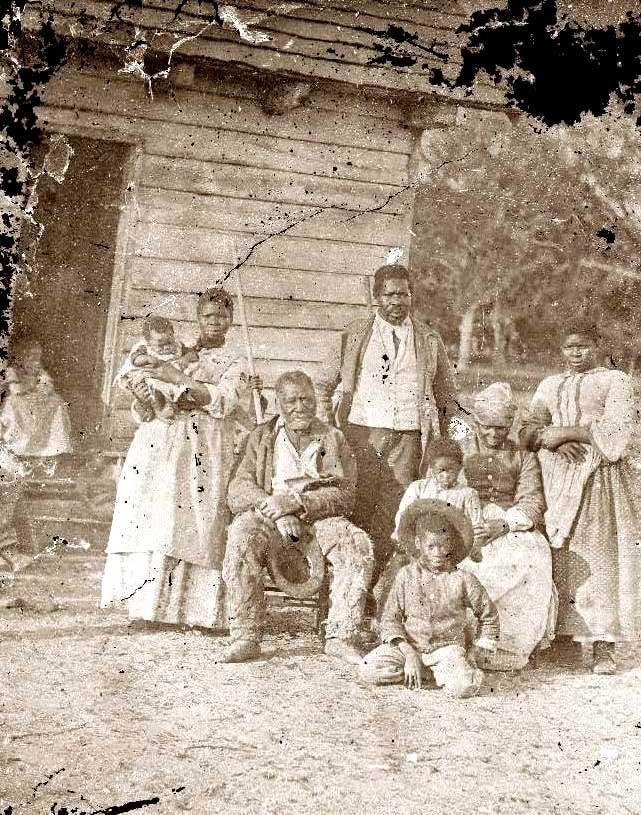
Children too young to yet work were often left to care for themselves. In many places, I’ve read where they were severely malnourished and were fed meals out of a trough like animals. I’ve read where they’d sometimes fight over food and were so hungry they’d lick the sides of the trough for anything left behind.
Many enslaved women were assigned to be wet nurses to a plantation owner’s child. Yes, the milk an enslaved woman’s body naturally produced for her own infant was often denied to these little ones and given to White children, instead. In an unknown number of cases, enslaved infants born to wet nurses died.
I’ve read about mother’s taking their children out with them while working in the fields, setting them in baskets and working all day under an overseer’s whip in all sorts of unforgiving weather. If a child was crying, needed attention, was hungry or sick, there was nothing a mother could do unless she was allowed a scheduled break. More often than not, an overseer would threaten her to keep the baby quiet and keep working or he’d harm the child… and she better not produce less than the required daily pickings at the same time.
Children also never knew when they’d either be sold away or their mothers or fathers (if they were lucky to have one) would be. It wasn’t uncommon for a child to be sold to several different owners even before becoming a teenager.
Women who were bred to produce more children to supply labor for other plantations sometimes had upwards of 25 children. In his book, Slave Breeding, Gregory D. Smithers writes about one woman having at least 35 children during her lifetime. Of course, these children were created to be traded, so the mothers didn’t get to keep them or nurture them. Or, if they did, it wasn’t for long. These children were made to be sold and when the timing was right, sold they were.
I recently shared a story about my great-great-great grandmother, Patsy. We don’t know what happened to the 2 children she was forced to leave. Who knows what their lives were like? We only know that when Patsy last saw them, the grief-stricken older child was holding the younger sibling and all were wailing in tears. Older siblings often took care of younger ones for as long as they were allowed to. Sadly, Patsy’s story or that of her children is not unique. This was an everyday occurrence and a part of every CHOSSA’s history (CHOSSA = Children of Stolen & Sold Africans).
In fact, my great-great Grandfather, Jim, was given as a servant to a plantation owner’s daughter as a wedding gift. I think he was 6 at the time.

I’ve read about children being barely clothed and some of them spending a good portion of their childhoods naked. Most only got clothes once per year which consisted of nothing more than one pair of pants and maybe 2 shirts. Children outgrow clothing pretty easily. They also have a tendency to get rips or tears in their clothing. Nothing was replaced so if you outgrew or otherwise could not wear your clothes before the year was up, you went naked.
Shoes were almost never part of the clothing allowance. I read where one little boy’s toes came off in his mother’s hands when she rubbed them after being severely frost bitten.
Pedophilia has, unfortunately, always been among us. And, yes, some children were literally owned for these purposes.
Girls who were of menstruating age were often bred either through rape by a White man or forced to have sex with another enslaved man.
There’s a popular, deeply problematic and plain wrong belief that an “up side to slavery” was that Africans were introduced to Christianity because of it. Never mind that Africans already had deeply meaningful spiritual traditions, never mind that Christianity was already on the Continent before Columbus even knew it existed, never mind that some of the oldest churches in the world are in Ethiopia or that an African was the first Christian convert in the Bible and that Africa is home to a few ancient Christian kingdoms. Never mind, also, that the religion the devils who were involved in Transatlantic slavery practiced was appropriated and twisted into something purely evil and never mind that Christianity is most definitely NOT a White religion and that Africans didn’t need White men to introduce them to it. But can you imagine being taught that fornication and adultery are wrong, yet you are forced to have sexual relations with a man whether you’re married to someone else or not? Whether you’re a virgin or not? Imagine being raped and used for all sorts of sexual perversions while being taught about Christianity and living in a very rigidly Christian environment where White women are praised for their “Christian” virtue while Black girls and women are subjected to all sorts of sexual abuse and degradation?
This was the life of infants, toddlers, young children, teenagers and the women who bore them during enslavement.
Things weren’t much better during Jim Crow either. My own great grandmother had 13 children. She, my great grandfather and their children worked from dusk till dawn as sharecroppers every day, which was, essentially, another form of slavery. As a child, my grandfather was left in charge of one of my great parent’s infant children one day while the rest of the family went to labor for a White landowner who never paid them and who kept then in perpetual debt. Unfortunately, the baby was very ill and died under my grandfather’s watch. I think he was 8 years old at the time. Pop-pop died an alcoholic and I’ve heard whispers that his alcohol abuse stemmed from that day, which he never forgave himself for.
The trauma our ancestors have collected seems never-ending. All CHOSSA have our stories and they are not just about adults being enslaved. Children were not spared any of the indignity or injustices of those times. Unprotected by parents or families — and treated as mere commodities — they didn’t have much to speak of at all in the way of childhoods. Yes, they made up and played games when they could, they sang songs and danced as children do, but they always did so under the awareness they could be sold on any given day or a mother or other family member could be. They always knew they could be beaten for any infraction or any lie told on them. They could be raped or subjected to whatever cruel abuses a White person wanted to mete out.
Through it all, though, we are the children of those children who survived the vicious brutality endured generation after generation after generation. We are strong, we are resilient and, at the same time, we are still wounded. When people say, “it didn’t happen to you, get over it”, they have no idea what that sort of trauma does to people. They don’t understand what it does to people’s ideas about family, responsibility, affection, stability. They don’t understand how those childhood sufferings affect parenting styles or how people have had to cope with depression and post-traumatic stress completely on their own while still dealing with the outside forces of White supremacy and oppression, which have never stopped assaulting them.
Simply put, slavery happened to infants and toddlers, too. There was no daycare, elementary school or after school programs these children were ushered off to while their parents labored for free. Because of this, a variety of stories can be told depending on the child and the savage who thought she or he owned them. One thing is for sure though, no one watched out for the safety or well-being of Black children born to into a plight they could never escape.
I’m blessed to have genealogists on both sides of my family tree as well as a great-grandfather who lived to be an estimated 107 years old and who was able to share stories of his own mother, father and grandmothers who were actually enslaved. Much of what I’ve shared here has been passed down through generations in my own family and I’ve also read quite a bit about the experiences of other enslaved individuals throughout the years. For those who are interested, here are several links where you can read more about some of the details I’ve shared here, as well as gain additional insight regarding the lives of enslaved Black children in America:
Slave Breeding: Sex, Violence, and Memory in African American History (See also: https://muse.jhu.edu/book/19461)
What Was it Like to be a Child Slave in America in the Nineteenth Century? (PDF)
Childhood and Transatlantic Slavery
Life for slave children in 1861
Interracial Relations in Antebellum Maryland
How Slavery Affected African American Families
Nell Irvan Painter on soul murder and slavery
Born in Slavery: Slave Narratives from the Federal Writers’ Project, 1936–1938