CHOSSA: One Powerful and Beautifully Precise Word Created For Special Black People
You’re going to hear me use the word CHOSSA quite a bit around here. It’s a word I created and one I hope you will proudly use. So, what does it mean?
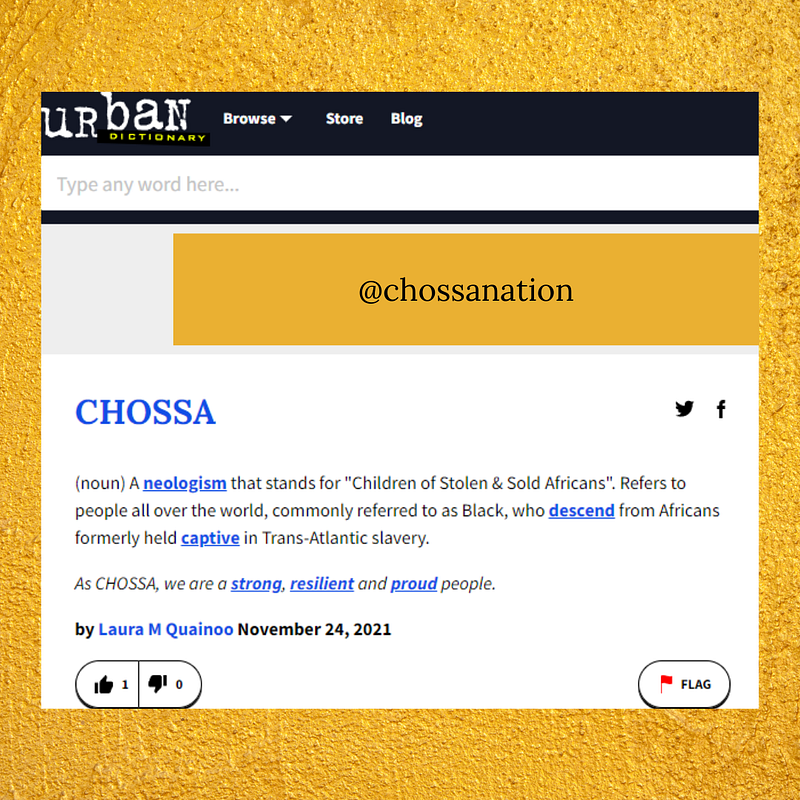
CHOSSA means Children of Stolen & Sold Africans
Pronounced “Chose-uh” (and rhymes with Rosa), I created this neologism for the following reasons:
- To Unite the Diaspora
- To remove the “slave” label from our ancestors
- To include those who aren’t clearly seen as Black, but who share our ancestry
- To make clear the fact that we are still African
Uniting the Diaspora
When our ancestors were forcibly removed from Africa, they were taken to various parts of the world where they were brutalized, raped, bred and forced to work solely for the benefit of others. As their descendants, most of us still reside in the places where they were held captive. Although we originate from the same continent, we are separated by distance, language and even the words we use to identify ourselves. Some of us are Black, some are Afro-Latin, some are West Indian, some identify simply as Spanish and so on and so forth. These divisions sometimes turn contentious as an “us and them” mentality can arise, but it is important to always remember that we are bonded by Africa, by our ancestors and by the history we share.
CHOSSA doesn’t exist to erase how people identify now. For example, I still identify as Black American. It does exist, however, as an effort to remind us that we come from the same root. As a global people with natural ties to Africa and all of her majesty, I believe we can accomplish so much if we are able to unite instead of continuing as a fragmented people. Socially, politically, economically, we are so much more powerful together than we are when divided by the “us and them” consciousness that often keeps us apart.
Removing the Slave Label
About 15 years ago, one of my older cousins checked me about referring to our ancestors as slaves. I hadn’t thought about it before then, but she made a strong point about enslavement being something awful that was done to our people and shouldn’t be used to describe who they were. Prior to being captured and even while enslaved, our ancestors were mothers, fathers, children, teachers, warriors, midwives, priests, leaders, healers, students and more. They were human beings. They weren’t slaves, they were enslaved and I’ve come to believe there’s a remarkable difference in honoring them that way.
Since my cousin’s correction, I’ve tried to be very careful with my words when speaking of our ancestors, when speaking of the Diaspora and when describing myself. It’s because of this that I began noticing how often others describe themselves as descending from slaves or even descending from so-called slave masters (perhaps we’ll address the deceptive titles used to describe vile, evil human traffickers some other time). The psychological conditioning of the caste system we were all born into continues with some of this language and I felt it was time to more appropriately name ourselves according to who our ancestors truly were and who we are as their children.
To continue to call them “slaves” is to continue to describe them through someone else’s lens, someone else’s opinion of who they were. CHOSSA, in my opinion, helps to restore their dignity — and our own — while still acknowledging what they were forced to endure.
To Include Those With African Ancestry Who may not Appear “Black”
I come from a generation who believed in the one-drop rule. Because of this, it’s normal to find people of mixed parentage referring to themselves as Black. At 55 years young, I have to accept the idea that this “rule” is no longer popular. Now, I do have a few minor issues with this, but those are topics for other days.
As far as CHOSSA is concerned, the word is inclusive of those who may have one Black parent and one non-Black parent. Now, depending on what people of mixed heritage look like, some identify as Black, some as mixed or biracial (or multiracial) and some don’t know what to identify as because they feel pushed and pulled toward more than one identity especially if they don’t have much melanin or they inherited most of their physical features from a non-Black parent.
As mentioned, I come from a generation that was cool with someone who didn’t appear to be even a little bit African identifying themselves as Black. Not in a Rachel Dolezal way, but in a way that honored the actual ancestry they felt closest to, most accepted by and most familiar with. Those days appear to be just about over, though, as many no longer find it acceptable for people like President Obama, Vice President Kamala Harris, Halle Berry, Mariah Carey or Drake to call themselves Black. Insisting, instead, that they identify as biracial.
Once my own grandchildren were born to a Black father and a White mother, I began to realize the potential for them to be stuck in the middle of the societal pressure around identifying themselves. They’re still young and haven’t had to even think about that yet… and I do trust my son and daughter-in-law to help them navigate the waters when that time comes… but I also had to examine my own ideas about the old one-drop rule.
I’m still examining, but, as I do so, I’m happy to have created a word that includes all Children of Stolen & Sold Africans, regardless of what racial category society will seek to assign them to. No matter what they may “look like” to others and no matter what else may be in their history, they can proudly proclaim they are CHOSSA.
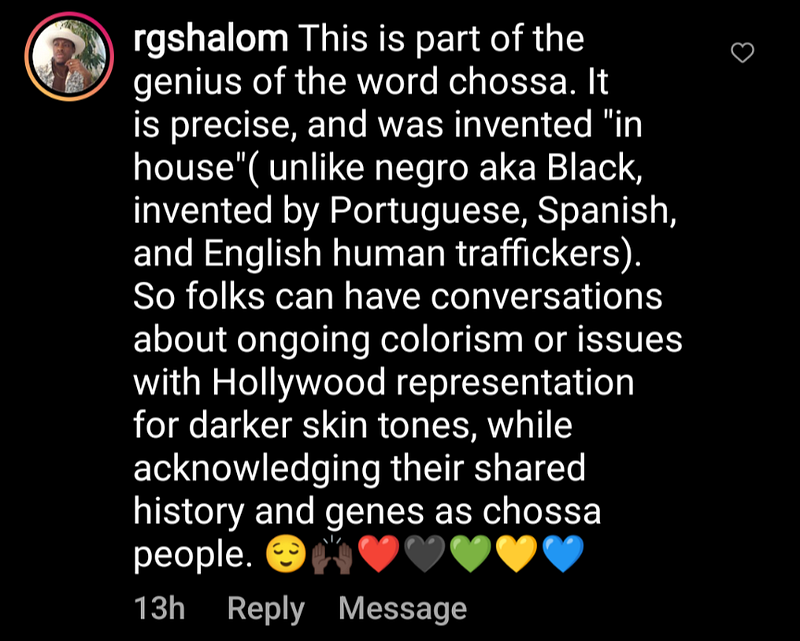
To Be Clear, We Are African
If you’ve read some of my other posts, you know I am deeply in love with Africa. I have a website called the Black to Africa Movement and I’m constantly encouraging Black people to visit, invest in and even move to Africa (for a short stint or permanently), if possible. I am not only proud of Africa, but I am proud to be African by way of my ancestors. Sadly, not all CHOSSA feel this way and I hope I can help change that.
See, we can’t be the CHILDREN of Africans without being African, right? No matter how we identify as Black or African-American, Afro-Latin, etc. the fact of the matter is we are African, baby! Maybe a particular type of African, maybe ones who have a long-distance and complicated relationship with that part of ourselves, but we are African nonetheless.
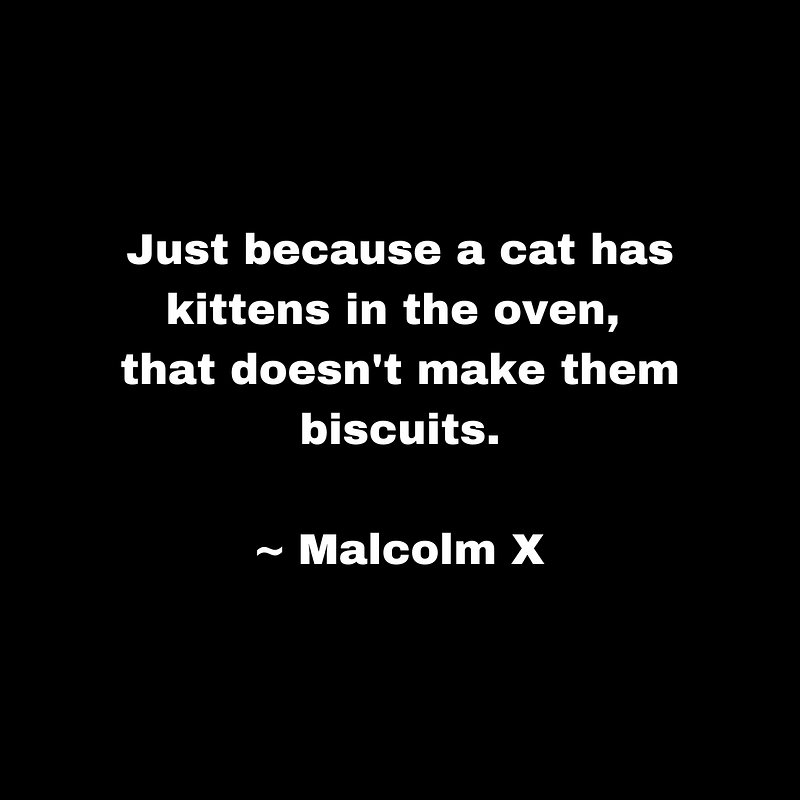
I wanted the word ‘CHOSSA’ to remind CHOSSA living all over the world about who we truly are and I also want Africans and others to know that we stand on being African regardless of our birthplaces, our citizenship statuses, our phenotypes or the languages we speak. I think it was Malcolm X who was famously quoted for saying, “Just because a cat has kittens in the oven, that doesn’t make them biscuits.” We may have been born elsewhere, but that doesn’t change who we are.
This is important, too, because, although most Continental Africans I encounter more than embrace CHOSSA as African (the African Union even identifies us as 6th Region Africans), a limited few can sometimes be a bit nasty about us reconnecting with the Continent. While these are mostly online trolls who may not even be African themselves, the word ‘CHOSSA’ makes clear that we are not asking to be given some sort of honorary African status, but that we already are African by blood. We don’t need permission, nor do we all have to know precisely which people groups or regions of Africa our ancestry hails from, but it should be understood and respected that we are African nonetheless. I hope that the more we begin using the word CHOSSA to identify ourselves, the less anyone will feel the need to question how we figure ourselves to be African.
Now What?
Well, let’s figure out how to spread the word (literally!). No longer should flag colors or skin colors confuse us into believing we’re not one people. We are connected through Africa and the trauma surrounding our separation from the Continent. So, share this article with as many CHOSSA as possible and encourage the use of the word in your personal circles. You should also follow CHOSSANation on Instagram and, by all means, follow me here, too (as a newbie, I’m still trying to get to 100 followers)!
The floor is now yours to tell me what you think of CHOSSA (the word, not us the people). Whether you like it or dislike it, I welcome your feedback below.