
The Conquistador Who Joined the Mayans Against the Spanish
Gonzalo Guerrero, the father of the first Mestizos
Many of us grew up hearing about the discovery of the New World. We learned the rhyme ‘in 1492, Columbus sailed the ocean blue’, we learned that he was not in fact the first European to discover the Americas and eventually many of us learned of the horrific cost of Columbus’ ‘discovery’. For too many of us, names like Columbus, Cortes, and Pizarro rightly elicit anger today, while others have been forgotten.
Few of these men can be called heroes, and fewer still went to the New World to aid the people they found there, but their contributions to aiding their plight set them apart from other conquistadors and religious figures of the time. Gonzalo Guerrero is no hero, but nor is he a two-dimensional villain either.
Early Life
Details of Guerrero’s early life are sparse, with some suggesting this is because records of his life have either been destroyed or heavily abridged by the Spanish authorities following his betrayal. That said, he seems to have been born around 1470, in Palos, a town in southwestern Spain.
At some point he became what we today would call a marine and he likely took part in the final push of the Reconquista, the Fall of Grenada, driving the Moors from their last stronghold on the Iberian Peninsula in 1492. Records conflict as to whether he was an arquebusier or an officer, but regardless around 1511 Guerrero was aboard a ship (perhaps a slave ship) alongside another man, Friar Jerónimo de Aguilar when they struck a rock, and the ship was unable to be moved. They were somewhere between what is today Panama and the Dominican Republic, and every crew member piled into a life raft.
Shipwrecked
Sources differ on exactly how many were aboard, but many died, presumably of exposure, dehydration, and starvation. They had hoped to make their way to Cuba or Jamaica but ended up washing ashore in what is known today as the Mexican state of Quintana Roo. 15 men, including Guerrero and Aguilar, and two women were taken captive by the local Mayans, the Calachionies, to be used as slaves. Some were sacrificed almost immediately, others survived for years, but all except Guerrero and Aguilar would die from overworking.
The two survivors would flee, eventually coming into the possession of another chief, though it’s unclear whether they were captured or went willingly, and again served as slaves. This in essence is the tale told by Bernal Díaz del Castillo, a conquistador who heard it from Aguilar himself, and is echoed by others such as Francisco López de Gómara and Fray Diego de Landa. Here though is where their paths diverge.
Becoming Mayan
At some point, the two men became separated. Guerrero and Aguilar both learned to speak the Mayan language (actually one of many languages in the Mayan language group), but where Aguilar clung to his Catholic faith and Spanish identity, Guerrero did not. Some sources say that Guerrero was given as a slave to a warrior named Balam, going hunting and joining him in war parties. Guerrero would supposedly save his master from a crocodile attack and for this he would be granted his freedom by Nachan Can, the chief of the Chactemal Mayans.
Through his linguistic and military skills, he would rise to the rank of captain in the Mayan army, leading war parties against rival tribes and the Spanish, and even marrying the chief daughter Zazil Ha, who would go onto bare him three children, the first Mestizos.
Hernan Cortes
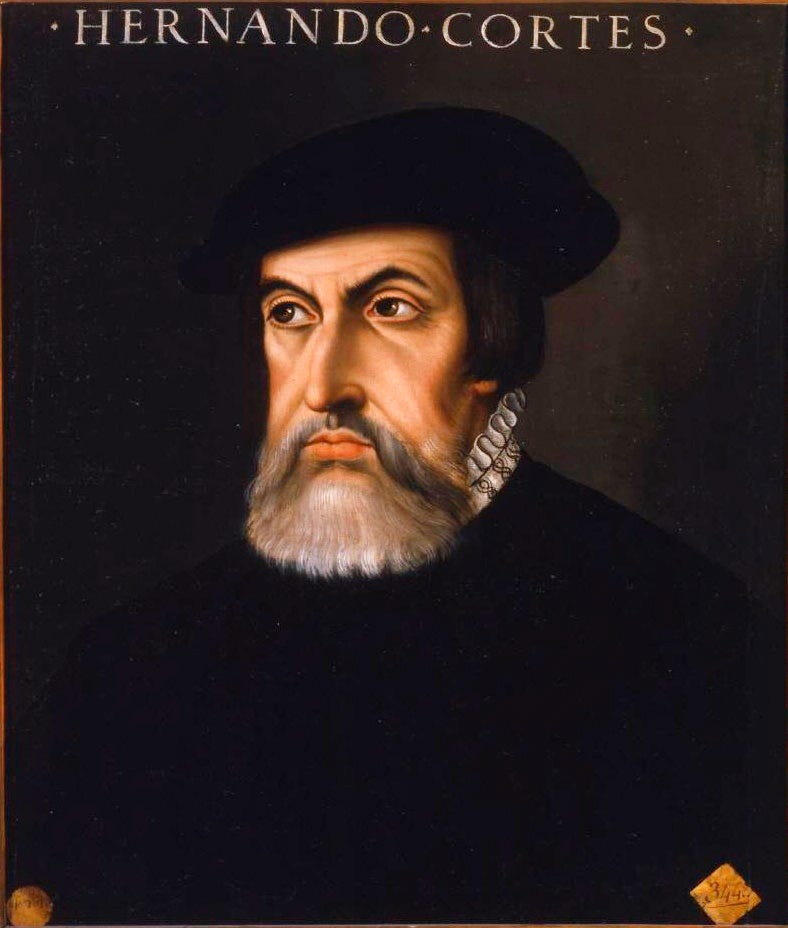
In 1519, Hernan Cortes had not yet brought the Aztec Empire to its knees, but was in the process of conquering Mexico and had heard of ‘bearded men living among the Mayans’. The first man he found was Aguilar, dressed in rags, though still in possession of his prayerbook, which he’d kept for some eight years. Cortes, in a rare moment of compassion, paid the Mayans a ransom for him and Aguilar would go on to be his translator for years to come.
Guerrero was another matter. It’s unclear exactly, but it seems that Aguilar was able to write to Guerrero, telling him of his good fortune and asking him to come home. Guerrero made the following reply:
‘Brother Aguilar, — I have united myself here to one of the females of this country, by whom I have three children; and am, during wartime, as good as cazique or chief. Go! and may God be with you: for myself, I could not appear again among my countrymen. My face has already been disfigured, according to the Indian custom, and my ears have been pierced: what would my countrymen say if they saw me in this attire? Only look at my three children, what lovely little creatures they are…’ (The Conquest of New Spain, p.60).
Aguilar would plead with him, telling him he could bring his children, pleading for his immortal soul, but Guerrero wouldn’t listen. Cortes, when hearing of this, reportedly said:
‘I wish I could get my hands on him, for it will never do to leave him here.’
He was not speaking out of kindness, he had just learned that Guerrero was likely involved in the defeat of his predecessor, Francisco Hernández de Cordoba. One wonders what might have happened had the two men met face-to-face, and the different course history might have taken had they come to blows.
Who is Gonzalo Guerrero?
In his letter to Aguilar, one cannot help but note a tone of grief. If he had not integrated himself so deeply into Mayan culture, perhaps he might have returned home to Spain after so many years in exile, first as a slave and then as a warrior for a distant people. This is certainly what Aguilar believed, but one must be cautious in accepting his words. Every chronicle is written with an agenda and to the Spanish, Guerrero was a traitor, a man to be derided and shunned, for he had joined the enemy, the dreaded other. Guerrero may never have expressed such a sentiment, or even replied to Aguilar, we simply cannot know the truth with so much distance between then and now.
What is known is how the story ends. On August 14th, 1536, Gonzalo Guerrero would die leading a charge against the Spanish forces. He had been among the Mayans for 24 years and died as he had lived his life, as a soldier. He did not, as so many other Spaniards did, die for gold and glory, but instead for his family and for his home.
Before Cortes destroyed their culture and decimated their population, the Aztecs had one of the most vibrant and unique societies in the New World and nowhere is this more apparent than in what they ate.
Bibliography
Castillo, Bernal Diaz del. ‘The Memoirs Of The Conquistador Bernal Diaz Del Castillo Written By Himself Containing A True And Full Account Of The Discovery And Conquest Of Mexico and New Spain’. Translated by John Ingram Lockhart. The Project Gutenberg. Accessed 13 June 2021. https://www.gutenberg.org/files/32474/32474-h/32474-h.htm.
‘Chactemal (Santa Rita) Archaeological Site’. Accessed 13 June 2021. https://chactemal.com/gonzalo.
‘Gonzalo Guerrero, The History Of A Conquered Conquistador | Faena’. Accessed 13 June 2021. https://www.faena.com/aleph/gonzalo-guerrero-the-history-of-a-conquered-conquistador.
Harvey, Ian. ‘The Shipwrecked Spaniard Who Became a Captain in the Mayan Army’. The Vintage News (blog), 25 March 2019. https://www.thevintagenews.com/2019/03/25/gonzalo-guerrero/.
Marez, Curtis. ‘Mestizo/a | Keywords for American Cultural Studies, Third Edition’. Accessed 13 June 2021. https://keywords.nyupress.org/american-cultural-studies/essay/mestizoa/.
Mingren, Wu. ‘Gonzalo Guerrero: Father of the First Mestizos and Army Captain of the Mayans’. Text. Ancient Origins. Accessed 13 June 2021. https://www.ancient-origins.net/history-famous-people/gonzalo-guerrero-father-first-mestizos-and-army-captain-mayans-006129.
Vázquez, Indalecio Cardeña. ‘Gonzalo Guerrero, the Renegade Spanish Soldier.’ The Yucatan Times (blog), 5 April 2020. https://www.theyucatantimes.com/2020/04/gonzalo-guerrero-the-renegade-spanish-soldier/.