
The Collection of Letters That Became a New York Times Bestseller
A look back at ’84, Charing Cross Road’
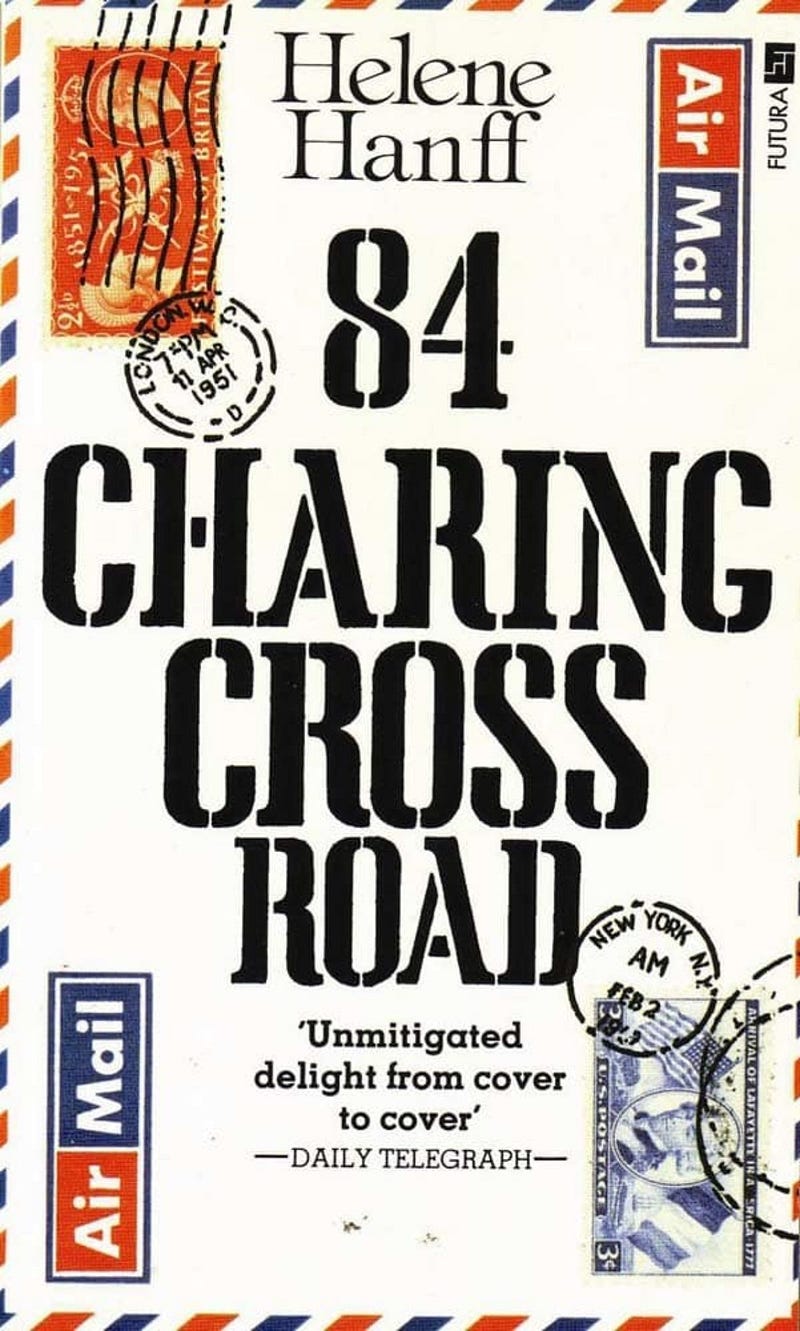
I recently wrote an article about the 40th anniversary of the film version of my favorite novel, The Razor’s Edge. In that piece, I mentioned that I have re-read the book every year since 1985; I only realized this morning (when I pulled it off my shelf) that there is another book I have read every year for almost as long: Helene Hanff’s classic 84, Charing Cross Road. This surprise New York Times bestseller isn’t even really a book in the conventional sense, but rather a collection of letters between Ms. Hanff and London bookseller Frank Doel between 1949 and 1969. The fact that it is such a slim volume (only 97 pages) makes its runaway success in 1970 even more amazing.
84, Charing Cross Road is a perfect example of why you can’t judge a book by its cover, its length, or the unorthodox nature of its content. Ultimately what makes the book work is what makes any book work, whether fiction or nonfiction: the relationships between the characters. And for readers today, the way the relationships develop are not simply interesting in themselves but also because of how they happen. In an age of instant communication, the leisurely pace of the letters between Helene and Frank (and later other store employees as well) are a window into an era we will sadly never see again.
The correspondence begins in 1949 as Ms. Hanff is searching for clean copies of used books she is unable to find near her home in New York City. This alone will seem strange to readers accustomed to using Amazon to locate any book ever published, but before the internet, books that went out of print could only be found through used and antiquarian booksellers, who themselves had to conduct exhaustive and time-consuming searches. She writes to London booksellers Marks & Co. requesting certain titles she cannot locate and thus begins the 20 years of correspondence that makes up the book.
Helene Hanff was a prolific writer during her life, but her letters in 84, Charing Cross Road prove that she may have missed her true calling as a stand-up comic. Many of her letters are laugh-out-loud funny, made more so when juxtaposed with Frank Doel’s typically proper and reserved British responses. For example, she shoots off this letter after she ordered the Latin Vulgate Bible and received the Latin Anglican New Testament instead:
WHAT KIND OF A BLACK PROTESTANT BIBLE IS THIS?
Kindly inform the Church of England they have loused up the most beautiful prose ever written, whoever told them to tinker with the Vulgate Latin? They’ll burn for it, you mark my words.
It’s nothing to me, I’m Jewish myself. But I have a Catholic sister-in-law, a Methodist sister-in-law, a whole raft of Presbyterian cousins (through my Great-Uncle Abraham who converted) and an aunt who’s a Christian Science healer, and I like to think none of them would countenance this Anglican Latin Bible if they knew it existed. (As it happens, they don’t know Latin existed.)¹
The books she orders are a veritable Master class in Literature, ranging from Chaucer to Virginia Woolf to Jane Austen. A lover of books could do worse than simply reading all of the titles mentioned in Hanff and Doel’s correspondence.
But had this just been an exchange of book orders and invoices, it would not have grabbed the public’s imagination in such a way that the book is still loved 54 years later, as well as having been adapted into both a play and a film. Helene goes beyond being a simple customer, becoming involved in the lives of the store’s staff, celebrating their joys, mourning their losses, and caring for their physical needs in a very real way.
After World War II, England was subject to severe rationing that lasted for many years. Upon learning that her new friends couldn’t get things like meat or real eggs, she began sending regular food parcels to them, especially during holidays.
One such parcel caused her to send a panicked follow-up letter: she had sent a ham before realizing that the shop owners were Jewish and offered to “rush over a tongue.” The staff (six in all) respond by sending her photos of their families, first-edition books, and teaching her how to make Yorkshire Pudding. Throughout this two-decade friendship, she planned to travel to London to meet everyone in person yet seemed to always be deterred by some unexpected event.
84, Charing Cross Road is at its core a book about lovers of books and is at the same time one of the funniest and most touching books you’ll ever read. Those who have read The Guernsey Literary and Potato Peel Pie Society, a novel comprised of only letters between the characters, will see how much that bestseller owes 84, Charing Cross Road. I am thankful their correspondence came at a time when people both wrote and kept letters; such a book would likely never have been possible in the era of texts and e-mail, and that would have been a tremendous loss.
You should pick up a copy of 84, Charing Cross Road immediately (as well as copies of her books The Duchess of Bloomsbury Street and Q’s Legacy: A Delightful Account of a Lifelong Love Affair with Books), but clear your schedule first; you will almost certainly not stop reading until you’ve finished it. And I can assure you that you will want to read it again.
¹Helene Hanff, 84, Charing Cross Road (Penguin Books paperback edition, 1990), page 5.


