
The Little-Known Bill Murray Film That Changed My Life
‘The Razor’s Edge’ 40 years on
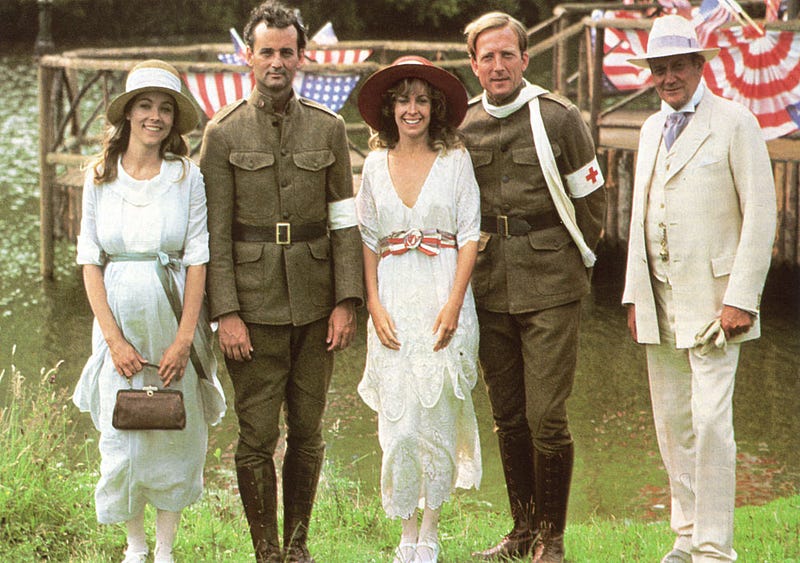
In October 1984, I was a punk kid just out of high school who had an unhealthy obsession with quoting Bill Murray films like Meatballs and Stripes and was still a month away from seeing Bruce Springsteen in concert for the first time (today I am a punk in my late 50s who has an unhealthy obsession with quoting Bill Murray films like Meatballs and Stripes and has seen Springsteen in concert five times; some things change while some never do). What will surprise some who read me regularly is that the key person in the sentence above is not Bruce, but rather Bill, most importantly the film he released that October four decades ago this year.
No matter what he may have become in his old age (the stories vary widely), in 1984 Bill Murray was considered one of the comic geniuses of his era. He was part of the original Saturday Night Live cast that went on to dominate the comedy film genre for more than a decade: Bill, John Belushi, Dan Ackroyd, and Chevy Chase. By the fall of 1984, he had a string of hits in a five-year span that included Meatballs, Caddyshack, Stripes, and Ghostbusters. At that time, there were only two people I wanted to be more than him when I grew up: Steve McQueen (I would never be cool enough) and John Wayne (which was as attainable as wanting to be God).
Bill Murray, however, was a role model anyone could relate to, especially a wisecracking teenager like me (I have written before that he both taught me everything I needed to know about life and that Stripes perfectly mirrored my Army experience ten years after I first saw it). Thus, I saw all of his movies, most multiple times, and when he followed up Ghostbusters with a film that was rumored to be “serious,” I was there for opening night. The film was an adaptation of W. Somerset Maugham’s novel, The Razor’s Edge, as well as a remake of a 1946 adaptation starring Tyrone Power.
At that point, I had never heard of the book or Somerset Maugham and was only vaguely aware of who Tyrone Power was, so I went in without any particular expectations or preconceived notions. To say I was unprepared for what would follow is a massive understatement.
The film tells the story of Larry Darrell, a World War I ambulance driver who returns to his native Chicago profoundly impacted by the events of the war and unwilling to join in his friends’ pursuit of money and leisure in booming 1920s America. Rather than enter the business world (as everyone expects him to do), he leaves his home and his fiancé Isabel and travels to Europe to, in his words, “loaf.”
Loafing as Larry practices it is quite strenuous however, consisting of days working as a fish packer or in a coal mine and nights reading the great philosophers and mystics. He eventually travels to India and comes under the teaching of a guru who helps him greatly in his search for meaning. As these events transpire, back home Isabel has married Larry’s best friend, the stock market has crashed, and the friends are ultimately reunited at the Paris home of Isabel’s uncle Elliott Templeton.
On the surface, it’s not anything groundbreaking and seems an unlikely film to have had an impact on me at the time. However, for reasons I still can’t explain, it affected me profoundly. I returned to the theater three or four times over the next two weeks, to the point that I could quote most of the dialogue; unlike with other Murray films though, this wasn’t dialogue you dropped sarcastically.
I knew after the first viewing I needed to read the novel, but since I was as much of a procrastinator then as I am now, I didn’t pick up a copy until after the new year. I read it in one sitting and have re-read it every year since. Each time I read it I get something new from it, but one thing was clear from that first reading in 1985: Murray should have waited to make the film.
There is no question that Bill Murray loves the novel as much as I do; he only agreed to take the role of Dr. Peter Venkman in Ghostbusters after Columbia Pictures agreed to finance The Razor’s Edge, and he co-wrote the screenplay with director John Byrum (who first introduced Murray to the novel). That love, however, did not change one fact: in 1984, Bill Murray was not yet capable of being any character on film except Bill Murray. The characters Tripper Harrison in Meatballs, Carl Spackler in Caddyshack, and John Winger in Stripes were all simply a variation of Murray’s SNL persona, and while that persona was hilarious, it was ill-suited for the gravitas of a character like Larry Darrell.
I didn’t realize this when I first saw the film, and the comic bits he included were perfectly in character for Murray. It was not until reading the book (and later seeing the superior 1946 film version) that I understood those comic bits were not at all in character for Larry Darrell. Had he made the film later in his career (at least post-Groundhog Day and ideally post-Lost in Translation) the result would have been far more faithful to the novel.
Murray and Byrum made two other significant changes that, I believe, hurt the film. First, Maugham himself is a character in both the novel and the 1946 film version, and while it seems odd at first, the inclusion of a detached observer turns out to be key to the book/original film. Second, Elliott Templeton is a major character in the book, but in Murray’s adaptation he is reduced to almost a bit part. It was a tragic underuse of the brilliant Denholm Elliott, one of the greatest character actors of his generation, and a mistake they did not make with the 1946 film; Clifton Webb was nominated for an Academy Award for his portrayal of Uncle Elliott.
The rest of the cast is solid, especially Theresa Russell (as Sophie) in one of her first major roles. The film is shot beautifully, particularly the scenes in the Indian Himalayas (which were wisely shot on location, unlike the original film which used the Rocky Mountains outside Denver rather than traveling to India). It did poorly at the box office, which wasn’t really a surprise; people wanted funny Bill, not searching-for-the-meaning-of-life Bill, funny though he still occasionally was.
Given the issues above, why did I call The Razor’s Edge a film that changed my life in the title of this piece? I called it that simply because it did; despite its numerous flaws, it retained the spirit of the novel enough to make a kid who was only reading Robert B. Parker detective novels at the time take a chance on actual literature. That chance turned into a lifelong journey with a novel that has indeed changed my life in countless ways, which I wrote about here. It’s one of those rare novels that you get something new from each time you read it, and it’s the only book I’ve ever read that makes a search for meaning both interesting and entertaining. That may be the most amazing thing of all.
The Razor’s Edge would have been a better film if Murray had waited a while to make it, perhaps even waiting long enough to take on the role of Uncle Elliott rather than Larry (he would be perfect for it now). But had he waited, the teenager I was 40 years ago might never have read the novel, and my life would be far less rich as a result. Four decades on, all I can really say to Bill Murray is this: thanks, Bill, for everything.