
The Cobra Effect (and How To Avoid The Trap)
About a hundred years ago, in British-ruled India, there was a rising population of wild cobras in Delhi.
The British government, concerned about the number of venomous cobras, adopted an ingenious crowd-sourcing idea.
They offered a bounty for every dead cobra.
Initially, this was a successful strategy. The locals got into motion and started killing snakes left, right, and center. Soon, the snake population started to dwindle, just as intended.
But the snake outage didn’t last long.
Soon enough, enterprising people recognized the flaw in the incentive program and came up with an ingenious idea.
They started breeding cobras for income.

Snake farms started emerging at every nook and corner of the city. Guess what happened next? The cobra population started to rise.
Once the government realized what was happening they scrapped the program, but it was all too late.
The cobra breeders set their now-worthless snakes free, and that triggered a further spike in the wild cobra population.
This story — also referred to as the Cobra Effect — is a classic example of Goodhart’s Law.
Goodhart’s Law
Goodhart’s Law, which is named after British Economist Charles Goodhart, is an adage that states:
“When a measure becomes a target, it ceases to be a good measure.” — Goodhart’s Law
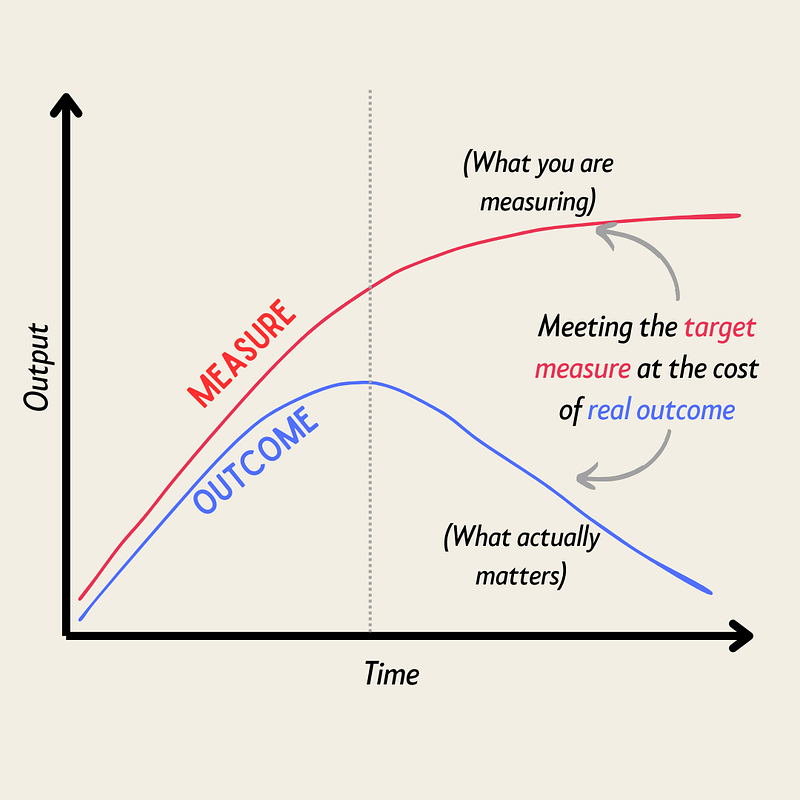
Many years ago I worked at a software company, and the company conducted what they called “bug bounties”. The Quality Engineers who would find the largest number of bugs would get rewarded.
Ring some bells?
The problem with incentives like these is that they are unintentionally setting the measure as the target.
As a leader, if you focus solely on achieving specific metrics or targets, you may unintentionally incentivize behaviors that optimize for those metrics at the expense of broader organizational goals. I call those “true goals”.
In the software bugs example, the “true goal” of the organization was to improve the quality of the products. The number of defects logged was just a metric.
In the cobra example, the “true goal” of the government was to make the city safer for the citizens. The number of dead cobras was just a metric.
Cobra-proofing Your Goals and Metrics
So, how do leaders avoid the trap of Goodhart’s Law? In other words, how do you cobra-proof your goals and metrics?
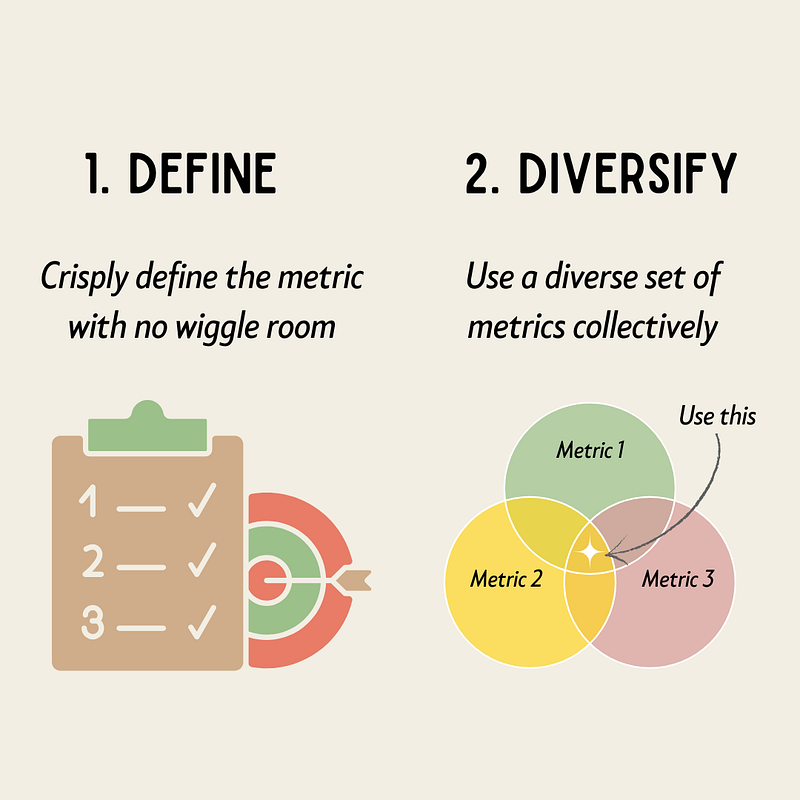
You can use a simple 2-D formula for that: Define and Diversify.
1. Define Your Metrics
First and foremost, you need to define your metrics.
The clearer and more specific your measures are, the fewer chances of people misinterpreting them, or twisting them to their advantage in ways you didn’t foresee.
In the cobra example, the government could have added “Only wild cobras accepted”, though I can only imagine how they would verify that when presented with a dead cobra.
This brings up another important point: the metric should be measurable in a reliable and repeatable manner. Ideally, it should have an exact calculation — a formula — that can be run on a computer.
I always prefer to have metrics presented in live dashboards rather than human-generated PowerPoint decks.
Ultimately, your goal is to make sure there is no wiggle room for misinterpretation.
2. Diversify Your Metrics
Avoid using a single metric, or closely related metrics. Instead, use a diverse set of metrics collectively to measure the “true goal”.
It’s easy to work out how to stretch the definition of one or two metrics or targets to game the system. But it’s a lot harder when there are several of them, especially those that don’t directly relate to each other.
For example, if you are looking to increase your sales revenue:
- Alongside sales targets, you can also measure customer satisfaction and employee engagement
- Adding customer satisfaction as a measure ensures that your sales team members are not overly aggressive when pitching the products, and they are selling only to the “right customers”. The last thing you want is a high sales revenue at the cost of customer trust.
- Adding employee engagement as a measure ensures that the sales targets set are challenging yet attainable, and that the sales team members don’t end up burning themselves chasing unrealistic targets.
Your goal is to have metrics that don’t correlate with each other, while maintaining a good counter-balance that makes it difficult to skew or manipulate.
In Summary: The Cobra Effect and How To Avoid The Trap
In this article, we discussed the Cobra Effect, and how that exemplifies Goodhart’s Law.
According to Goodhart’s Law, when a measure becomes a target, it ceases to be a good measure.
As a leader, you need to pay attention not just to setting your goals, but also to the metrics that measure progress towards those goals.
Two steps you can take to counter Goodhart’s Law (the 2-D Formula):
- Define Your Metrics: As you define your metrics, make sure to leave no gaps or wiggle room for misinterpretation. Clearly defined metrics ensure that what is being measured is what was intended.
- Diversify Your Metrics: Use a diverse set of metrics that counterbalance each other. This balance makes it harder for the metrics to be manipulated, and ensures that they help you reach the true goal.

If you liked this article, you may want to check out my eBook The Ultimate Leadership Toolkit. In the book, I summarize Goodhart’s Law along with 50+ leadership frameworks across 20+ categories. The book is in PDF format, and you can easily print and refer to it at your convenience. Medium members enjoy a 25% discount on this book using the coupon code MEDIUM25!
Like my writing?
If you liked this post, I would appreciate some claps👏 as a form of encouragement. Thank you!
To read similar content you can follow me (Gaurav Jain) and subscribe to get these posts delivered directly to your Inbox. Check out my profile for other ways to connect with me.
Feedback is a gift! I would love to hear your thoughts and suggestions in the comments below 🙏
Related articles:


