The Claim: Sade’s Early Years and her Complicated, Conflicted Blackness
Did you know Sade was in a film that makes a fetish of her Blackness? At the beginning of her career, Sade had to navigate the uniqueness of her music with the way white people regarded her Blackness.
“This year the fairly intelligent American will be allowed to make his own decisions about Sade. Her looks will work for her commission-free, as will her down-to-earth approach to unpretentious charm. One problem she does face, because of a heavier emphasis on her heritage, is deciding to present herself as a black or white artist. One may not wish to differentiate between the two, but the music industry requires it.”
–Jessica Berens, SPIN Magazine, May 1985
“Feast Your Eyes on a Vision!”
Critics and the public did not enjoy Absolute Beginners.
The 1986 film was a big-budget musical drama showing Britain transitioning from the jazz-influenced 1950s to the rock-inflected ’60s. The plot follows a teenaged boy named Colin trying to get the attention of a career-oriented gal in a neighborhood swelling with racial tension, with the self-titled David Bowie song anchoring the entire thing.
“The results are erratic, especially in the musical set pieces, where style reveals character” Caryn James of the New York Times wrote. It lost nearly £3,000,000 and, according to Wikipedia, was the death knell of Britain’s film industry.
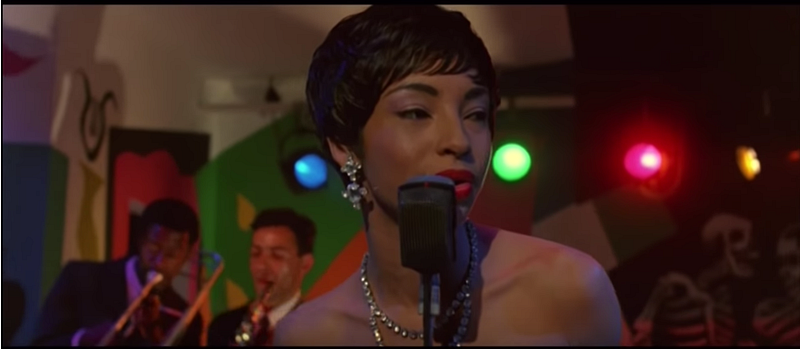
An hour and six minutes into the film (I watched it so you wouldn’t have to!), the Empress takes the stage. “Feast your eyes on a vision!” Big Jill exclaims as Sade, resplendent in an emerald dress and red lipstick, sings “Killer Blow” in the role of Athene Ducannon. The dancers are Black. Her backup band is mostly Black. The Black trumpet player smokes a joint, and then comes offstage and offers it to Colin; he proceeds to enjoy Ducannon’s performance through the haze of THC. It is all hilariously gauche about this white boy getting a taste of Black performance.
Sade got less than four minutes of screen time. Her brief performance sets up the paradox around her relationship with Black personhood at the starting point of her fame. The film firmly entrenches her in white-created tropes of Black art and performance. Yet the opposite was happening in the world of chart-topping albums and musical acclaim. The mainstream media of the time was distancing Sade from the very Blackness the film said she belonged.
“Traditional Jazz Album”
Sade’s seemingly overnight success confounded the music world in the 80s. She dropped her albums Diamond Life in 1984 and Promise in 1985, the only time in her career where the band would output content so rapidly. Her first album peaked at #5 in America, with the second eventually obtaining the top spot.
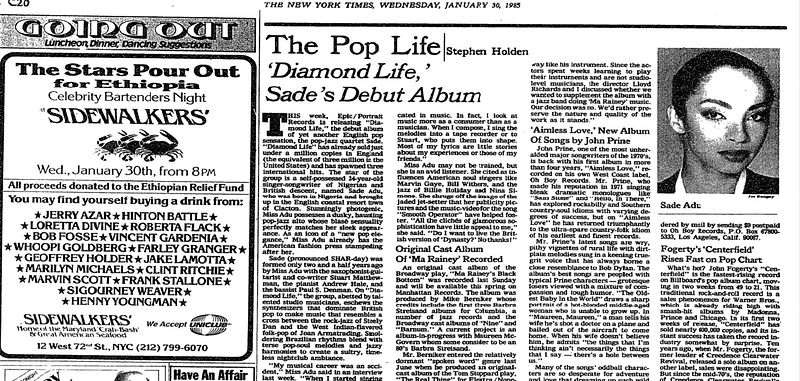
Reviewers quickly went about constructing her halcyon origin story. Legend has it that she was the child of a Nigerian man and English woman who spent the first 11 years of her life being raised by her father in Nigeria before moving to cold, cold Holland-on-Sea. She was always going to be an artist. She took her time deciding her medium. She went to school for fashion, and while dancing her night away through London’s nightlife with her brown skin and husky voice, a band called Pride recruited her to sing. Bored with their unfocused fusion of music, she took the key instrumentalists with her, formed them around her voice and persona, and quickly built up such hype that they were able to sign a deal that allowed them creative freedom and ownership of their masters — all at the tender age of 25!
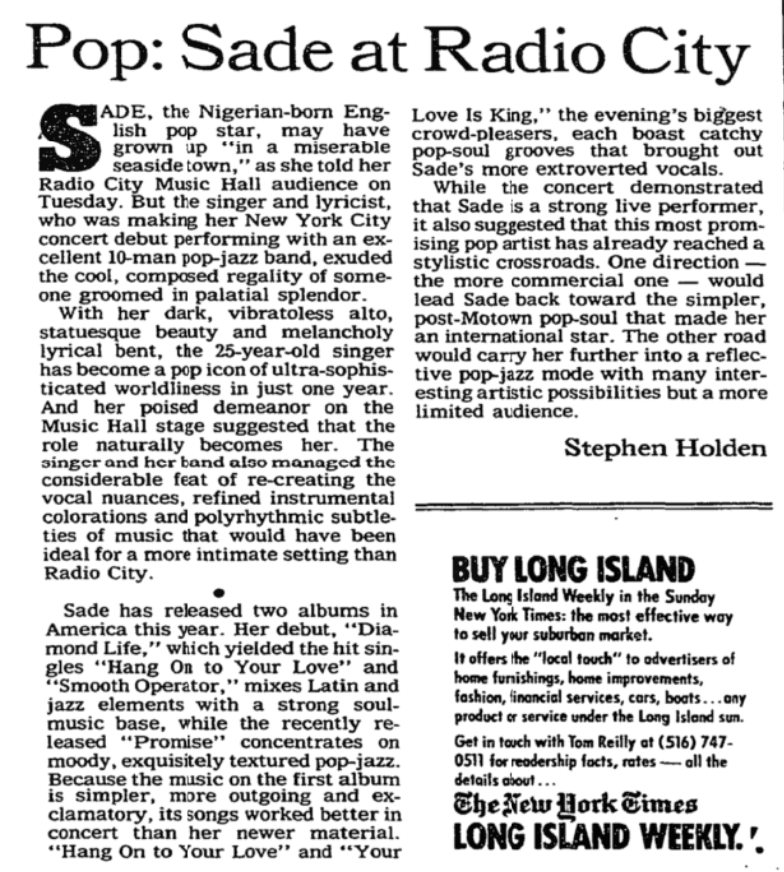
Listeners claimed she sounded nothing like her contemporaries. Her albums shared the charts with Prince’s Purple Rain and Around the World in a Day, Tina Turner’s Private Dancer, The Pointer Sisters’ Breakout, and New Edition’s and Whitney Houston’s self-titled albums. Critics were quick to point out that Sade’s tone and live instrumentalization made her distinct from the synth-driven music of her contemporaries.
These types of proclamations, however, would only be true by completely ignoring Prince’s virtuosity. He had mastered many instruments and many of his hits at the time were also backed up by his band, the Revolution. Ignoring Prince’s success was impossible, and not making comparisons to Sade seems bizarre when looking at their chart histories. So — why did it occur? The music industry was so adamant about Sade’s cleaving from her Black contemporaries that Billboard put Diamond Life and Promise in their Traditional Jazz Album category. While her first two albums are jazz driven, their lyrical nature should have precluded them from being on the list. Her placement on the lists of what is considered the most artistic music Black personhood has produced only served as an elevation to estrange her from her peers.
“They Have to Categorize Things”
At the same time, Sade took an #allivesmatter stance toward her music — owning her influences, then stating that the consequences of her muses belonged to the world.
“I’ve always listened to black music because I like the sound of the black voice, so it wouldn’t be bad to be successful in the same place I have always loved” she claimed at the end of a 1985 SPIN Magazine interview with Jessica Berens. Yet, earlier in the text, she also said that “Music is something which should be available to all people. When you go into a club there is no color bar on the dance floor, so why should it apply to radio stations? Unfortunately it does. It does not only apply to black and white, it also applies to heavy metal, pop, all that.
“It’s such a big place with such big corporations everywhere that to feel safe they have to categorize things.”
There are many things I know I am not accounting for when sketching Sade’s relationship with her Black personhood. Her early life in Nigeria and cold, cold Holland-on-Sea. How she navigated her racial identity, and how different it must be to do so across the pond. What it felt like being the bronzed belle in London nightclubs, courted by the young and the sexy, the world finally off your shoulders and firmly in your hand at so young an age. There is so much I cannot know.
But what I do know is how white supremacy reacts to an aspect of Black personhood it desires. It acquires, then separates, and finally claims that its acquisition belongs to the entire world. It has happened with blues, and jazz, and R&B, and hip-hop; Black excellence simply becomes excellence and becomes a testament to the human spirit versus a product of Black genius.
Despite the Empress believing her hype about her cosmopolitanism, Black personhood made its claim. Before #blacktwitter, we had magazines like Ebony, Essence, and Jet that served as our cultural gatekeepers. Our elders saw her, and saw themselves, and made sure to herald it.
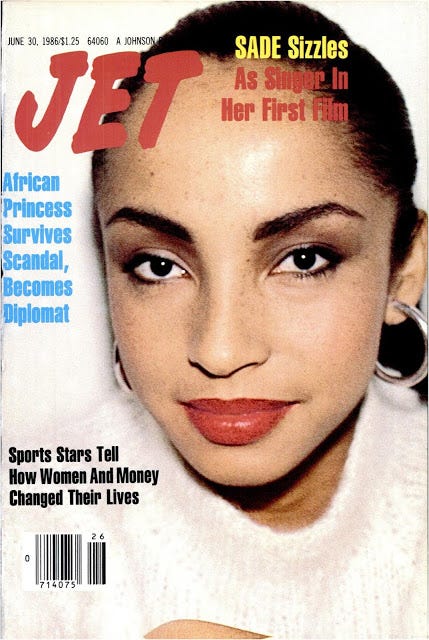
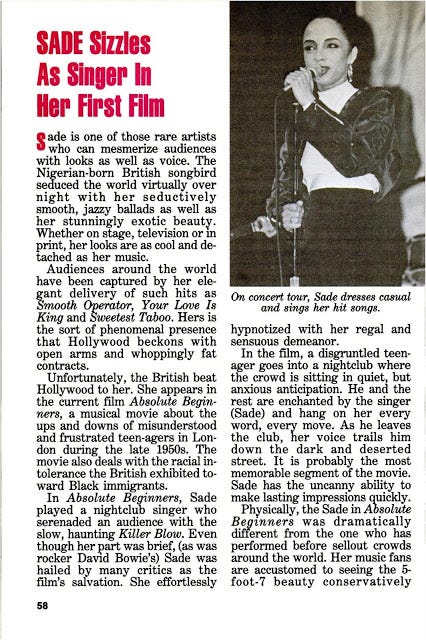
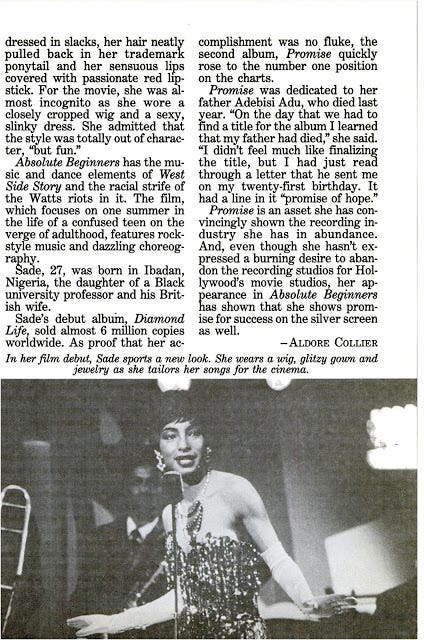
There is no greater evidence of our claim to the Empress than Aldore Collier of Jet sat through Absolute Beginners just to write two pages of copy on Sade’s performance. Remember — the movie was horrible! Yet Collier gushed about Sade’s performance. “As [Colin] leaves the club, her voice trails him down the dark and deserted street. It is probably the most memorable segment of the movie” Collier writes. A repository of Black personhood would have no interest in watching a British bomb of a movie in 1986 unless a part of it stroked a nerve in Black culture. That nerve was Sade. She belonged to us — even if the world worked hard to not have it that way.
If you want to read more on Sade, please read The Dignified Child: In Her Music, Sade Answers the Great Question of the West!