
The Cedar Tree of Lebanon: Our Heritage?
The Open Letter to King Charles that I Never Wrote: Save our cedars
Your majesty,
I know how much you believe in the beauty of our natural world. Therefore, as you convalesce after your recent operation, I wish you well, and wonder whether you will have time to read this letter. This letter is about our shared heritage, something ancient and wonderful hidden in plain sight.
Up and down the country, The cedar of Lebanon resides. I have caught sight of it in gardens in Bath, Kingston-upon-Thames, Clifton, and even small towns and villages in humble back gardens.
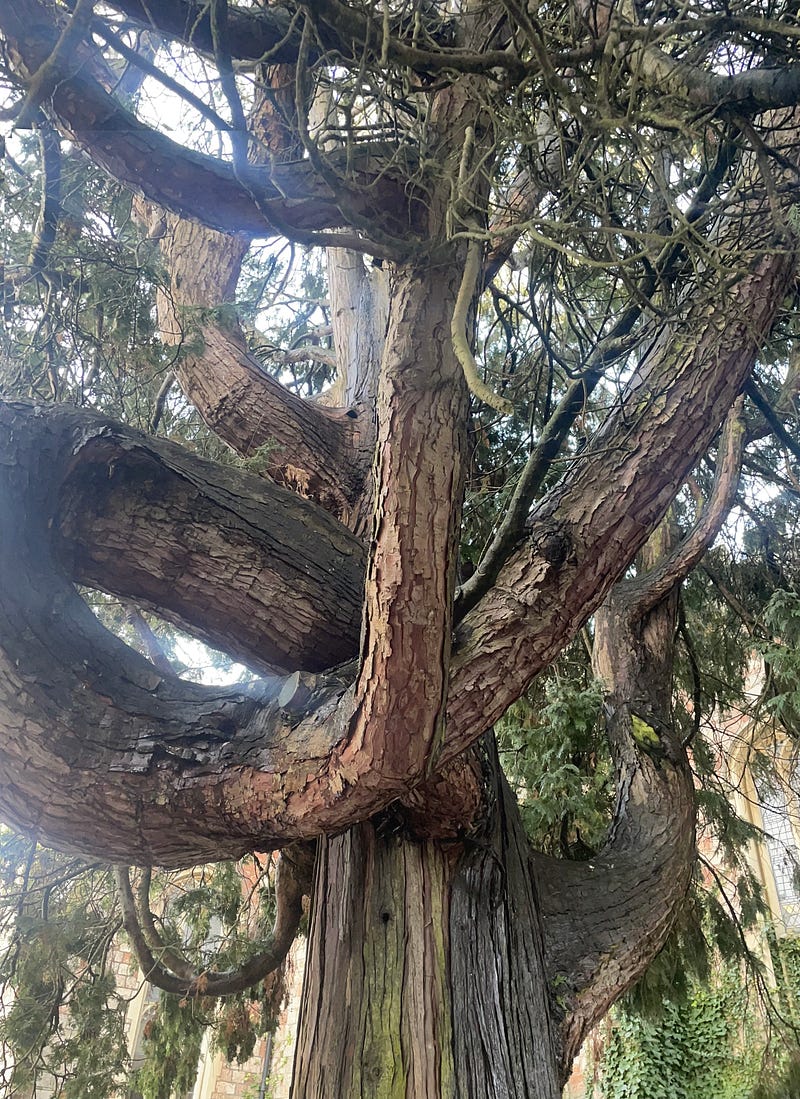
There is no match for this tree, which has a habit of growing in a staggered way making room for the eye to rest on the silky matt green fronds which stretch outwards, like the arms of a bejewelled queen. It has an ethereal beauty, your majesty, unmatched by any other tree.
The cedar of Lebanon resides a stone’s throw away from many family homes in our gardens and churchyards across England. I wonder whether you know of it? Yes, it is unmatched. Unmatched.
Thankfully, most of the cedars I have seen (There is one in a garden in Sturminster Newton opposite William Barnes School), I believe they are all the same species, are in private gardens or churchyards. And yet other cedars are being cut down in their prime in parks.
I write this letter, your majesty, because I am constantly seeing 400-year old cedars being felled across England. In Bath and Bristol only a few weeks ago a favourite tree I used to visit was cut down without notice. The girth of most of these trees is so wide, I estimate the age, of course; 200 to 300 years old. This fills me with dismay. Why are we culling ancient trees in fields and parks?
Your majesty, these ancient trees in gardens are perhaps more threatened than they appear to be. What will happen to the cedars of Lebanon in decades to come when developers buy the land that is now private if we are so indiscriminately destroying the cedars in our parks?
Perhaps these non-native trees appear to be threatening our native trees by taking resources; water and light, and I have been told so, and that they are invasive, but trees in private gardens ought to be assessed by individual merit by experts in conservation. (I am not an expert, not an arborist or a surgeon, just a gardener and writer who loves nature; however, I want our heritage to survive, and I think you do too your majesty). Therefore, I wonder whether a counterintuitive response might be needed. Please save the cedars of Lebanon. They are our heritage.
Since the planet is warming, might we need these drought-resistant trees in future, or am I barking up the wrong tree, or worse, barking mad? Do you have a cedar of Lebanon in a town, village, or city garden near you?
I have observed these trees growing in stature year after year for five decades.
Is there a cedar of Lebanon in a private garden near you? What are you able to do to ensure the longevity of these incredible trees and to protect them, your majesty? Make haste before it is too late.
Your humble servant,
#saveourtreescedarofLebanon
Dear readers, I wrote this a week ago. I am very selfish, apparently, because these trees are invasive (I am told the word ‘indigenous’ isn’t PC, and therefore, I shouldn’t use it. In the 1970s we used the word, indigenous to refer to plants that were non native. Ah, well, now we are educated, I suppose.) Yes, I do realise that many of our plants and flowers originate from North America, and being a student of literature, I know the Victorians planted many exotic trees which they bought to fill their gardens and walks.
However, time slips on. Will we regret the loss of our mighty cedars one day? Will we learn that we have been too hasty in culling these trees? What do I know? I am not educated enough to fully understand the term invasive species.
I do know that once upon a time we had woodland where now we have built up areas and heather where we now have woodland. What I do know is that I have driven past these cedar trees in my car and admired their majestic beauty. And, yes they are providing shade and, perhaps, more than we are yet educated to realise. They feel like home to me these towering trees of Lebanon that stand tall through generations.
I read somewhere long ago that the cedar of Lebanon represents peace and eternity.
After writing this, I took pause to consider the idea that I may be wrong. Perhaps it would be better to return to our native condition, whatever that is. And that is the point. We were once part of Europe, not detached from it and naturally our flora and fauna reflected that.