
The case that Jesus was raped
A Christian scholar suggests a #MeToo messiah
When I set out to learn about the sexual teachings of the Bible, I came upon a scholarly paper that was shocking, horrifying, and mind-bending.
I’m returning to David Tombs’ “Crucifixion, State Terror, and Sexual Abuse” to understand the history of how it was written, and update its conclusions.
Trigger warning: Everything horrible in human experience is here.
In 1998, Tombs was an Anglican graduate student in London.
He was studying the history of Liberation Theology in Latin America. A brief account caught his attention—just a stray line in a book. A female health worker had been tortured and killed in El Salvator in the early 1980s.
The details were excruciating. She had been gang raped, then dragged to a town square, where a soldier poked a machine gun into her rectum, and fired. She was three months pregnant.
Tombs felt he had to study this scene. It was a category not usually examined by scholars: sexualized state terror.
He writes later:
“This story made me aware that acts of extreme sexual violence should not be dismissed and ignored as unexplainable horrors. Instead they needed to be examined as intentional acts with layers of meaning.”
He thought about the way in which agents of the state use sexual violence in the course of state terrorism. The woman had been tortured in such a public and theatrical way.
And then he was thinking about Jesus.
In 1999, he published “Crucifixion, State Terror, and Sexual Abuse.”
Over the next decades, he published several more papers on the subject. This was all in the ‘genre’ of Liberation Theology, largely ignored by Bible scholarship, and totally ignored by the Christian public.

For Christians, the crucifixion is how they get ‘saved’.
When the religion thinks about Jesus on the cross, the central thought is them getting to Heaven after they die. Somehow, his death made that possible.
On the primary level, however, the gospel narratives do not describe a religious event. When Jesus is crucified, this is the punishment of a political dissident by the ruling government.
Not much is known about crucifixion. It was practiced in Rome for over a thousand years, and yet there’s little surviving description. A few writers referred to it. Cicero called it “the most cruel and disgusting penalty.”
Seneca recalled:
“…some have their victims with head down toward the ground; some impale their private parts; others stretch out their arms on their crossbeam.”
But mostly, crucifixion was just not discussed.
In a 2017 paper, Tomb wonders about that curious silence. He finds it pregnant with meaning. The experience was so horrible, he suspects, that it “should not be spoken about, or even mentioned, in respectable society.”
The gospels narrate the experience, scene by scene. The Christian reader may not realize: this was a story about a deeply tabooed event. It is the darkest and most terrifying experience in the Roman world.
Crucifixion was not just a violation of the body, but of the soul. The largest effort, Tombs finds, was to make the victim “believe that God would reject them and that they would die alone.”
Indeed, one thinks of Isaiah 53:3, in which the messiah is said to be “one from whom men hide their faces” — and understand: this is more than an observer can bear. It goes beyond everything.
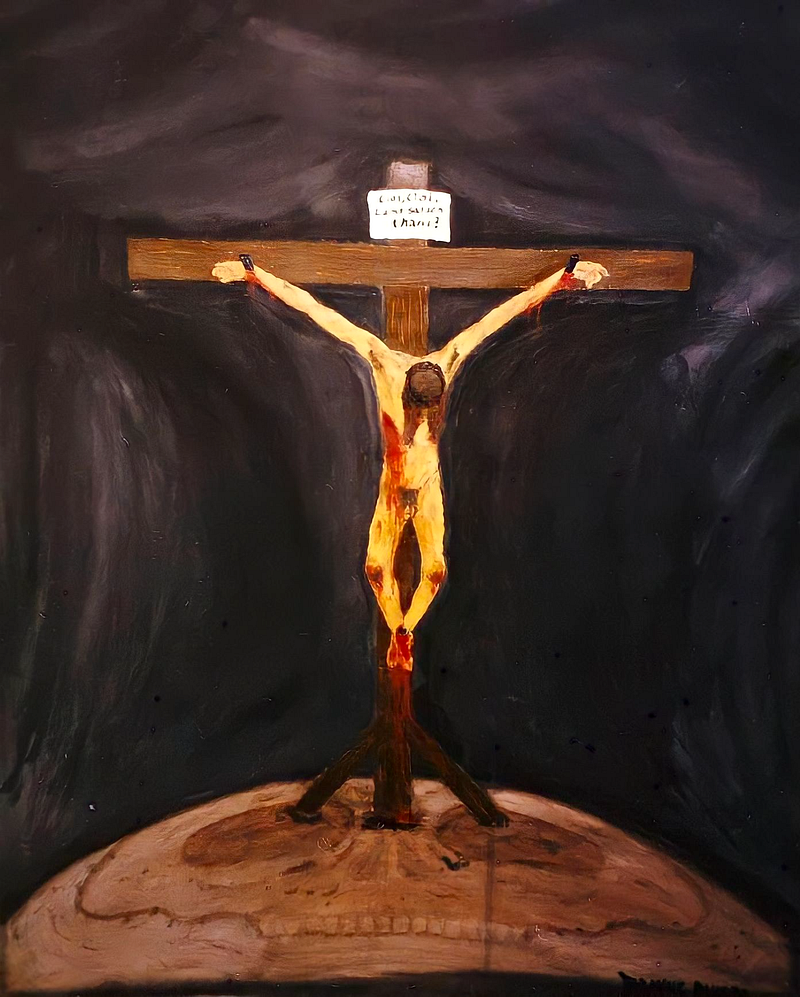
Crucifixion long, painful, bloody—and sexual.
The ordeal described in the gospels is given erotic suggestion. It begins with Jesus being kissed. Scene by scene, then, he is slapped, stripped, scourged, flogged, nailed and pierced.
Tombs wasn’t the first scholar to find a dark eroticism in this progression. Another 1999 paper, “The Displaced Body of Jesus Christ,” had another Anglican scholar, Graham Ward, discussing the crucifixion as the “sexually charged manifestations of desire in conflict.”
But Tombs discussed it in more detail as a darkly erotic narrative. Jesus clothes are torn off. Now he is naked. Christian depictions have Jesus with a little loincloth. As Tombs writes: “These images distance us from the biblical text, perhaps because the sexual element has been too disturbing to confront.”
The crucifixion itself is a kind of rape.
The male victim was hoisted up onto the wood beam that represented the power of the state — erect and triumphant, penetrating all enemies.
A bolt was apparently often driven through the groin. Sometimes the victim was castrated. The suggestion was clear. As Tombs writes: “The cross held up the victim for display as someone who had been — at least metaphorically — emasculated.”
In the Roman world, the dream was to be masculine. This meant controlling, and penetrating others. But crucifixion was the horrifying reversal. The victim was caught, pinned down.
In a 2002 paper, Tombs tracks how, into the modern world, state abuses against male victims seem to be intent on feminizing them.
In the gospels as well, he notes, there can seem to be “a transgendering dimension to Jesus’ humiliation.”
Was Jesus physically raped?
The gospels are a little cagey about this possibility. After stripping Jesus, the Roman soldiers take him away to be “mocked.”
This seems to be an important stage, mentioned in all the synoptic gospels (cf. Mt 27:29, 31; Mk 15:20; Lk 23:36). But we don’t get too many specifics about what was involved.
Roman soldiers were famous for male rape. The Roman writer Seneca noted that “bad army officers and wicked tyrants are the main sources of rapes of young men.”
At first, Tombs didn’t take a position on whether the rape of Jesus was suggested, except to add in a footnote: “It is quite possible that Pilate deliberately handed Jesus over to be sexually assaulted by his soldiers as part of the crucifixion sentence.”
But he kept thinking about it. In a 2014 paper, he notes:
“It would not have been unusual if Jesus had suffered in this way; on the contrary, the impression is that it would have been unusual if he did not suffer in this way.”
Tombs studied the Holocaust, and had a new idea.
He found that when Jews were tortured by Nazis, the methods used were often ones that Jews would find especially upsetting. The Nazis, that is, delighted in whatever would be a ritual violation for Jews.
Tombs reflects on first century Rome, where Jewish culture was deeply hostile to male homosexuality. Could this suggest what Romans would’ve naturally thought of as a means of punishing Jesus?
The Bible doesn’t downplay the torture of Jesus.
We’re to see the Crucifixion as shocking, horrifying—a scene so evil one would not talk about it. A scene that can’t be be discussed.
To skeptics of Christianity, after all, the crucifixion was a sure sign of the Jesus story being fake. If the deity had been “punished to his utter disgrace,” as the skeptic Celsus noted, how great a god could this be?
But the suggestion is still very surprising: not only did Jesus endure this agony, but he rejected the shame and disgrace that went along with it. He shows up after dying — just radiant.
The Bible is actually full of male rapes.
Though Christians try to read the scriptures as affirming male power and male rulership, the Bible is a long story about the pulverization of the male body. Story after story has men in states of total humiliation.
I won’t count Sodom—since there was no rape there. But just afterward, Lot is raped by his daughters (Gen 19:33–35).
In Genesis 21:9, two boys are ‘playing’, as Ishmael does something very upsetting to Isaac — translated as ‘mocked’. The very word used of Jesus.
Sometimes the translation is ‘playing’, as if the boys are doing some roughhousing. But when Isaac’s mother sees it, Ishmael is sent away. That suggests a very serious concern.
The religious reader may wish to rush by the scene, but scholars often mention that the Hebrew word translated ‘mocked’ “can also have sexual connotations,” as a scholar notes.
In a 2010 paper, the scholar David J.A. Clines says that “homosexual sex” is clearly happening between the Isaac and Ishmael — the older abusing the younger. I wrote to Clines asking if he could comment on the ‘mocking’ of Jesus. He replied: “Sorry I don’t have the time now to respond to your interesting point.”
And I wondered, again, if Christianity knows more than it will admit.
There are many more male rapes in the Bible.
Ehud is raped in Judges 3. The English translations bury it in mistranslation. “The number of scholars who have resisted reading this as male-on-male sex is really quite astonishing,” notes Christine Mitchell.
Samson is raped during his captivity. As Shalom M. Paul notes, the ‘grinding’ in Judges 16:21 is a sexual suggestion. The superhero’s kids are greatly desired by his enemies, and the verse suggests that the Philistine men brought women to the prison to be impregnated by Samson.
When Ruth makes an approach to Boaz at night, it is an attempted rape.
The rape of men by men seems to have been well-known in the world of the Bible, since King Saul fears being raped by the Philistines (1 Samuel 31:4; cf. 1 Chr 10:4), though it is translated “toyed with.”
Saul kills himself by falling on his own sword to prevent himself from being tortured in that way.
In the Bible there’s sexual evil of every kind.
And there is the usual human unwillingness to face it. But the Jesus story insists that divine love prevails even in these dark moments, and there is no shame. As Hebrews 2:2 puts it:
“For the joy set before him he endured the cross, scorning its shame, and sat down at the right hand of the throne of God.”
As Jesus rejects sexual shaming, so can we? David Tombs presses on in a 2020 paper to see Jesus’ crucifixion as a cosmic #MeToo story—allowing the recognition of evil acts in a sacred experience of understanding.
Maybe that was the “good news” from the start? 🔶


