
‘The Cartographers’ is a Big, Big Book
I’m glad I read it, but is it really just too much? You could read it and find out.
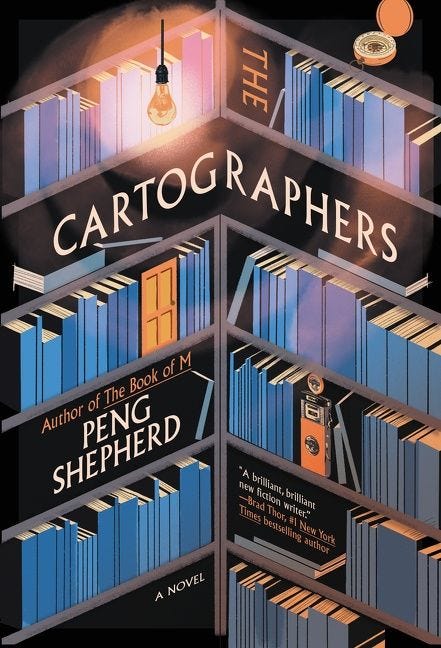
Peng Shepherd, The Cartographers. William Morrow, 2022. (Also audiobook, Harper Audio, 2022.)
Peng Shepherd, the author of The Cartographers, takes a spacious and elaborate dive into the world of map making. The novel is at once an academic thriller, a paean to place, a celebration of adult friendship and its profound hazards, a playing field for magical realism, and a family melodrama.
And that’s not all!
Nell Young and her father, Daniel Young, form a tiny troubled family after the death of young wife/mother and brilliant cartographer Tamara Jasper-Young in a fire, years before, when Nell was a toddler. Nell grows up dedicated to the idea that she will follow in her parents’ footsteps as a cartographer, and she takes her first big step when she parlays her graduate degree into an internship in her father’s Map Division at the New York Public Library.
It was like going home for her, in some ways — she knew the library and its Maps Division inside out, from childhood, when it was a playground and training ground for her. Her father’s frequent emotional distance is mitigated by the nurturing Swann, a leading NYPL maps professional.
But then Nell — and as collateral damage, her fiance and fellow intern, Felix — is fired, BY her father, as a result of a very public argument in her father’s office at the library, about the relative worth of a set of maps she finds in a “junk box” among the NYPL’s uncatalogued holdings. After her dismissal, which effectively ends her academic career, Nell descends into a seven-year position at a commercial map-making shop aimed at uneducated buyers who want cool-looking maps to hang over their mantelpieces. Her relationship with her father is over.
The angry, bitter, and now-estranged Felix lands on his feet, eventually, at the William Haberman corporation, whose mission is to map the entire world, down to the last detail, for the good of mankind. I mean they do stuff like find missing persons.
Nell’s own exile from academic cartography ends with news of her father’s sudden death at his desk in the library. As she goes through his office to gather his personal belongings, she discovers, in a familiar leather portfolio, the same cheap gas station road map that precipitated her firing seven years earlier.
This is how the story begins. I listened to it rather than reading it on the page (or my Kindle). It is well performed, with multiple voices presenting the many voices of the ten or eleven main characters: the seven friends of Nell’s parents’ generation, her patron Swann, and her estranged boyfriend Felix, as well as, of course, the myriad additional bit players. (To illustrate the novel’s heft, I’ll say that the audiobook is about fourteen hours long.)
Listening rather than reading both animated the tale and highlighted one of my problems with the stylistic decisions. A huge part of the grinding revelation of the buried past is elaborate point-of-view narratives from the surviving friends of Nell’s parents, recalling the traumatic events of twenty-five years before, when their brilliant cartography friendship group imploded in a mess of weird magic, jealousy, infidelity, and intellectual competition. The narratives, solicited by the young woman Nell as she sorts out this big incredible mystery story from her parents’ generation, are often delivered in front of other players in the drama, yet they “read” as stories told in a vacuum….as if the listener/participants would have nothing to say or interject on their own behalf, or as part of a different set of memories. They also “read” as friendly, revealing, detailed stories, whereas the narrators had resisted saying anything at all just moments before. “This is too dangerous, for me and for you — well, OK, here’s the story.” So — maybe more yes/no action needed.
Some of the outcomes of the tale are predictable from the get-go, while others are random, strange, and don’t really help carry forward the novel’s themes. There are also plot holes and motivational mysteries, which the reader must put aside to enjoy the drawn-out, action-filled denouement. I should give examples but I don’t want to inject spoilers here. I’ve gotta say there are a few wtf moments along the way, and I don’t mean ‘wow, who could see that coming?’ in a good kind of way.
Then there are some devices that work. The concept of a phantom settlement is a genuine piece of cartography lore — a spot on a map that represents a place that doesn’t exist, and is either a mistake or a ‘copyright trap’ — a way to demonstrate that a company has copied the work of another company by putting the same nonexistent settlement on their maps.
Such a phantom settlement is the device on which the narrative turns in THE CARTOGRAPHERS, and I must say that I really don’t like magical realism and, yes, I was really impressed by and drawn into the phantom town at the heart of the story.
The main character, Nell, is pretty obnoxious. I love strong heroines, but this strong heroine — not uniquely — is at a number of points just annoying and occasionally not credible. She doesn’t listen. She is sometimes slow on the uptake (of course, that is undoubtedly part of the author’s piece by piece revelation of the mystery at the heart of the story).
On the other hand, I’m the reader who always whispers, “Don’t go down those stairs. Just don’t. Back out the door, get in the car, and drive away.” So I’m not the greatest judge of the protagonist who moves the action in a thriller. Still….Nell wavers, for me, from admirable to “you’re kidding me — come on, ask that informant a different question now.”
As for the too many themes: oh my gosh. Professional jealousy and competition, professional integrity versus human passion, human passion versus professional obsession, parenting good and terrible, family secrets, friendship and betrayal, lifelong regrets, lifelong missions turned deadly — and so on.
At the beginning I asked if The Cartographers is too much. I also have to ask, regarding motivation and character development, if in some spots it is too little.
We know the bad guy early on, so early that of course the reader has to question whether he really is the bad guy, and there is a bit of a twist to that, but again, kind of predictable. Shepherd does create a smarmy character whom we suspect all the way along, but as a kind of foil she creates a character who might also be the bad guy but — well, there’s a bit of effective sleight of hand there.
I am coming down critical, and so I’d also say that this is a smart novel that creates a world justifiably tempting to immerse yourself in. I think it is important that the magic is not the most important part of the story, because the magic is just too easy (and this is from a Harry Potter devotee). As a mystery/suspense junkie, I would feel betrayed by the magic if it were critical to the themes of the story, if that makes sense — if there were no other ways to deliver the drama and surprises of the narrative. The magic is not consistent and can’t carry the weight of the real life characters.
Another thing that I like about the novel is that it crosses, or blends, so many genres. I said that it has too many themes. It kind of does. But its genre-crossing is comforting and makes the story more real (despite the magic. OK, maybe I should say it makes the magic more real). It is mainstream fiction, speculative fiction, magical realism, thriller, mystery, love story, and family melodrama, all at once.
And it is huge. December is a good time in many parts of the world to bury yourself in an immersive narrative. If you can overlook some of the, um, wrinkles, go for it.
If you listen instead of reading, don’t miss the PDF extras that you can find either with the audiobook or as a separate download from HarperCollins. They include the gas station map from 1930 (the core artifact in the story) and the maps of the NYPL referred to in the novel.
At the end of the Harper Audio version is an interview with Peng Shepherd by the “Book Club Girl” podcast hosts. A nice extra. Among other things, Shepherd talks about the real-life phantom settlement case that inspired the novel.
A couple more of my thoughts on books:
Thanks for reading!