
‘Bad Gays’ — Gotta Love The Title
Review of this new queer history
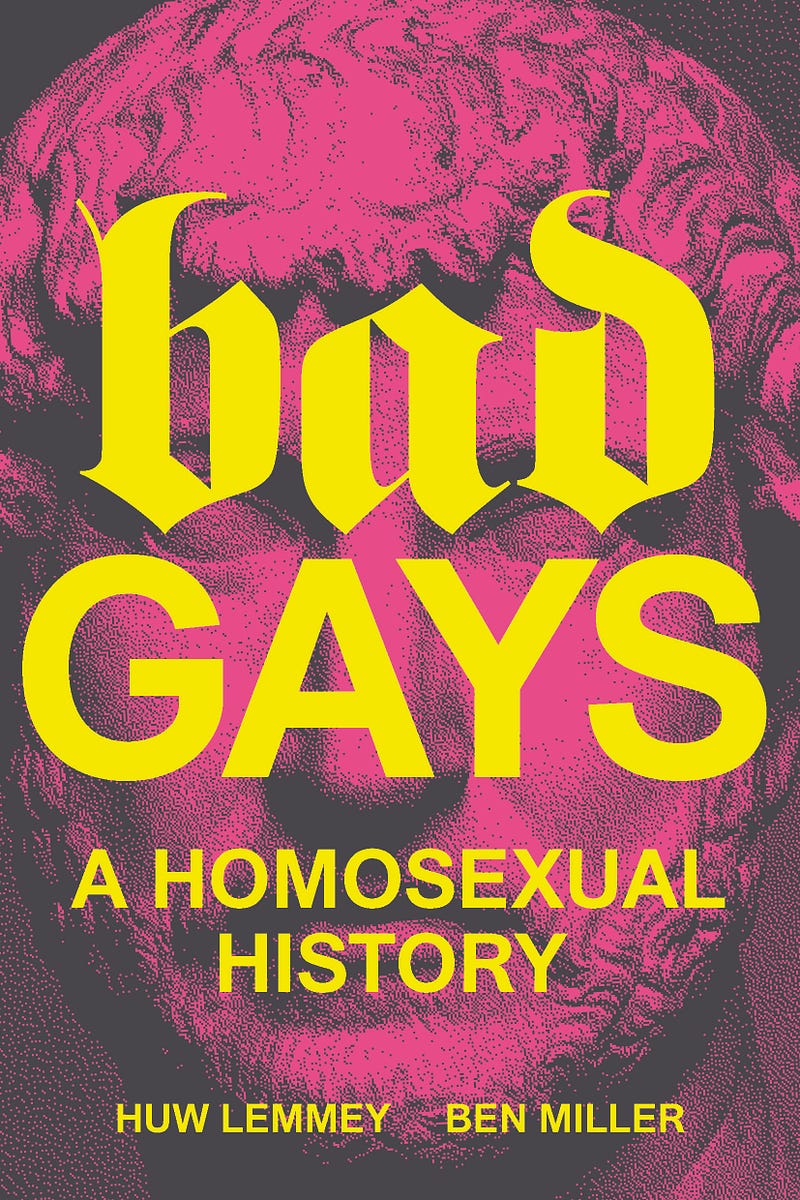
A book review of Bad Gays: A Homosexual History, by Huw Lemmey and Ben Miller.
The fascination of this book, published by London’s Verso Press in 2022, goes beyond the title, which is way better than mere clickbait. Lemmey and Miller want to expand our understanding of queer history by wedging it open to include homosexual people who don’t figure well in our pantheon of heroes (and heroines).
“If ‘gay’ is an imprecise term of convenience, so is ‘bad’. While some of the folks in the book are, without doubt, bad — fascists, murderers, and other such scumbags — many are a bit more complicated.
….
“Many were profoundly traumatized by the guilt they felt as a result of their sexual desires: pushed by society into lives they found themselves unable to lead, they made strange choices, or ended up damaging the world in their efforts to reform it. Nonetheless, the links between their negative actions and their sexual desires are worth exploring, worth expanding upon.”
— Lemmey and Miller, Bad Gays, Introduction.
The book is a series of portraits of these ‘bad gays,’ from Hadrian through Ronnie Kray and Pym Fortuyn. The portraits are fascinating, lively, erudite, and effective.
What may not be as effective, overall, is the authors’ quest to use these ‘bad gays’ portraits to persuade readers to buy into a new coherent thesis about queer history. Their reframing of the necessity for a fluid and contextually conscious history of ‘homosexuality’ is well presented and not problematic, at least for this reader. Their plea for us to shake loose from the remnants of liberalism’s class-based neo-colonial blindness is well taken and beautifully illustrated in several of the portraits, notably those of Margaret Mead (the only woman in the book!) and Pym Fortuyn, the Dutch anti-immigrant nationalist.
But I think the ‘bad gays’ envelope is at once too big and too tattered to hold the evidence for a sweeping reconsideration of gay history. There are too many types of badness displayed here — and also, really, too many historical settings to hang together.
Still, it’s a wonderful book. I loved every chapter. As a retired university professor who taught LGBTQ+ history, I burned with shame as some of their points shredded a few interpretations that I allowed to survive through various revisions of my course. As I suggested above, embedded in the chapter on Margaret Mead is a succinct critique of the Western anthropological project of the late nineteenth and early twentieth centuries, which they effectively tie to her ideas of sexuality and her own sexual life. While the chapter on J. Edgar Hoover and Roy Cohn doesn’t contain many big surprises, it does offer a lot of fascinating detail on both men’s often despicable lives and careers.
Really shocking to me was the chapter on Philip Johnson, the architect. His overt and persistent embrace of fascism came as a complete surprise to me, and even more troubling was the way he was allowed to paper over his admiration of Hitler’s antisemitic ideology in the years after the war. Johnson really does personify the ‘bad gay’ character: wealthy through family resources, unapologetically reactionary through the 1930s and into the 1940s, able to slither through challenges to his loyalty to the US with the aid of upper class family connections, he was one of the gay men who profited from what the authors characterize as the political rebellion of working-class queers, youngsters, and trans actors — the people who spearheaded the Stonewall rebellion in 1969. By the 1970s he was openly gay in the elite New York circles he inhabited, and when Barbara Walters asked him why he never brought his partner to social events, he reports that he thought, “‘By God, you’re right Barbara’” (Bad Gays, chapter 12, “Philip Johnson”).
In the introduction, the authors capture the dialectic between elites and non-elites that shapes their interpretive framework:
“…[W]orking-class people, colonized people, and people of colour have consistently lived, fought for, manifested, and expressed forms of social and sexual expression that have challenged both social prejudice towards sexual and gender minorities and the bourgeois politics of the gay elite. These challenges have often been bitterly resisted by that elite in their time, while still — owing to their embrace of mass politics and disruptive organizing — having far-reaching effects in our queer lives. Often, after the fact, the queer elite will belatedly acknowledge these people, movements, moments, and struggles in an attempt to incorporate them into the dominant story of what it means to be gay or lesbian or trans, as though the working-class gays and sex workers, drag queens, and trans women of colour at the Stonewall Inn in New York City’s West Village threw bricks at cops in order to win marriage equality for the gay and lesbian donor class.”
— Lemmey and Miller, Bad Gays, Introduction.
Whew, that’s a long, tightly-packed passage. I reproduce it whole because the authors here clearly express that historical conversation that they believe drives gay history and also creates its disappointments.
I like this proposal for its description of what has happened in the last fifty years: the jousting of rising militancy against cautious, somewhat fearful organizing with its attempts to color inside the lines of liberal politics. (Of course, come on, any kind of ‘coming out,’ even since that astonishing 2015 Supreme Court decision, takes courage — now even more, with the states and the courts chomping away at our rights.)
At the same time, I think this dialectic or conversation is too starkly drawn. The nature of class alliances, the intersectionality of class identities, and the fluidity of 21st century society (even, or especially, in our dreams) all make the stark division between “working-class people, colonized people, and people of color,” on the one hand, and social and economic elites on the other, too simple. Yeah, the world is going to the dogs, and yeah, the actual gulf between haves and have-nots has been widening ineluctably, but — the fluidity of behaviors and ideas and alliances and sexual identities across individual and cohort lifespans still muddy the waters, I think. I don’t want my old liberal self to melt away all these contests and contrasts, but I prefer a more nuanced (as they say) analysis.
But in a sense that’s what Lemmey and Miller offer us, through their individual portraits: nuanced, inconsistent, often fractured lives. So — is the whole book at war with itself? Nah. It’s just — complicated.
The early chapters, brilliantly written, on such figures as Hadrian, Pietro Aretino, and Frederick the Great (that one is really cool) don’t support the book’s thesis as well as the chapters about figures thriving after the mid-19th century, probably because, as the authors point out, it is in the nineteenth century that our contemporary discussions about homosexuality began. I know, I’m way oversimplifying, but I think we’ve kind of got two books here.
Still, as one book, this one satisfies. The authors offer further reading and complete notes. I’m always a nerdy sucker for acknowledgments, which in a co-authored book are, not surprisingly, pretty extensive. The book deserves a place in a core library of LGBTQ+ histories and theory.