
[Fractional Calculus Demystified: Part 3] The Caputo Derivative and The Fractional Calculus Wishlist
Disclaimer: After reading this, you’ll have a hankering for exploring fractional calculi and their applications
Hopefully, you’ve come here from part 1 or part 2 of my friendly introduction to fractional calculus. So far, we’ve introduced the Riemann-Liouville (R-L) fractional derivative of order α between 0 and 1.

Recall from part 2, that this operator is phrased as the derivative of an Riemann-Liouville fractional integral of order 1-α. To check the order of the derivative, we can look at de derivative d/dt as adding an order of 1 to the derivative and the fractional integral “taking away” 1-α derivatives. Since we have the derivative of the fractional integral, the order of the derivative is of 1 — (1-α) = α as desired.
One question posed earlier was whether or not there is another way to define the so-called fractional derivative. My short answer is yes, but we should be careful. What I mean by this is that, in the grand scheme of things, these operators and their properties/consequent results will define different types of calculi. We have been exposed to classical calculus with the classical derivative, but there are alternate approaches in analysis!
While there are many others, we will focus our attention to the Caputo fractional derivative of order α between 0 and 1 defined by

They certainly look similar except that the derivative was flipped inside the derivative. Somehow, that makes a big difference. One notable difference is what is required of the function f so that each derivative makes sense. Making sense of definitions is probably half the battle in my experience with math.
I’ll give an example of one way to make sense of the Caputo derivative. It has the derivative of our function f inside the integral. As such, it requires that the derivative of our function f be integrable. One such suitable space is that of the strongly differentiable functions 𝒞¹(0,t) where the derivatives of f are continuous and therefore integrable.
In practice, this space might too restrictive. I’m personally biased towards weaker spaces where solutions to differential equations might exist. You can look for the wider class of functions known as the absolutely continuous functions AC[0,t]. This space is somehow related to the Sobolev space with integrable weak derivatives. We can cover these more technical details in future work.
Put this interpretation in contrast to the Riemann-Liouville case. There, we need the derivative of an integral to make sense. One example of a space of such functions is the Hölder continuous functions of order α.
A Simple But Interesting Example
Having defined our two derivatives, you might as yourself what I meant by different operators bringing out a different calculus. Let’s look at the fractional derivatives of the function f = 1! First, the Riemann-Liouville derivative:
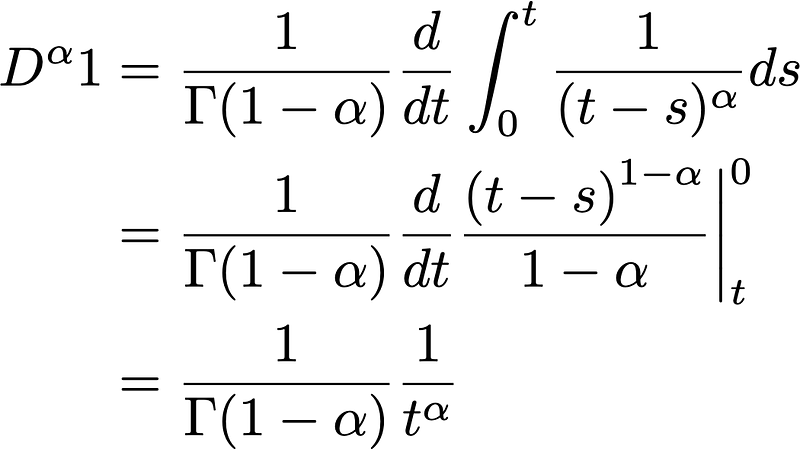
One curious thing to notice is that we took a derivative of a constant function 1 and we received a nonconstant function in t! Recall that the classical derivative of constant functions is 0. Compare to the Caputo derivative of the constant function 1.
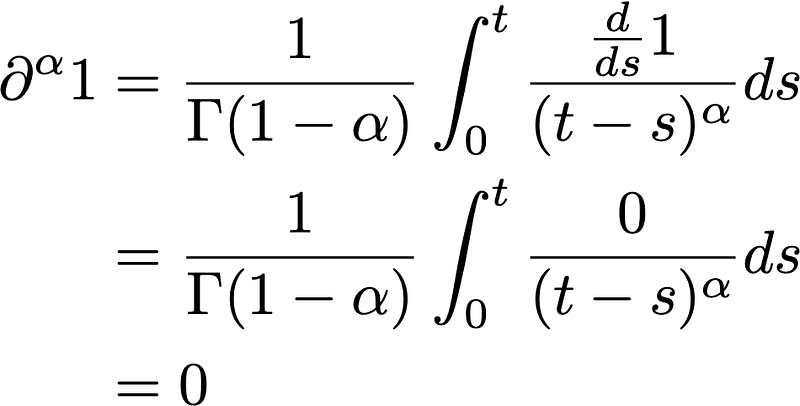
Here, we’ve got that everything zeroes out. Therefore, it is clear that the operators are not the same. One natural question to ask is, if they’re not the same, which one is better? The use of the word better is intentionally vague.
These fractional derivatives are therefore not unique by any means. Personally, I do not think this lack of uniqueness of definition has to do with the pending further development of the field. It simply just opens the door for application specific choice of operator!
For example, when looking at mathematical physics and partial differential equations, an appealing feature of the Caputo derivative is that the derivative of constant functions is 0! The reason is that a solution to a partial differential equation which is time independent will remain time independent. This invariance in time is important in the physical intuition required in applications.
The Fractional Calculus Wishlist
You might ask yourself: okay, if there are many operators are there then no rules by which we have to abide? I thought math is full of rules. The answer is not exactly set in stone but this set of rules proposed by Hilfer and Luchko seems to be spot on. In this paper, they build the fractional calculus wishlist! The desiderata is as follows
- Fractional derivatives and integrals should be linear operators acting on linear spaces. Those of you who are familiar with linear algebra can think of a matrix as a linear operation sending one vector to another vector by means of matrix multiplication. So, it starts as one vector in a vector space and gets transformed into a different vector in a vector space. Same thing should happen here!
- Composition of fractional integrals of different orders should yield the fractional integration of the sum of the orders. That is, if I take a half integral twice, the result should just be a full integral. Or, if I take a 1/4 integral and then a 1/2 integral, the result should be a 3/4 integral. That is the sum of 1/2 and 1/4.
- The fractional derivative of the fractional integral should give you back the original function. That’s something that resembles the fundamental theorem of calculus! This is analogous to our discussion in part 1 of our series regarding the fundamental theorem.
- We can recover the classical derivative and identity operator as the order of the derivative goes to 1 and 0, respectively. This is so as to have an agreement with the classical derivative theory and so our operators maybe serve as interpolation between a function and its derivative.
- The 0th derivative is merely the function itself.
- As the order of the derivative goes to 1, we can recover a Leibniz Rule (Product Rule). We don’t have a clean product rule for fractional derivative operators but we’d like to at least recover the classical one in the limit case.
With some special attention to domains of our operators, the two derivatives we have shown here can be defined in such a way so as to satisfy this wishlist. There are others, of course. I will mention the Hilfer derivative and Riesz deriavtives as some of special interest.
We will continue to explore the world of fractional calculus and its applications! I hope you enjoyed my hand-wavey introduction!
Comment below if you have any feedback! Claps and follows are very much appreciated since they help me grow and make sure you are enjoying this type of content! I look forward to many more articles.
[1] Hilfer, R.; Luchko, Y. Desiderata for Fractional Derivatives and Integrals. Mathematics 2019, 7, 149. https://doi.org/10.3390/math7020149
[2] Diethelm, K. The Analysis of Fractional Differential Equations: An Application-Oriented Exposition Using Differential Operators of Caputo Type. 2004. https://link.springer.com/book/10.1007/978-3-642-14574-2


