
What it takes to bring a new product from 0 to 1
For product managers, founders, startups, and anyone building or considering building a new product.

Product development is often labelled “messy” and “chaotic” but it doesn’t have to be.
Whether you’re at a startup, an established company, or working on a side hustle product, starting with a good bird’s eye view and understanding what the main “layers of the cake” are and how they need to fit together can help greatly to create clarity amidst ambiguity.
While there are many drivers of product development, “The illusion of progress” is often weighed heavily in the equation. Investors, leadership teams, and boards all want results and the faster you can get them the better, right?
Wrong.
There’s extreme value in pausing to take a breather. Assess the landscape before acting.
Here’s my take on setting the stage, how the puzzle pieces of product development fit together, and why going slow actually helps you move faster.
(Note: Each one of these subsections deserves a much deeper dive — this article is meant to focus on what the pieces are, why they’re crucial, and how they connect.)
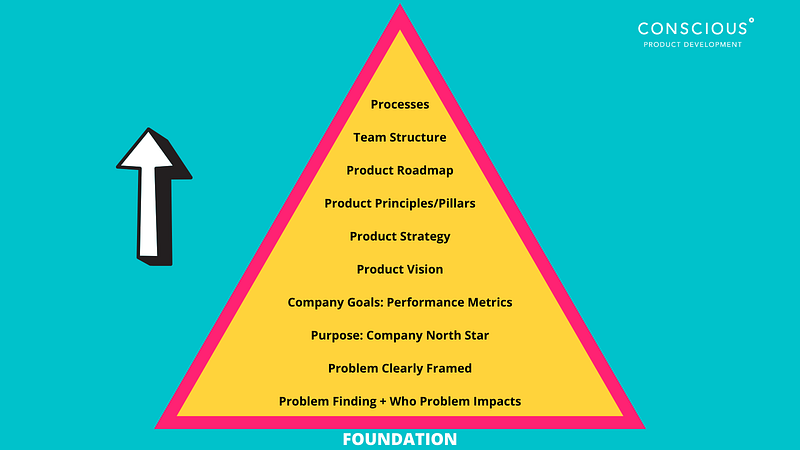
The general idea is to start at the bottom (FOUNDATION) and work your way up if you’re looking to develop a product from scratch (read: startup, solopreneur project, new opportunity exploration at an existing org). If you’re already well on your way but experiencing challenges (i.e. team frustration, too much churn and “throw away work”, customer’s extracting little value from a product you’ve already launched, becoming a “feature factory”, misaligned stakeholders, low confidence in your roadmap and ability to deliver, etc.) this diagram can help you understand where the gaps are and focus on filling them in the right way vs. continuously patching things with half ass bandaid solutions.
Let’s slice some cake.
1. Find the problem
Identify and describe the problem to be solved and the particular group of people it impacts.
Many teams skip this step entirely and jump right into solutions, or do a lackadaisical job defining the problem to be solved and who that problem impacts, specifically. This is not glamorous work and it’s sometimes very hard. But if you can do a great job in this stage, it will dramatically impact every other puzzle piece, reduce churn, reduce the number of meetings and resources wasted, and improve the ROI of your efforts.
There are actually three parts to this step:
- Problem finding
- Identifying the people who are impacted by this problem and how they are impacted
- Validating whether the problem you’ve found and defined is actually a good problem to solve
To make things easier, here is a 7-page guide I put together that addresses this. In addition, Teresa Torres is a rockstar resource for all things product discovery.
2. Frame the problem
Albert Einstein once said, “If I were given one hour to save the planet, I would spend 59 minutes defining the problem and one minute resolving it.”
I strongly believe that spending the majority of your time in the problem finding and framing space enables bringing more elegant (and efficient) solutions to life.
Framing the problem starts with asking questions to understand what the constraints are. You are creating the sandbox that the team has to play in. If you create the wrong sandbox, or if one of the sides is not constructed well, the solution will not be as impactful and valuable resources will be wasted.
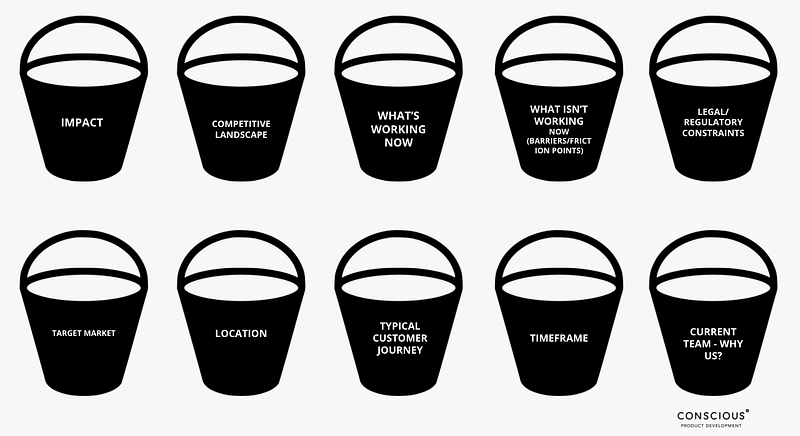
Questions like, “Has anybody already tried to solve this problem?”, “What solutions currently exist to help X population solve this problem?”, “Are these insufficient? If so, why? If not, why? Where are the gaps?”,”What are the regulatory and legal guidelines in this problem space?”, “Are there currently any workarounds to solving this problem?”, “What does the current customer journey look like?”, “What geographic locations do the people experiencing this problem live in?”, and “Why are we the ones that should be solving this problem?” are important to ask in the early stages of product development.
Typically these types of questions can be bucketed into the following categories:
- Problem/solution impact
- Competitive landscape
- What’s working now
- What isn’t working now (barriers/friction points)
- Legal/regulatory constraints
- Target market
- Location
- Typical customer journey
- Timeframe
- Current team — why us?
3. Define your company North Star
What is your company’s purpose? What is the reason your company exists? What does the team believe in? What is the team’s “WHY”? What value is your company adding in the world, for who?
Now that you’ve got a solid understanding of the problem and who it impacts, the North Star for your team should be a unifying statement that can create alignment in an amplified way as things grow.
Some examples of company purpose statements:
- Google: “To organize the world’s information and make universally accessible and useful.”
- LinkedIn: “To connect the world’s professionals to make them more productive and successful.”
- NASA: “To advance and communicate scientific knowledge and understanding of the Earth, the solar system, and the universe.”
If you don’t have a clear purpose that the team can repeat verbatim, the application of your team’s efforts will likely not be very focused.
4. Define what success looks like for your company (Performance Metrics)

What are your company’s OKRs?
What are the most important milestones to hit? Why?
If you could set up a dashboard with 3 key indicators to track performance and know when to adjust course, what would they be?
Key metrics should feed into the North Star/Company Purpose and serve as a way to:
- Create alignment within the team
- Communicate goals
- Measure goals
5. Define your product vision
What is the future you are trying to create?
Some cool examples of simply communicated product visions:
Apple iPod: “1000 songs in your pocket”
Uber: “Tap a button, get a ride”
Dropbox: “A new way to store and share files online that just works”
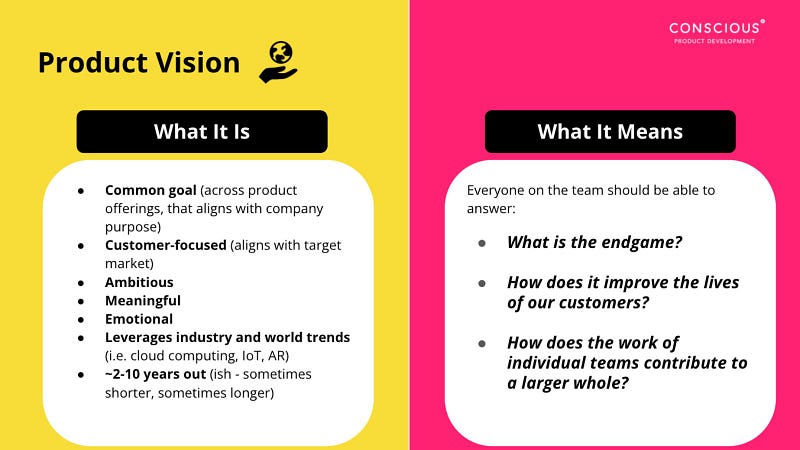
What the product vision is NOT:
- How to get there (that’s the strategy)
- A different goal for each team in the org
- Something that someone comes up with in a silo (needs to be a collaborative effort)
The best examples I have seen that show how to articulate a product vision in a tangible way have come from Marty Cagan and the Silicon Valley Product Group.
6. Define your product strategy
If the product vision is the “WHAT” (what you’re trying to accomplish), the product strategy is the “HOW” (how you are going to accomplish this goal).
Marty Cagan has a great article on this here.
Superhuman CEO Rahul Vohra wrote a great article in First Round Review about Superhuman’s product strategy — building an engine to find product market fit.
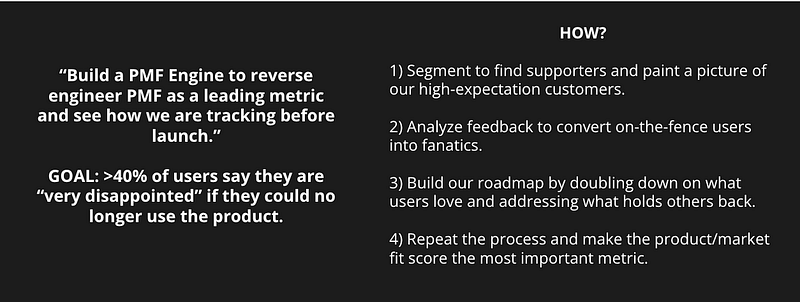
Here are some additional examples from TCGen.
Amazon’s strategy has always been customer-oriented — what does the customer need and how can we deliver that, working backwards after deeply understanding the target market. Apple is more product-driven and has built it’s strategy largely around Steve Job’s legacy and thought process — customer’s do not always know what they want, being innovative and ahead of the curve, and focusing on high-end product/platform/derivatives that are designed superbly, delight, and keep customers loyal to the brand and ecosystem. Google has been a lot more tech driven and has focused on bigger bets — solving big problems in big ways using a market-oriented approach and looking at the long-term developments needed to be a market-leader.
Defining the HOW is crucial to keep efforts aligned and focused to achieve your team’s goals.
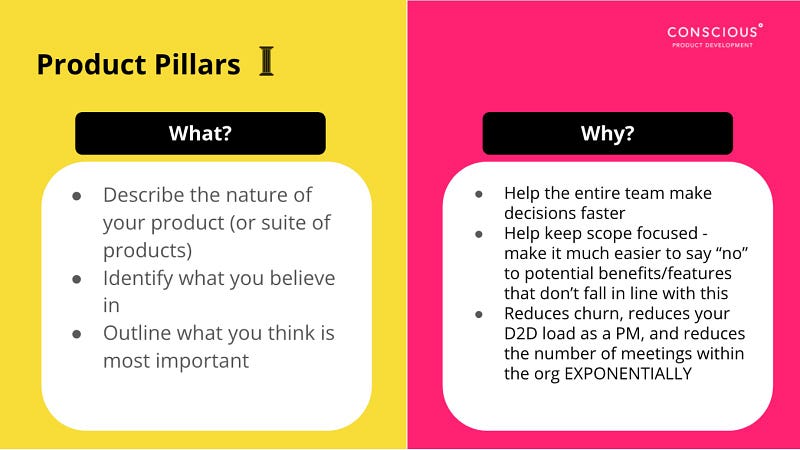
7. Establish product pillars/principles
Product pillars (also called principles or tenants) describe the nature of your product, identify what you believe in, and outline what you (the team) thinks is most important and WHY.
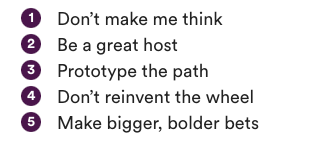
Here’s a great, tangible example of Slack’s product pillars from Ethan Eismann, SVP of Design:
8. Create your product roadmap
At their core, product roadmaps should answer:
- What are we doing?
- Why are we doing it?
- How does this tie back to our company and product goals?
Andrea Saez is a great resource here — I highly recommend her article, “How to Build a Product Roadmap Everyone Understands”.
Product roadmaps should include:
- Company goals
- Product goals
- Users
- Timeframe (milestones and why they are important to hit)
- Problems to solve
- Themes
- What to build + why
- Context and supporting info (i.e. user feedback, business use cases, problems with previously launched solutions, competitor solutions, etc.)
- Prioritization framework
How you choose to bucketize or create “themes” for your problem areas will depend highly on your context. Shreyas Doshi, product leader, startup advisor, and one of the greatest sounding boards when it comes to developing new products, has a great thread that includes ideas for themes for product planning here.
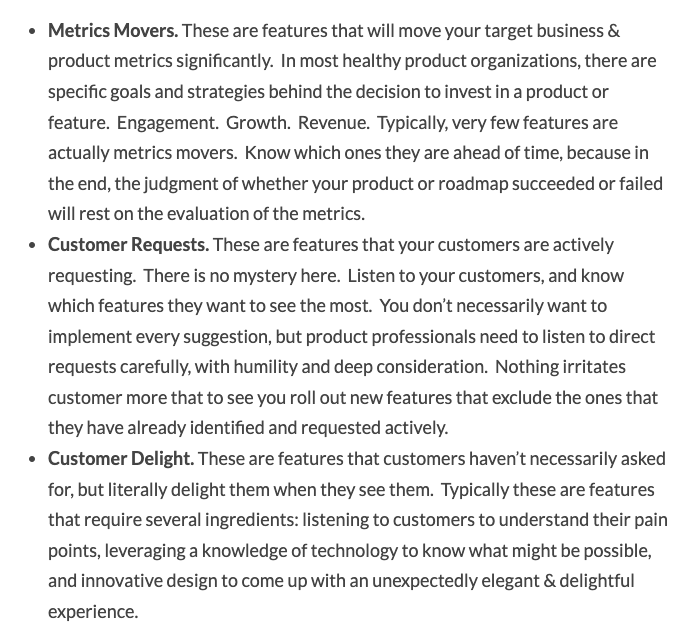
Similarly, Adam Nash, CEO, product leader and angel investor, has a valuable take on product themes in his Guide to Product Planning:
When pulling together your product roadmap, it’s easy to get caught up on the bigger problems to solve and more “glamorous themes”. Whatever you do, don’t forget about tech debt/”Keep the lights on” work.
9. Structure your team strategically to get the best results
When assembling your team to build and launch your product, this should depend on:
- Problem space
- Purpose: Company North Star
- Company Goals: Performance Metrics
- Product Vision
- Product Strategy
- Product Pillars/Principles
- Product Roadmap
Important questions to ask when assembling a team to build and launch a product:
- What is the minimum team required to deliver on the product vision via the product roadmap?
- What expertise (broad and deep) do we need?
- What diverse perspectives are required to do this well?
Identify the key positions that are needed to hire for to support the product and company vision and create a creative hiring plan for those that works for you.
Get very clear on what you need before you ask for it.
This is one of my favourite job postings I’ve seen for a product manager role (from Siteline, a startup that builds billing software for construction teams).
What I like the most about it:
- The problem they are solving is clearly defined.
- The WHY of what they are building and WHO they are building it for are clearly defined
- They have a very good idea of the foundational skills they need in a person to do well in this role, with the right framing (i.e. the role is for their very first PM, and it’s a startup, so they know that this person needs excellent base cross-functional skills like communication, leadership, proven ability to execute, user empathy, humbleness, and adaptability vs. very deep experience and skills in a particular area of technology)
I strongly believe hiring is going in the direction of video/personalization like this, where hiring managers create videos to explain who they are, what they stand for, what the role they are hiring for entails, and the type of person they are looking for.
This helps to dramatically streamline the recruiting process and makes it a lot more human — candidates get to know hiring managers (who they are, how they think, and how they communicate) and get a better feel for what it would be like to work with them and at the company.
On the other end, video submissions from candidates can dramatically help to streamline the actual time it takes to go through multiple rounds of interviewing, and get a better sense of the candidate’s WHY, how they think, and what their goals are earlier in the process and with less lift.
10. Establish processes to support product discovery, development, and delivery
There’s an unwritten rule that anytime an org doubles in size, systems fall apart.
Internal product development processes should take into account:
- Stage of company
- Problem space
- Purpose: Company North Star
- Company Goals: Performance Metrics
- Product Vision
- Product Strategy
- Product Principles/Pillars
- Product Roadmap
- Team Structure
…and be HIGHLY context-dependent and thoughtful. There is no one size fits all solution.
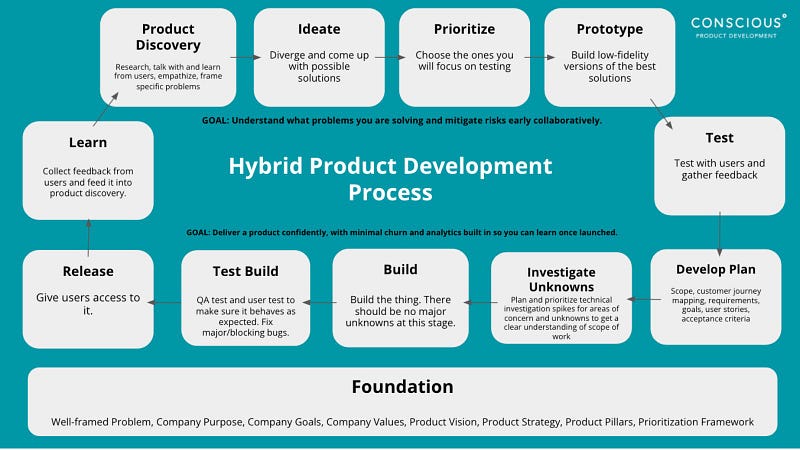
It’s important to understand the main buckets of things that need to happen to work towards the team’s goals within constraints. Things like product discovery, product design, product planning and prioritization, requirement building, product development, QA testing, release, and feedback gathering.
Specific processes to think about:
- How are decisions made?
- Who makes which types of decisions?
- How do we plan work?
- How do we build things?
- How can we address risks up front?
- How do we learn post-launch?
- How do we communicate within and across teams?
With all of this in mind, having regular check-ins to understand current statuses and cross-referencing this with team goals is crucial.
Processes should:
- Be simple (if a process makes things more complicated, it should not be implemented)
- Provide transparency (everyone in the company should be able to understand where we are in the process at any given time)
- Be easily communicated (if any changes need to happen, people can easily understand the thing that needs to change and why and easily adopt it)
- Foster collaboration (and each team should know when in the process their input is needed)
- Be adaptable (things change rapidly in startups — build processes that are flexible and that can be scaled later)
- Be timely (they should facilitate getting things done quickly vs. slowing things down)
Here’s my take on a hybrid process that can be adapted based on your specific context.
Here’s a quick recap of the 10 cake layers:
I would love to hear your thoughts on this article and suggestions for future articles! I’m planning on doing a deep dive into each of these 10 areas to get more into the weeds.
-Lisa 🧢
Follow me on Twitter: @lisazane15
🧠 Join 800+ people interested in building products and their product careers more consciously: https://www.consciousproductdevelopment.com/newsletter
🧭 If you’re ready for a role transition or just want to make more conscious career moves going forward, check out The Product Manager’s Career Guide that I just launched: https://www.consciousproductdevelopment.com/the-product-managers-career-guide
Related:
- What Product Teams Can Learn From The Mayo Clinic’s Care Model
- “How Can I Build Tech Knowledge In A Specific Domain as a PM?”
- “How Do I Improve My Storytelling Skills as a PM?”
- A Call for More Conscious Products
- “How Should I Approach Product Strategy?”
- What It Takes To Be An Exceptional Product Manager
- Cultivating An Exceptional Team


