
The Brain Science Behind Aging and Forgetting
Are younger people smarter? Are older people wiser? Living longer affects the brain, but exactly how may surprise you
Solomon Shereshevsky, a Russian journalist in the 1920s, was known as “The Man Who Could Not Forget.” He could effortlessly recall long lists of numbers or nonsensical information, books of poetry in languages he didn’t know, and complex scientific formulas he never learned.
But his superpower came at a price. He was burdened by irrelevant data and struggled to prioritize, filter, and forget what he no longer needed.
In his later years, desperate to purge his cluttered mind, Shereshevsky drank himself to death. His story serves as a cautionary tale about the roles of remembering and forgetting.
While we tend to vilify forgetting, everyone forgets, and forgetting plays an essential role in maintaining cognitive health throughout our lifetime, argues Lisa Genova, author of Remember: The Science of Memory and the Art of Forgetting. “An intelligent memory system not only remembers information,” she says, “but also actively forgets whatever is no longer useful.”
Pay attention: This is why we forget
Among people of all ages, the main cause of forgetting is failing to pay attention. If you’ve driven a familiar route and can’t recall passing landmarks or making certain turns, you’ve experienced this phenomenon.
Why didn’t you remember? Your brain was on autopilot. You never created a memory in the first place.
One of the most tragic examples of inattention concerns children left in hot cars. Each year, dozens of young parents forget their child in the back seat. Often, it’s hours later before the child is found — strapped into their car seat, dead from heat stroke.
If this seems like a far-fetched example of absentmindedness, consider the Apple logo test. Since most of us regularly see Apple’s iconic emblem, we should be able to remember it, right?
That was the question researchers sought to answer in a 2015 study featuring 85 UCLA college students. Despite their youth and familiarity with Apple products, fewer than half could identify the correct logo among a lineup similar to the one below. When it came to drawing the Apple logo from memory, only one student could do it accurately.
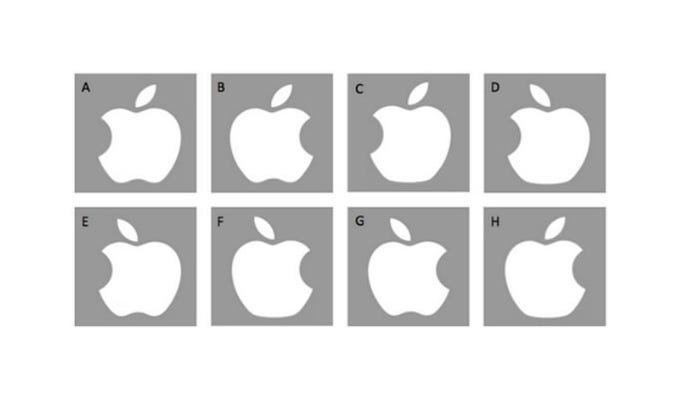
The researchers’ conclusion: Of everything we see, we don’t notice much. The vital ingredient, regardless of your age, is attention.
Younger ≠ smarter
Even when we do manage to stay focused, people of all ages inadvertently change, edit, and manipulate the details. Science tells us that many of our episodic memories — the ones that tell the stories of our life’s most emotional moments — turn out to be dead wrong.
In a landmark study conducted the day after the tragic Challenger space shuttle explosion in 1986, researchers asked a group of 44 college students about their knowledge of the event. Nearly all expressed confidence about where they were and what they were doing at the time they heard the news.

Three years later, researchers asked the same participants the identical questions and compared their answers to their previous ones. Remarkably, no one scored 100%, and 25% scored zero. Half could correctly recall their answers to only one of the original questions.
“In the process of consolidating an episodic memory, your brain is like a sticky-fingered, madcap chef,” Genova says. “While it stirs together the ingredients of what you noticed for any particular memory, the recipe can change, often dramatically, with additions and subtractions supplied by imagination, opinion, or assumptions.”
The bottom line? Whether you’re young or old, you can be 100% confident in your memories and still be 100% wrong.
Where senior brains struggle
Over the course of normal aging, changes occur in the prefrontal cortex, affecting many types of recall.
Prospective memory — trying to remember something you need to do in the future — often takes a hit with aging. That could have been the case for Yo-Yo Ma, the world’s most famous cellist, who in his mid-40s forgot his $2.5 million cello, leaving it in the trunk of a cab. (To his immense relief, it was returned the next day.)
Older adults also frequently experience a decline in working memory. That means if you have to remember something for a short period of time — for example, a six-digit code — you’ll have a harder time doing this at 60 than at 40. And unless you’re a super-ager, you’ll do it more slowly, due to a decline in processing speed.
Where senior brains shine
Older adults are better at retaining information they’ve learned, called semantic memory. For example, throughout life, people maintain and grow their vocabulary. Seniors are better Scrabble players and often excel in foreign languages. At age 69, Akira Haraguchi, a retired engineer from Japan, recited 100,000 digits of pi from memory.
Likewise, older people outpace their younger peers when it comes to combining and utilizing complex ideas. While they may not be pumping out new cutting-edge gizmos, people in their 40s and beyond excel at using the concepts they’ve learned and expressing them to others, says author Arthur C. Brooks in From Strength to Strength: Finding Success, Happiness, and Deep Purpose in the Second Half of Life.
Using complex concepts, Brooks says, is a sign of crystallized intelligence — knowledge that’s stored and accumulated over time. It’s the secret sauce of older adults who lead the way as teachers, writers, and historians. With continued learning and socialization, crystallized intelligence can increase throughout most of a person’s life.
Raw smarts or wisdom?
Scientists who study aging stress that there is a huge degree of variability in cognitive functioning among individuals. Some teenagers are perpetually forgetful, while some in their 50s are Jeopardy! champions.
However, one factor is consistent: The cognitive skills that tend to surface later in life bring increased insights and an enhanced level of discernment. In a word, what emerges is wisdom.
Wisdom manifests in many ways: Seeing the big picture. Exercising emotional control. Demonstrating compassion. Making decisions based on a broad perspective. Avoiding black-and-white thinking.
Arthur Brooks says: “When you are young, you have raw smarts; when you are old, you have wisdom. When you are young, you can generate lots of facts; when you are old, you know what they mean and how to use them.”
Make a note to remember: Those skills may be the most priceless cognitive traits of all.
The correct answer to the Apple logo test is B.
Thanks for reading! Your support makes my writing possible. You can sign up for emails when I publish on Medium, or join Medium to directly support me and gain full access to all Medium stories.


