
The Brain Science Behind Forgetting Kids in Hot Cars
You might think it happens only to bad parents. But anyone can fall prey to the brain glitch that causes these horrific accidents.
This article is part of a Wise & Well Special Report: Extreme Heat and Human Health.
Each case is different. But there’s always that awful moment when the parent realizes what they’ve done. There’s a desperate sprint to the car. A nightmarish discovery. A gut-wrenching call to 911.
Each incident has its own painful backstory. In Florida this past month, an 11-month-old baby died in a scorching van, after her mother rushed off to officiate church services. In New York City, a VA Hospital employee worked his full eight-hour shift before returning to his car to find his twin daughter and son dead. In several similar cases, a parent drove from their office to pick up their child at daycare — only to later check the backseat and find their child there, passed away.
In the past 25 years, nearly 1,000 children have died after being left in hot cars. It happens somewhere in the United States an average of 38 times per year.
The stories shake us to the core. They defy our understanding. What was the mom or dad thinking? How in the world could loving parents let horrors like this happen?
David Diamond knows. A neuroscientist and professor of psychology at the University of South Florida, Diamond has studied memory and the brain for more than four decades and has served as an expert witness in dozens of court cases involving child hot-car deaths.
What he’s found is that the human brain is a jerry-rigged structure, where the sophisticated “planning” parts sit atop a primitive “automatic” part. And when the primitive part hijacks the sophisticated part — often due to everyday stress or mundane changes to routine — parents are at risk of making serious and sometimes lethal mistakes.
The makeshift rigging of our minds
At the top of the human brain sit its most advanced parts: the prefrontal cortex, which thinks and plans for the future, and the hippocampus, which recalls facts and details. Both areas are involved in prospective, or forward-thinking, memories. The basal ganglia, nearly identical to the brains of lizards, lies at the bottom of the brain. It controls routines and actions that can be performed with little conscious effort and involve habit-based memories.
When familiar motor skills are required, the habit-based basal ganglia swing into action on autopilot, Diamond explains. This clarifies why it’s common to arrive home after driving a familiar route, without recalling the turns taken or the scenery passed.
But problems can arise when the basal ganglia override the hippocampus and prefrontal cortex, Diamond writes in a white paper.
A benign example: You plan to pick up groceries on the way home from work but then drive right past the store. In this case, Diamond says, the habit-based basal ganglia suppress the forward-thinking prefrontal cortex/hippocampus, causing you to forget the groceries. You remember only when exposed to a cue — such as an empty refrigerator or a scolding spouse.
The same mechanism is at work when a child is forgotten.
“What happens is that the memory circuits in a vulnerable hippocampus literally get overwritten, like with a computer program,” Diamond says. “Unless the memory circuit is rebooted — such as a child cries, or if the wife mentions the child in the back — it can entirely disappear.”
What’s behind the loss of awareness
One of the most perplexing questions in pediatric hot-car cases is how parents can go from caring for their children — dressing, feeding, and carefully loading them into their car — to forgetting altogether that they’re there.
“In all of the cases I’ve studied, the parent begins the drive with the plan to bring the child to a destination, but at some point during the drive, the parent reports having lost awareness of the child in the car,” Diamond explains. “In these cases, the parent travels directly to the final destination (typically home or work), and in the process, exits the car without awareness that the child is still in the car.”
What changed the situation? Diamond points to three factors:
- Stress and fatigue: Many parents who have left children in cars report experiencing a stressful experience prior to or during their drive, or interrupted sleep the night before. Diamond says stress and fatigue have an adverse effect on prospective memory, but not on habitual memory.
- Level of interaction with the child: Some parents reported that on most drives they communicated with their child, but on the day of the incident the child was unusually quiet (presumably sleeping). “The change in the interpersonal dynamics between the parent and child would be identified by the basal ganglia as a day in which the child was not present in the car,” Diamond explains. “Therefore, the ‘autopilot system’ would recognize the drive with a quiet child as one without the child. In the absence of child-specific cues, the basal ganglia would direct the parent to go directly to work, rather than to daycare.”
- Change of route: Parents may typically drive straight from home to daycare, and then to work. But a change of route — for example, from home to a fast-food restaurant for breakfast — could trigger the basal ganglia to an autopilot response, bypassing the planned route to daycare. Again, children are particularly vulnerable if they fall asleep.
Whatever the circumstances, Diamond says, it’s common among parents who’ve forgotten a child to create a “false memory” that they’d in fact left the child at daycare. This false memory allows parents to go about their day doing their normal activities. They even tell others they need to leave work at a certain time to pick up their child.
“Many parents return to the daycare expecting to retrieve their child, only to be told that the child did not arrive at daycare that day,” Diamond says. “These individuals are then horrified to learn that their child spent the entire day in their car, with fatal consequences.”
Too many gone
The official designation for children who die in hot cars is “death by pediatric vehicular heatstroke.” Despite the heatwave affecting millions this summer, experts believe this year’s death toll in the US will end on par with average years.
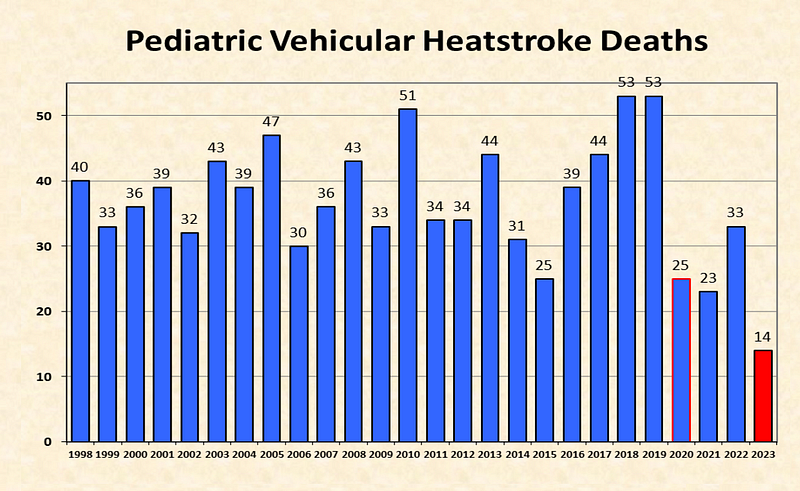
More than half of the deaths involved children accidentally forgotten by their caregivers, says Jan Null, CCM, who compiles data for the website No Heat Stroke. Of the remaining cases, more than 25% of children who died entered a vehicle on their own, and approximately 20% were intentionally left by their caregiver (whose explanation was most often a version of “I’ll be gone for just a minute”).
Pediatric vehicular heatstroke happens most frequently from April to September — the five-month stretch the advocacy group Safe Kids calls “hot car death season.” Young children are particularly at risk because their bodies heat up three to five times faster than an adult, according to Safe Kids. And when a child’s core body temperature reaches 107 degrees, the child will most surely die — often within hours.
Despite the dangers, many parents remain unaware or unmotivated to change their habits.
A national study conducted in 2014 by Public Opinion Strategies revealed that nearly 1 in 4 parents of children under age 3 admitted to having forgotten their child in a car.
Additionally, more than 6% of parents said they’re comfortable letting their young children stay in a parked and locked vehicle for more than 15 minutes. This is despite the fact that the risks have been well understood for decades, and many children are too young to free themselves from safety restraints or to unlock doors.
“Even at relatively cool ambient temperatures, the temperature rise in vehicles is significant on clear, sunny days and puts infants at risk for hyperthermia,” researchers concluded in a 2005 study published in the journal Pediatrics. “Vehicles heat up rapidly, with the majority of the temperature rise occurring within the first 15 to 30 minutes. Leaving the windows opened slightly does not significantly slow the heating process or decrease the maximum temperature attained.”
How to stop the deaths
How can these tragedies be prevented? The first step, Diamond says, is to accept that human memory is faulty and that even loving and attentive parents can accidentally leave their children in cars.
Many strategies have been suggested, such as these from the American Academy of Pediatrics:
- Always check the back seat and make sure all children are out of the car before locking it and walking away.
- Avoid distractions while driving, especially using your cell phone.
- Be extra alert when there is a change in your routine, like when someone else is driving your child or you take a different route to work or child care.
- Have your childcare provider call if your child is more than 10 minutes late.
- Put your cell phone, bag, or purse in the back seat, so you have to check there when you arrive at your destination.
As the heartbreaking stories of child hot-car deaths remind us, it’s not difficult for the brains of stressed and exhausted but otherwise loving parents to switch to autopilot.
As Diamond puts it, “Memory is a machine and it’s not flawless. Our conscious mind prioritizes things by importance, but on a cellular level, our memory does not. If you’re capable of losing your cell phone, you’re capable of forgetting your child.”
Thanks for reading! Your support makes my writing possible. You can sign up for emails when I publish on Medium, or join Medium to directly support me and gain full access to all Medium stories.


