
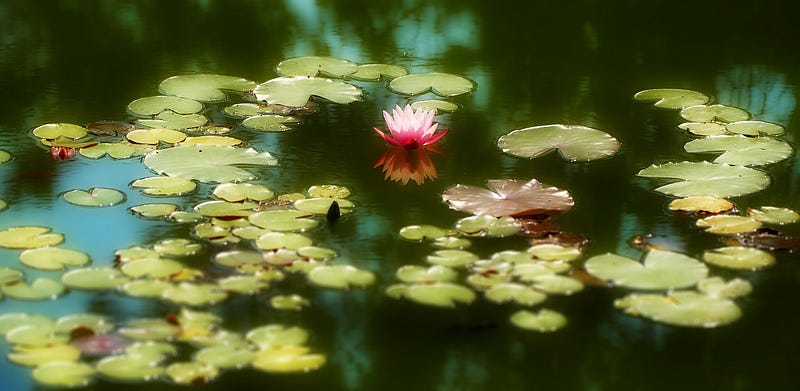
The Birds, Buddha and a Flower
On the importance of laughter
Somewhere, an enormous stadium-sized flock of birds is laughing. “Return to one-ness?” they ask. “How can one return to one-ness when it is impossible to be separate from it?” The birds live their entire lives in one-ness and have no concept of separation, so they laugh.
Those goofy humans, however, have created a perception of separation and this has given them an opportunity to see one-ness from the perspective of learning what one-ness is not. While the birdies live in one-ness, as that is all they know, the goofy humans have expanded their awareness of that one-ness — or at least moved into a possibility of expanding their awareness of that one-ness. They stopped living in one-ness in order to expand their awareness beyond simply living in one-ness. They will eventually return to living in one-ness but they will have a new awareness of it when they do. Through the humans, one-ness will have a new awareness of itself. That is when the humans will finally laugh.
Buddha scheduled a talk one day. Many, many disciples came to sit and listen. But the Buddha just sat there holding a flower. An hour passed and then another and the Buddha never uttered a word. The disciples grew restless. Finally, one of the disciples named Mahakashyap began laughing hysterically. The Buddha smiled and handed Mahakashyap the flower. Mahakashyap was the only one who understood.
After receiving the lotus flower from the Buddha, Mahakashyap became a Buddhist master with his own gathering of disciples. Eventually, one of his disciples named Bodhiharma also laughed and became enlightened. Bodhiharma then went to his own personal guru named Pragyatara (who happened to be a woman!) and told her that he had become enlightened.
She laughed and told him that he must immediately travel to China. So Bodhiharma left India and traveled north to China where he became aware of and studied the teachings of the great Taoist master Lao Tzu. After years of study Bodhiharma synthesized the teachings of the Buddha and Lao Tzu into a new teaching that has since become known as Zen.
While philosophies change and adapt the one thing that remained constant through the evolution of Buddhism and Taoism into Zen is laughter. I have a feeling that while all philosophies continue to change and adapt and evolve, the one thing that will remain through it all is laughter. Christianity, Islam and Hinduism have downplayed and nullified laughter but Zen has kept it alive to some degree. When we finally go beyond religion and philosophy and all attempts at conceptualizing one-ness and enter that silence the Buddha once expressed that is beyond conceptualization then we will all laugh. And the birds will be in awe of us. Like the lotus flower, we will have blossomed.
Copyright by White Feather. All Rights Reserved. Complete White Feather Archive Index


