
“The Birdcage”: An Underrated Comedy Masterpiece Turns 25
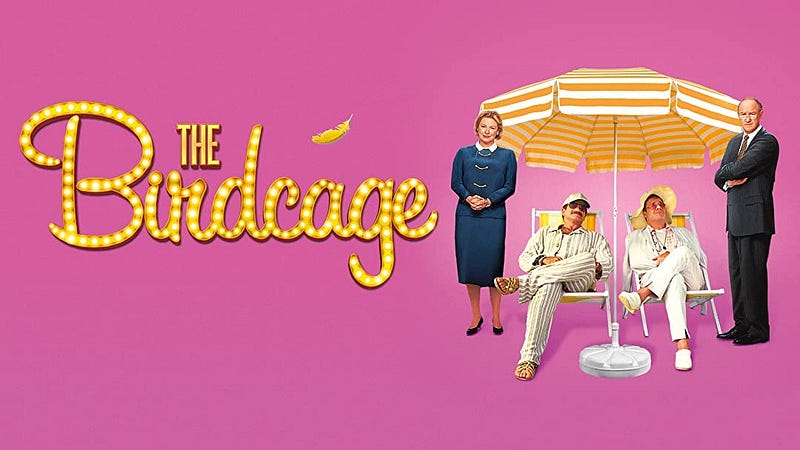
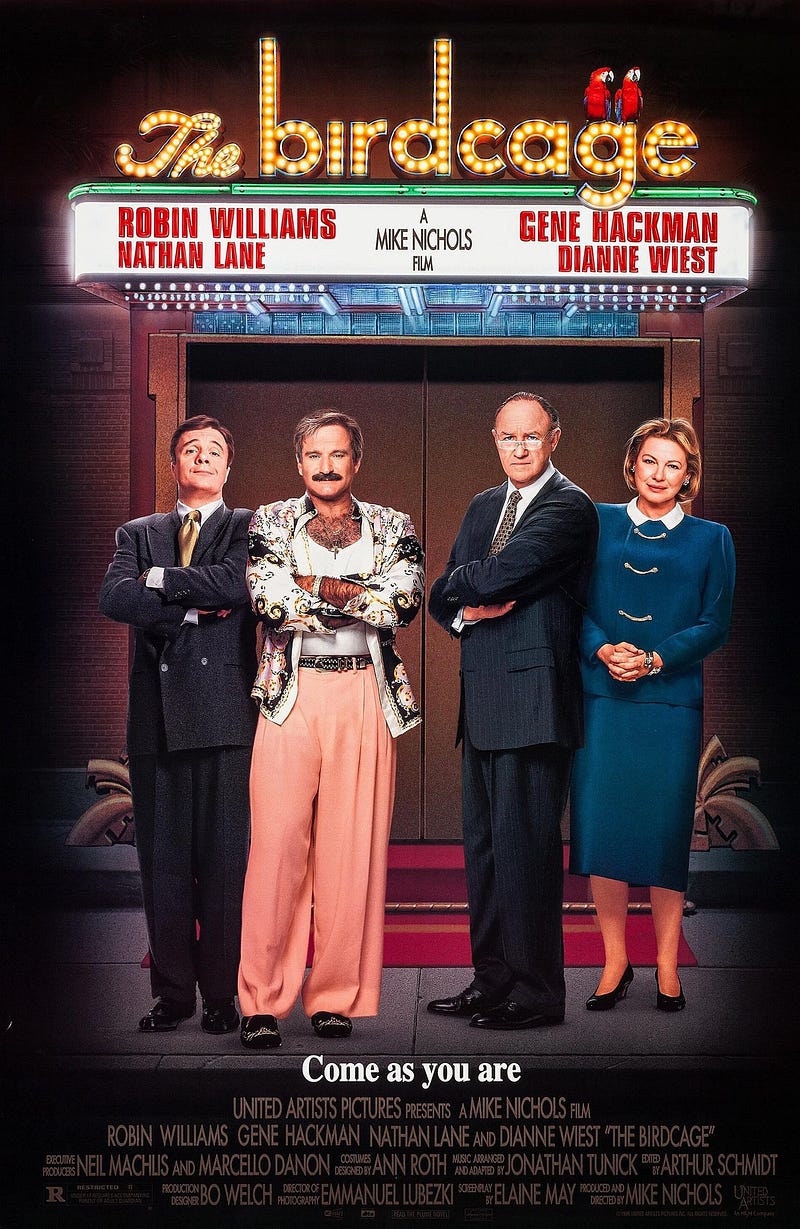
25 years ago today, an all-star American remake of a highly esteemed queer European comedy premiered in theaters. The film featured an astonishing array of talent both on- and off-screen and was greeted with warm reviews and blockbuster box office receipts. Revisiting it a quarter century after its release highlights that despite its pedigree and success, its role in the history of film comedy and queer representation is still enormously under-appreciated.
A Brief History of The Birdcage
The Birdcage was an American remake of the landmark 1978 Franco-Italian queer comedy La Cages Aux Folles. The remake centers on Armand Goldman (Robin Williams), the middle aged, Jewish, and gay owner of a Miami Beach drag club. He lives above the club with his longtime partner Albert (Nathan Lane), who is the club’s headliner. Armand’s 20-year-old son Val (Dan Futterman), who was conceived during his youthful experimentation with heterosexuality, comes back for a visit and announces that he’s getting married to a woman named Barbara (Calista Flockhart).
Barbara is the daughter of ultra-conservative Senator Kevin Keeley (Gene Hackman). Keeley is the co-founder of the Coalition for Moral Order and repeatedly derides conservative icons like Bob Dole and Billy Graham as being “too liberal.” When Eli Jackson, Keeley’s co-founder of the Coalition, dies in the bed of an underaged black prostitute, Keeley is faced with a profound political crisis. Sen. Keeley’s devoted, clever, and presumably long-suffering wife Louise (Dianne Wiest) suggests that the family could detract from the scandal by throwing a lavish white wedding for Val and Barbara. Of course, this requires them meeting the parents.
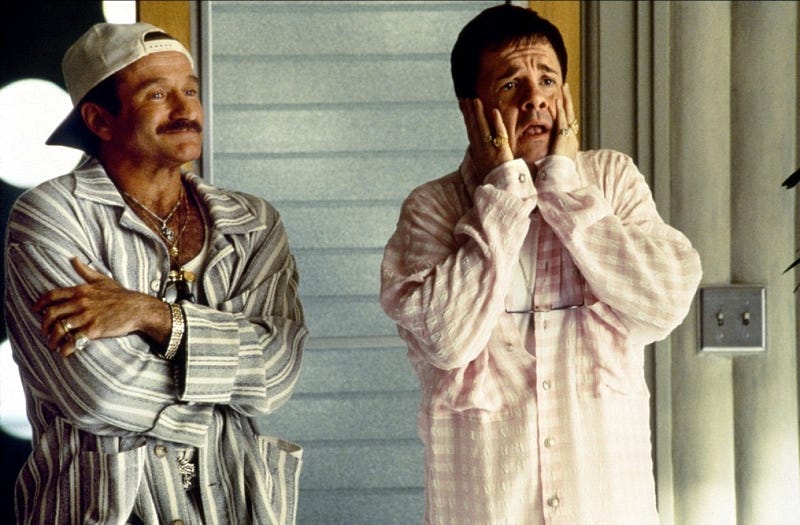
Inevitably, a farce of epic proportions ensues as the flamboyantly gay couple tries to play it straight (literally) for the bigoted and controversy-averse Republicans. However, the film goes much deeper than that synopsis implies. It explores the profoundly negative effect that being asked to conceal their identity by their child has on Armand and especially Albert (who has long been feeling insecure and unappreciated by Armand). It also explores a variety of other textured dynamics, including the fascinating marital dynamics of the Keeleys. The cast of characters is rounded out by Agador, the Guatemalan houseboy played by Hank Azaria, and Katharine Archer, Val’s birth mother played by Christine Baranski.
The talent assembled both in front of and behind the camera was one of the most impressive groups assembled by Hollywood in the entirety of the1990s. The eight actor ensemble featured three bona fide big screen legends (Williams, Hackman, and Wiest), three well-known stars of stage and television (Lane, Azaria, and Baranski), and two up-and-comers who would go on to notable later success (Flockhart, who would go on to become Ally McBeal, and Dan Futterman, who would go on to become an award-winning screenwriter). To date, the octet has received the following accolades:
- 13 Oscar nominations and 5 wins (Hackman and Wiest have 2 each, Williams has 1)
- 53 Emmy nominations and 14 wins (Azaria has 6, Williams has 3, Lane and Wiest each have 2, Baranski has 1)
- 34 Golden Globe nominations and 12 wins (Williams has 6, Hackman has 4, Wiest has 1, Flockhart has 1)
- 9 Tony nominations and 5 wins (Lane has 3, Baranski has 2)
The film was directed by none other than legendary filmmaker, theater producer, actor, and comedian Mike Nichols, who won an Oscar, four Emmys, and eight Tonys over an illustrious career that produced such masterpieces as The Graduate, Who’s Afraid of Virginia Woolf?, Working Girl, Silkwood, and Angels in America. The screenplay was written by Nichols’ longtime comedy partner Elaine May, a Tony and Grammy winner who also received two Oscar nominations for screenwriting over the course of her career (for 1978’s Heaven Can Wait and 1998’s Primary Colors).
The Birdcage received strong reviews upon its initial release (an 80% approval rating on Rotten Tomatoes and a score of 72/100 on MetaCritic) and it majorly exceeded expectations at the box office, grossing $124 million domestically and an additional $61 million outside the U.S. This blockbuster total vastly exceeded its $31 budget, making it an enormously profitable film for MGM (when adjusted for inflation, the film’s gross sails past $300 million, an astounding sum for an R-rated comedy that’s not a sequel).
Despite being released before the 68th Academy Awards were held, The Birdcage was heavily in the conversation for the 69th Academy Awards a year later. The film picked up Golden Globe nominations for Best Motion Picture — Comedy or Musical and Best Actor in a Motion Picture — Comedy or Musical for Nathan Lane. The film then won the coveted Screen Actors Guild Award for Best Performance by a Cast in a Motion Picture (their top award) and received additional nominations in Best Supporting Actor for Nathan Lane and Hank Azaria. However, these big nominations and wins did not translate into Oscar success. The film received a sole nomination for Best Production Design. To date, The Birdcage remains the only winner of the top SAG award to not be nominated for the Best Picture Oscar.
Revisiting The Birdcage at 25
I have seen The Birdcage about a dozen times since its initial release and it has never once failed to garner my full attention and make me laugh out loud numerous times. In fact, it’s one of the few movies that I can never multitask while watching no matter how many times I have seen it. But as I revisited it for this anniversary article, I found myself analyzing it at a deeper level and reflecting on more powerful and nuanced themes than I ever had before.
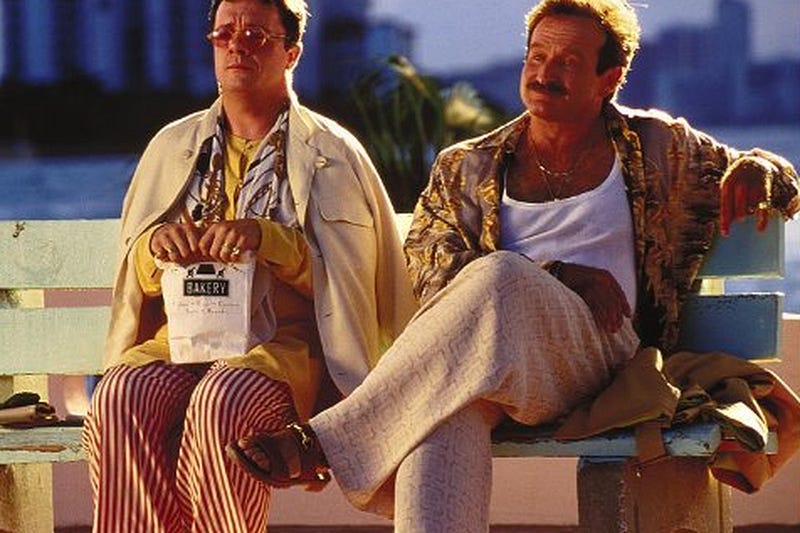
The film’s highlight is undoubtedly the performances, which is perhaps unsurprising given the astonishing number of accolades that the ensemble has received. The lion’s share of the buzz and acclaim rightfully went to Lane’s fully committed performance, which abruptly pivots from slapstick to clever diatribes to raw sadness without ever breaking a sweat. But as good as Lane is, he’s hardly the sole attraction. Williams plays the role of Armand with marvelous skill, precision, and restraint. He garners his share of laughs while mostly standing aside to let Lane shine. It is one of the late, great comic geniuses best performances. Equally impressive is Hackman, who rarely if ever was as funny on screen as he was here. For most of the first half of the film he is a rage-filled alpha male in crisis mode, but when we see his softer aside as he becomes enamored with Val’s “mother” (Albert in drag), he becomes something wholly unique and oddly endearing. Although she doesn’t quite get the quantity of quality of material she deserves, Wiest expertly delivers every single line and exasperated look while injecting the character with hints of a history and interior life that I’m not even sure May knew were there when writing the role. In the remaining roles, Azaria turns in an unforgettable purely comic performance, Baranski is mostly underutilized but has a great introductory scene with Williams, and Futterman and Flockhart are strong enough to hold their own against the formidable ensemble despite their thinly drawn roles.
The fact that Val and Barbara are essentially plot devices as opposed to fully drawn characters is one of the only criticisms I have heard levied against May’s screenplay that I agree with. I believe that May’s screenplay is an Oscar-worthy masterwork, with complex plotting that never feels convoluted or confusing; big laughs that come from visual gags, word play, richly drawn character dynamics, and savage, razor-sharp political satire; and a deep interest in and respect for the gay men at its center. At the time it was released, some accused Nichols and May of playing too much into gay stereotypes. But despite the fact that Armand and Albert are wildly flamboyant, I never found them to be anything less than layered and believable humans. Their relationship is the film’s centerpiece and issues related to homophobia and lack of legal protections for LGBT couples and parents are sensitively inserted. Although much of the plot revolves around them going back into the closet to impress someone of importance, the toll this takes on the characters is explored and the resounding take-home message at the end of the film is that not only do Armand and Albert have nothing to be ashamed of, but actually their willingness to sacrifice their pride to help their son is a richer display of good family values than anything Sen. Keeley is lobbying for.
The film is also remarkable at a technical level. The visually stunning opening, in which the camera zooms in from the Atlantic ocean to the South Beach strip, is a perfect example of three-time Oscar winning cinematographer Emanuel Lubezki’s style. The film is dripping with richly detailed art deco gaudiness, which rightfully earned Bo Welch and Cheryl Caraski an Oscar nomination for Best Production Design. The combination of Nichols’ superb comic timing and two-time Oscar winner Arthur Schmidt’s superb editing keeps the film moving at a breakneck pace. Rounding it all out is the superb selection of music, with both instrumentals and pop hits perfectly accentuating the scenes.
My First Viewing of The Birdcage
I went to a lot of movies when I was growing up. A lot of movies. But there are only a handful of movie-going experiences that I can recall vividly. The Birdcage is one of them.
I was a movie-obsessed 12-year-old who was still many years away from realizing that I was gay. My 21-year-old (and very straight) brother was home from college on Spring Break and he took me to see a matinee of the film at our local cinema. I was starting to get away with seeing some R-rated movies, so I didn’t expect my parents to say “no” on those grounds. But I did expect someone, anyone, to raise an uproar over going to see a movie about a gay couple.
But no one did.
In their minds, it was simply “the new Robin Williams comedy” and after a wild string of hits including Aladdin, Mrs. Doubtfire, Hook, and Jumanji, there love for him obscured any concerns about the subject matter. Nevertheless, I recognized it as something more than a new Robin Williams comedy and was a bit worried about how this particular moviegoing experience would play out.
At the time the film was released 25 years ago, Ellen was still a year away from coming out of the closet, the premiere of Will & Grace was over two years off, and Brokeback Mountain’s landmark release was still nine years in the future. Some notable queer stories had been told on the big and small screens, but it was rare to see ones that weren’t tragedies and featured major stars. And The Birdcage was very queer, very much a comedy, and featured some of the biggest stars on the planet. (A rare exception that I recall was the Patrick Swayze-Wesley Snipes comedy To Wong Foo, Thanks For Everything, Julie Newmar that was released to middling critical and audience reactions the prior year.)
Not only did my brother nor anyone in my family deride the movie, its subject matter, or the characters, but they actually loved it. Watching my family — who was deeply embedded in a Republican, Catholic, military, suburban community — enjoy a film that ultimately celebrated the validation of queer identities and relationships and denigrated the hypocritical efforts of “conservative values” proponents was jarring in the best possible way.
It validated my burgeoning identity and world view.
It paved the way for greater confidence and acceptance.
And it did so in a manner that was so entertaining it took me decades to figure out it was doing it.
Follow the author of this article on Medium and Twitter.
Read recent articles about revisiting classic films from the 1990s:


