
The Biggest Mistake You Can Make When Sorting LEGO
There are many ways to sort LEGO, but only one, is truly efficient.

If you are a real hardcore LEGO fan, you have many problems, and sorting pieces is just one of them. You’re probably overspending, are fighting a borderline addiction, have become very good at rationalising every purchase as an investment into your happiness — which I condone, btw — and are running out of available space faster than any hoarder out there. In fact, let’s just call it what it is. Collecting LEGO is essentially hoarding plastic sold at a premium. If a 30+ year AFOL can admit it, so can you.
But the biggest issue of all, isn’t the amount of money you spent on LEGO or the space you don’t have, but the ungodly mess you find yourself as soon as you hit 10K pieces, and you realise, oh fuck, all this LEGO needs to be sorted. But how? And that, my dear LEGO friend, is a truly existential question.
How do you sort LEGO that it stays sorted, it’s efficient when building MOCs, and it makes sense not just to you, but everyone else?
Do not sort by colour!
Your God-given natural tendency will be to sort by colour. Why? Because colour-coding is traditionally a fairly good way to organise things. Heck, we do that with people. Black, White, Brown, Yellow, Translucent (most gingers and some blondes). Look how “well” that turned out… Nevermind that technically no one is really white, black, or yellow, we’re all just different shades of Mexican, except of course the translucent folks in parts of Northern Europe and Ireland. Lucky bastards don’t need x-rays, just move the iPhone’s flashlight to the desired area, and you have yourself a free CT. If you need an MRI, just use two flashlights. 🤣
Jokes aside, do not sort LEGO by colour. While there aren’t an insane number of colours in the inventory, some colours are far more common than others. Take for instance light-grey, black, blue, or yellow. Nearly every LEGO piece you can think of exists in these colours, so good luck finding what you need in those gigantic tubs.
In reality, you rarely, if ever, build something of just one colour. Perhaps that was partially true in the classic red brick era, but nowadays even the simplest ideas rely on some variations of colour. During the build, you’d quickly find yourself hunting down individual pieces in different tubs of a different colour, sometimes pieces you might not even have! You’ll focus so much on just finding that one piece in that given colour — because you’re invested in that particular colour — that you forget why you started building in the first place: to be creative and have fun.
The two biggest issues with colour-sorting LEGO are inefficiency and stifled creativity.
Sorting by not sorting
Believe it or not, this was my “sorting strategy” for a good number of years. This is — for most people — the default approach after all, but it’s not scalable. As long as you only have a few sets, or say, no more than 5–10K pieces, you’re probably fine, and you can rely solely on your memory to know what pieces you have, which ones you used and haven’t used already in your build. I did that for several years, and up until a point it worked.
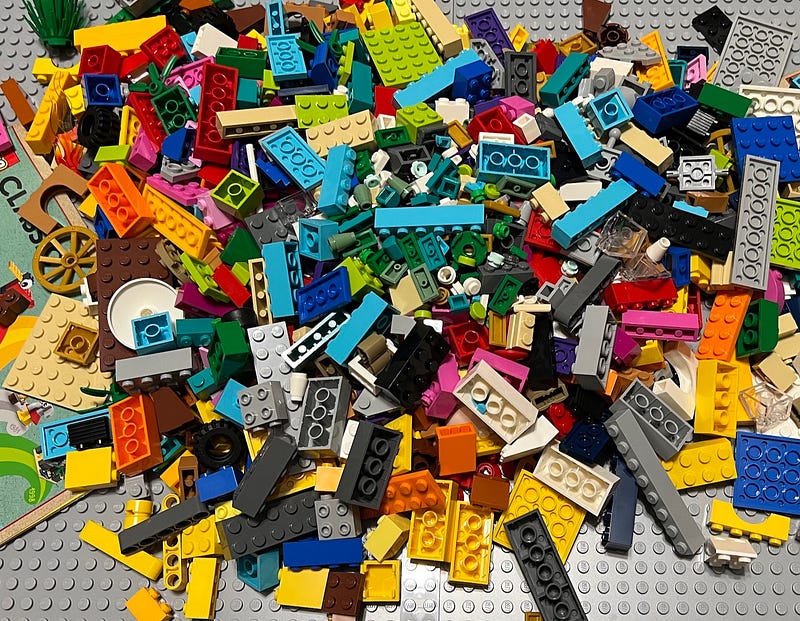
The biggest downside of sorting by not sorting, and just having everything in one or two big tubs, is the issue of efficiency. You will be spending a lot of time just looking for the pieces you need, especially the small ones, which in LEGO’s case, they all tend to fall to the bottom. A lesser downside, but a downside, nevertheless, is the fact that with all that rummaging you’ll scratch the pieces more, and they’ll lose their shine faster, especially the bigger transparent bricks. While LEGO bricks are quite strong, they’re also soft enough to scratch easily.
Big, unsorted tubs of bricks are OK until you go beyond two. That’s when you graduate to sorting strategies.
The infinite wall of little trays
This one is actually an AFOL favourite, and I think I know why. For anyone who lives in a house, the concept of sorting tools, screws, nails, and the likes is very familiar, which is why I think many LEGO fans default to the grid of toolboxes with little drawers. But what might have worked for your parents’ shed or garage, doesn’t necessarily apply to LEGO bricks. First of all, 10–100K pieces is far more than your dad probably has screws or nails, and the variety of LEGO pieces is quite frankly extreme in comparison to the bits and bobs a tool-shed would have.
The core problem with these little drawers is the fact that they’re well… little. You will very quickly find yourself spreading the same kind of pieces across many little drawers, and for every single piece you’ll be closing a drawer and opening another little drawer, probably in the other end of the room. Incredibly inefficient. Tiago Catarino, an ex LEGO designer, also pointed out once that the drawers are incredibly shallow in depth, which means they’re also very inefficient from a real-estate usage perspective.
Finally, they’re also incredibly ugly. Perhaps they’re passable if you have a dedicated room for LEGO, but not many people do. They are absolutely not something you’d want to mix with your home’s usual decor.
The best way to sort LEGO
Take that with a pinch of salt, but interestingly enough, the Tiago guy I mentioned just a couple of paragraphs ago, reached the same conclusion that I did after many years. Really, the only and best way to sort LEGO, especially if you have a large collection — think 100K+ pieces — like me, is by type.
The beauty with sorting by type is that it can be as granular as you want.
Take, for instance, tiles. First of all, all colours can go into the same tub, but you might want to separate the transparent ones out. Apart from that, any tile from 1×2 to God knows how big the latest and biggest ones are, can all go together. You’ll always know where the tiles are, and by seeing them often in the same place you’ll even remember roughly how many you have of which colour, shape or size.
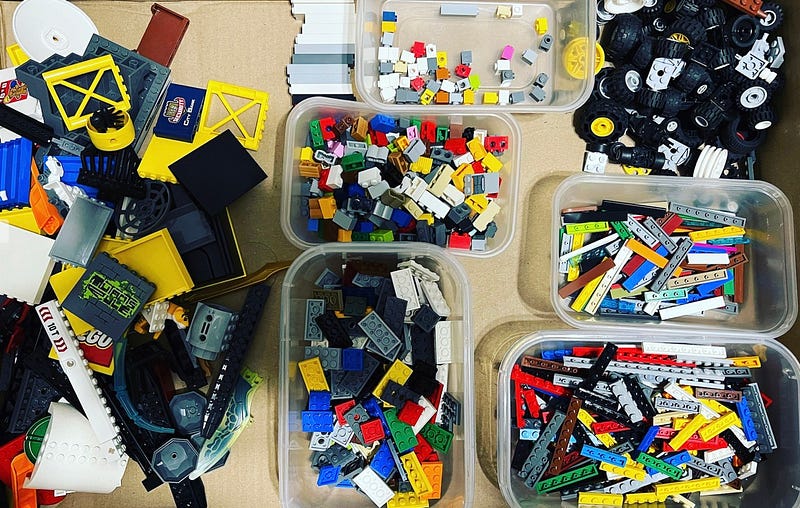
Bigger bricks like 2×4 and larger can also go into a different tub. The same applies to plates, windows, doors, wedge pieces, and so on. For instance, I am currently in the process of separating all the 1×1 transparent pieces out. It’s a fiddly process at first, but once I am done, every time I need a transparent 1×1, I’ll know where to find it.
Sorting like this, also means you have great flexibility in just how granular you go based on the space you have. You can use nice IKEA cabinets to achieve this. If you want to go cheap, Kallax shelving units with drawers are an option, or if you wish to emulate what LEGO designers have, the ALEX line is near-perfection. Once you have your LEGO pieces sorted by type, you can even get creative based on what you learn to be your recurring needs. Perhaps some smaller pieces, you want to separate by colour. At this point, sorting by colour becomes a good idea, as you’re only categorising a single type of often used piece.
One additional trick you can employ, as suggested by Tom Clark in the comments, is using ziplock bags of various sizes. This is a brilliant idea, especially if you don’t want to invest in new cabinets. Ziplock bags are cheap, tend to last ages and can fit anywhere. You can also get them in various sizes and usually have a label space where you can write, just in case looking at the parts alone isn’t enough, or you want to sort by LEGO sets, but you didn’t keep the boxes. Tom, huge thanks for this suggestion! 🙏
Sorting by type is by far the most efficient sorting strategy, and LEGO designers agree as well. 😉
Now that you know how to sort your LEGO collection, go forth and sort, but please keep in mind, ultimately, what matters most, is for you to stay creative and have fun. As Ole Kirk Kristiansen said, “play well”. 😁
Attila Vago — Software Engineer improving the world one line of code at a time. Cool nerd since forever, writer of codes and blogs. Web accessibility advocate, LEGO fan, vinyl record collector. Loves craft beer! Read my Hello story here! Subscribe and/or become a member for more stories about LEGO, tech, coding and accessibility! For my less regular readers, I also write about random bits and writing.