
Debunking The Most Perpetuated LEGO Myth Ever
Sorry to disappoint, but no, LEGO sets are much, much older than most of you remember…

The myth of the classic red brick. That’s what I call it. Perhaps others have a different name for it, but that’s what I — very intuitively — call it. It’s probably one of the oldest ones out there, and I first started hearing it in the mid 90s, when a friend from Germany got me a classic set of bricks, and as he placed it on the table, said, “this is what LEGO is supposed to be”. I was 10. I couldn’t give a flying brick what LEGO was supposed or not supposed to be, as long as the parts had LEGO printed on them. Everything else was semantics.
As you can imagine, I am not 10 any more, and over the years, as I grew and got deeper and deeper into the rabbit-hole of the LEGO universe, the opinion that LEGO was far from its “good ol’ days” values of just playing with bricks started becoming a noise I couldn’t ignore any more. The unending remarks of “back in my day” all referring to the “forgotten” heydays of the Danish toymaker when supposedly everyone played with nothing but 2×2, 2×3 and 2×4 bricks — especially in red — started to really bug me in my 20s. While as early as my mid-teens I was quite occupied with the opposite sex, that didn’t stop me from becoming an AFOL (adult fan of LEGO); though the latter by my mid 30s definitely made me appreciate the opposite sex more when it happened to come with at least some affection for the premium plastic brick.
It’s now got to the point that I dedicate 20% of my writing “career” to LEGO, and anyone who has a problem with that gets a mental — but nevertheless real — restraining order. Just saying. I take LEGO seriously. 🤣
If you ask me, it’s only a hobby, if you take it seriously. Otherwise, it’s just a casual distraction. 🤷♂️
What I really want to get at, though, is that when it comes to LEGO, I know my shit, and knowing my shit is what prompted me about four months ago to begin drafting this article. As I got increasingly tired of articles and even some fans on specialised forums perpetuating the myth that LEGO isn’t what it used to be, I thought there’s no better way to end the discussion once and for all, but to refute — with actual evidence — the myth. Put it to bed, burn it, annihilate it by educating the masses and giving me the satisfaction of finally being — and looking — old enough to be taken seriously when laying out a counterargument. 🤓
There were no sets, just bricks…
The argument is based on zero factual evidence. Most LEGO fans or disappointed fans, to be more exact, who perpetuate the myth are past the age of 45. Many in their 50s and 60s. This is by no means an ageist remark. Both fortunately and unfortunately, they are the age-group that actually can remember back as far as the 1960s and ’70s. They’re in the unique position to tell history as they saw it, and I for one, love that, except when it comes to LEGO history. That’s the one they all seem to get horribly wrong, and while there’s a reason for that too, allow me a couple more paragraphs, before getting into that.
The myth basically perpetuates that back in the 60s and 70s there were no sets, just bricks. This myth is referenced as a means to highlight the need for children having more toys that enable imagination. Having just simple LEGO bricks — no sets — supposedly enabled that, compared to the modern sets we have in the shops today. The most common example of the set that wasn’t a set “back in the day”, is the 24 piece red brick set, that came in a small cardboard box and cost just 50 cents, which in today’s money is around $4.
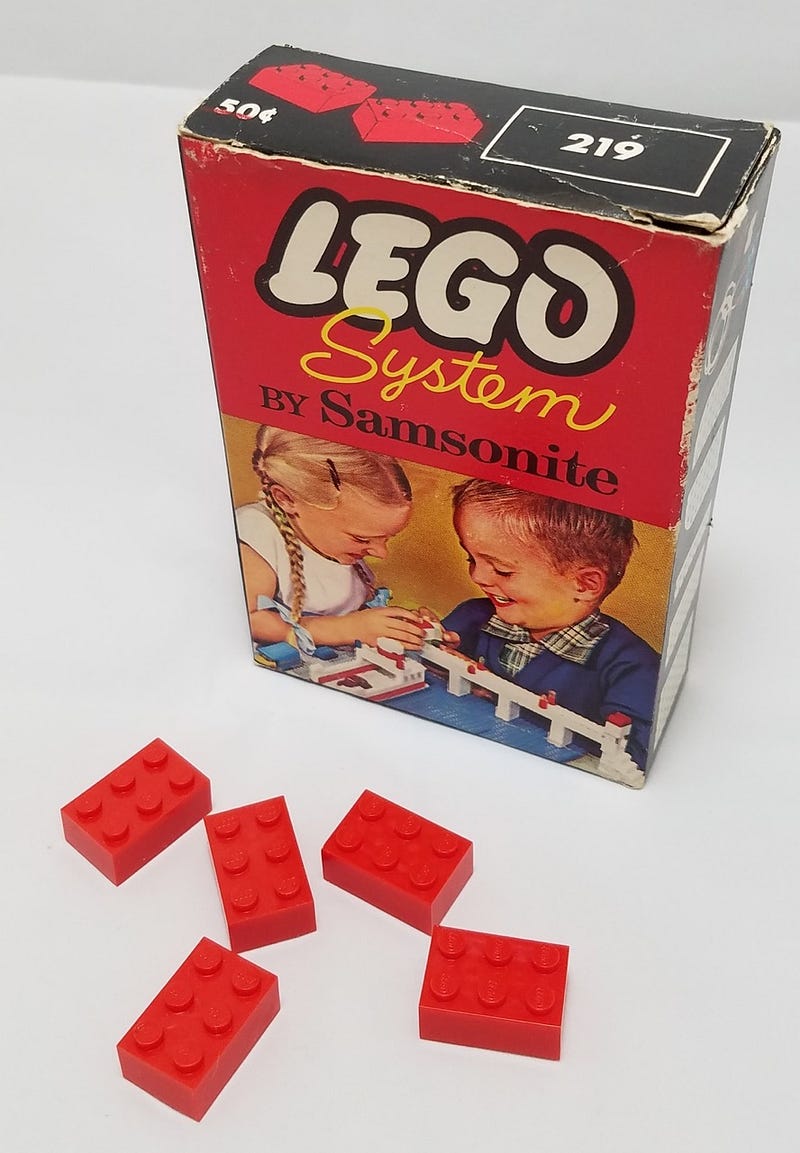
Now, ask yourself, how feasible does it sound that even back in the 60s, a toymaker would be able to build a business, not just survive but eventually thrive by selling nothing more than 50 cents boxes of red bricks? If you think for more than a second, you’ll realise, it’s quite unlikely they only sold the classic red bricks. Well, they probably sold them in blue and yellow as well, right? True. Still not a viable business. And frankly it wasn’t, and it didn’t have to be, because LEGO sold a good number of sets as early as 1961!
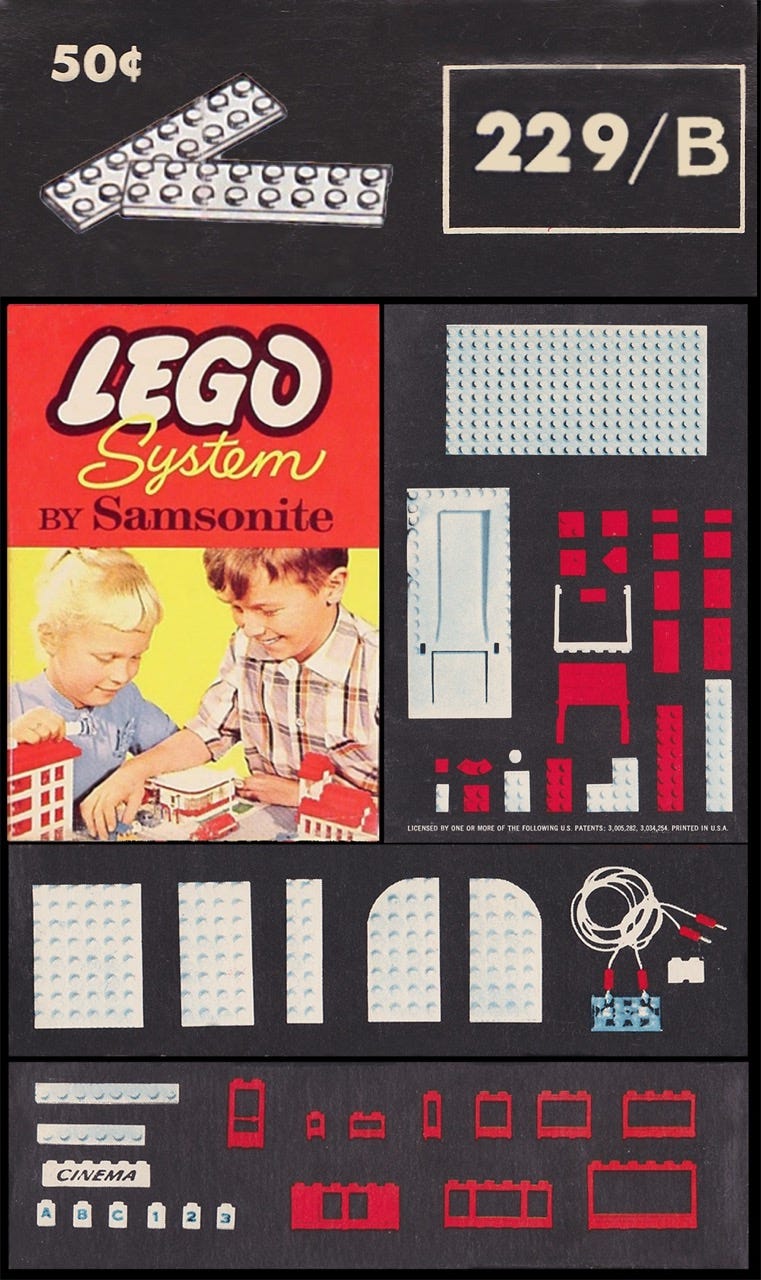
In fact, if you look at the 1961 portfolio, you’ll see that the bricks barely made up 25%. Everything else wasn’t just bricks. You’ll see there were already a wide array or pieces from bushes, trees, to printed elements, road-signs, lamp-posts, garage doors, windows, plates of various shapes and sizes, flags, slopes, you name it. Take a look at the 229/B extension set, and you’ll already see how wide the brick selection alone already was. It even comes with electric lights!
Scrubbing through the years, the 1963 Educational set is another fantastic example of just how many types of parts, LEGO already made back then. Then there’s the 1964 train and the 1965 airplane, and these are by no means the exception to the rule, they’re just notable examples of sets that many claim never existed or had no idea about. Were the details less fine? Sure. Everything looked a tad more blocky, but the concept of having a selection of bricks to build something specific according to instructions, and then maybe — if you wanted to — take it apart and build something else, was there for many decades now, over half a century, in fact!
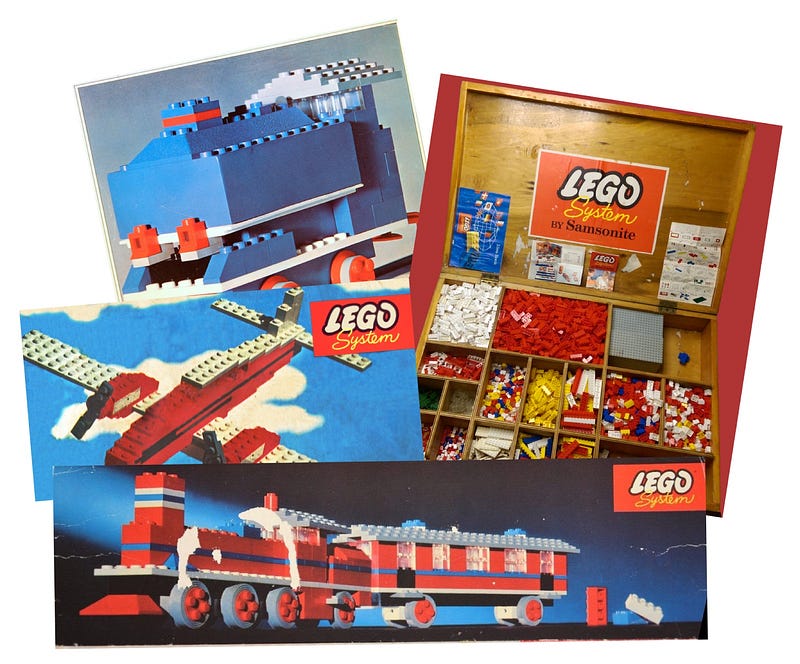
By the way, what’s with the Samsonite bit, you ask? Well, that’s a whole other story for another article, so subscribe, and you’ll find out all about it without having to Google! Ain’t that neat? 😁
And speaking of the 60s, and nostalgia, here’s a very timely, fantastic insight into where it all started, by Manali Mitra.
So, why the myth, then?
Short and funny answer? Your parents were cheap. The less funny but equally short answer is that your parents were poor. I’m not trying to offend anyone here, but let’s admit, every myth starts somewhere. There is a cause, so this one isn’t entirely unfounded either.
Most people very conveniently remember only these small cardboard sets with nothing but one kind of brick, like this 2×3 box of 24 bricks. To some extent it’s understandable, they’re certainly iconic, and 50 cents a box also made them widely affordable for parents to get for their kids. But that’s also the reason, why many people only remember or choose to remember these.
It’s an involuntary bias to think that just because I didn’t have something, it didn’t exist, and just because me and all my friends had the same thing, that’s the only thing that existed.
There was no internet back then. The information-sharing highway was the street, and the hubs were the schools. Television ads perhaps added an extra layer to it all, but not enough to register for most kids. In sharp contrast, today, if a new set leaks, within hours, in every corner of the world, every LEGO fan knows and has an opinion on it. Heck, I found out about Queen Elizabeth II from an Instagram LEGO page, as brick-built corgis started popping up everywhere within hours of her death!
It is absolutely normal and human to think that our bubble of reality is the de-facto reality for everyone. Don’t think that’s true? How many times do you read an article or see a video from an American, Australian, or even European perspective making ludicrous assumptions that it applies to the entire planet? More often than not! Us, humans, are shite at looking at the world from any other perspective than our own, at considering that reality around us, might just be a sliver of a much larger world.
There was never any malice behind the classic red brick myth, just pure ol’ human nature.
A warm message to the LEGO nostalgics
This article is by no means a stab at any of ye. Let’s agree that we all love LEGO in some shape or form, and move on. The way the younger generation loves LEGO and the way many of you did (and still do), does not have to be the same for us to all enjoy the same toy. In fact, LEGO never gave up on the nostalgic adult who used to be a kid in the 60s and 70s.
You absolutely can recreate those times. There’s a fairly wide array of classic sets, and if you’re a hard-core LEGO nostalgic wishing back the red-brick days of the mid 20th century, you can get that. LEGO has a pick-a-brick service, that lets you buy just that part as many times as you like. In fact, I did some of the work for you, and did some maths, so you don’t have to.
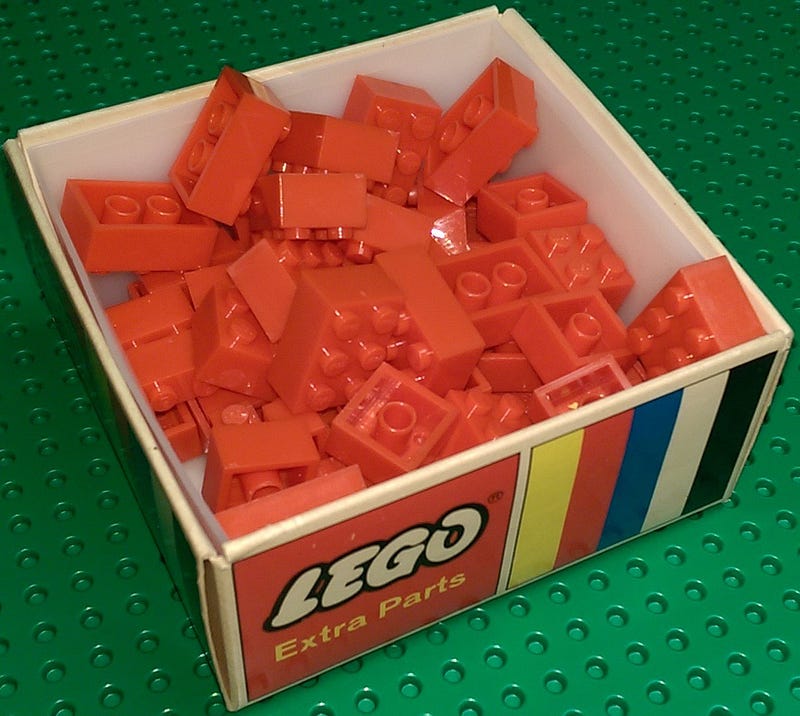
You can still get classic red bricks. On average, 17 cents a pop. Calculated with inflation, it’s still the same price, might even be a tad cheaper. A 2×2 brick costs 14 cents, a 2×3, 17 cents and a 2×4, 22 cents. Looking at the 1966 assorted basic brick set which at today’s prices would cost nearly 9 bucks, still gives you 50 bricks, just like back in the day, with money to spare for that 10×10 baseplate. If you want to go even cheaper, there’s always the pick-a-brick wall at the official LEGO stores. You can fit a ton of bricks into a cup. A lot more than you think! So, stop moaning about the “good ol’ days”. They didn’t go anywhere! 😄
Alright, so with that out of the way, can we all go and build something cool, please? 😁
Attila Vago — Software Engineer improving the world one line of code at a time. Cool nerd since forever, writer of codes and blogs. Web accessibility advocate, LEGO fan, vinyl record collector. Loves craft beer! Read my Hello story here! Subscribe and/or become a member for more stories about LEGO, tech, coding and accessibility! For my less regular readers, I also write about random bits and writing.