
The Beatles: Influence that Lasts #1
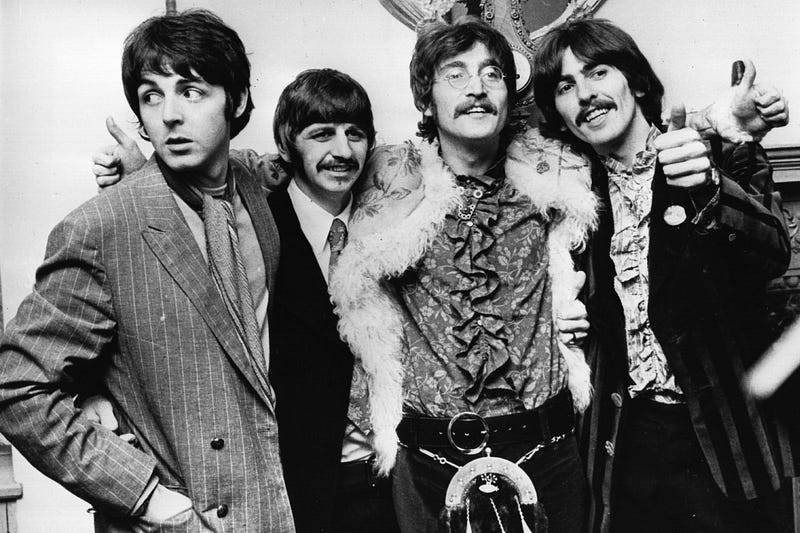
Recently I have been returning to that mysterious well that never dries up, the source of eternal inspiration, I am speaking of course about the article in Vulture magazine
All 240 Artists in the Rock and Roll Hall of Fame, Ranked From Best to Worst
An article that epitomizes everything that is wrong about listicles while also being actually pretty great, if you can get past the fact that some rankings are weird and the haphazard application of moral stances to rock and roll groups, of all the weird things to apply moral stances to.
I am not the kind of person who can get past certain facts, which is why I wrote a bunch of responses.
Recently I wrote some stuff focusing on one inductee in particular
The Vulture article didn’t really have a lot to say about his old group, here’s the entirety of their entry:
A joyous sound that turned ever inward, leading the way for just about everyone who followed — and, with Elvis, the epitome of pop stardom.
The third hall of fame induction numbered only five acts and included ’60s stars like the Beatles, Dylan, the Beach Boys, the Supremes, and the Drifters. (The Stones didn’t get in until the following year.)
Which really doesn’t say why Wyman thought they should be at second place, but we didn’t actually say anything more enlightening — focusing more on The Beatles relationship ranking-wise to Chuck Berry
1. Chuck Berry — The Beatles
It used to be that the Beatles would always be at #1 in these kinds of things, but in recent years Berry has started getting ranked first. I can’t help but think it is prompted by a feeling that it is somewhat gauche that 4 white guys from England should be the top of an art form created by black people.
But on the other hand Berry has always been placed near the top. Many innovations lyrically and musically can be placed at his feet, and I think it is reasonable to say it would be wrong to dislodge him from first place. Therefore Berry and The Beatles share the first place.
Wow, we probably had more to say about the individual members in their 70s period in:
Yes, now — let’s see we put them at
17. Martha and the Vandellas — Paul McCartney — John Lennon — George Harrison
Aside from the Martha and Vandellas part I said the following
Those Guys who were once in the Beatles
The guys who were once in the Beatles can never be considered the GOAT, because anyone liable to do that considering would of course choose the Beatles. Anyone who persisted nonetheless would again be treated as absurd.
Wyman put Lennon at #44, McCartney at #77 and George Harrison at #224 which are again all defensible choices and in fact I am willing to admit my choice here is more of a reach and Wyman may be totally correct and I am totally off.
In some ways, the guy that is the most defensible for Wyman’s viewpoint, George Harrison, is most defensible for my viewpoint.
Here’s the quote from the original article:
This induction is sort of a joke. After Bangladesh and All Things Must Pass — that is to say, after 1971 — Harrison’s solo career was a steady downward slide. You won’t hear this in the four(!)-hour Scorsese documentary, but his Dark Horse tour was a fiasco, his solo records were uniformly mediocre, and that big late-career hit (“Got My Mind Set on You”) was a cover. Harrison was a fabulous part of the fabulous Beatles and he’s deservedly well-loved. The Concert for Bangladesh film is highly enjoyable to this day. But he’s not an important artist as a solo figure.
Evidently not a Traveling Wilburys fan, then.
Harrison has 4 important qualities that make him influential solo for Rock and Roll, many of which are not musical.
First without the concert for Bangladesh would Live Aid have happened? I discussed this kind of critical what-if-ism in the earlier listicle 3 article:
There will always be a first, because that is just how time works. But of course if you have been preceded by someone and you are naturally inclined to do something similar to what those before you have done, you will probably become familiar with their work and as such you will be influenced by them
Which is about musical influence anyway, but in the case of Concert For Bangladesh and Live Aid I mean it.
I remember reading somewhere the idea that Bob Geldof was the perfect musician to organize Live Aid because he was not particularly important , but still well enough respected that others would value his opinions and ideas, that because of his minor status people would not let their egos get in the way. I think that is true, but also due to his minor status it would not have come together and been made to work if it were not for being able to point to Concert for Bangladesh. In short George Harrison is probably the most influential person for Rock and Roll’s version of charity.
Musically My Sweet Lord, aside from being a great song, is one of the few songs by a white guy (in Rock and Roll) that is spiritual and believing in a God of some sort that is not also absolute dreck. I don’t think that made it especially influential as I just noted all the other white guys doing God stuff are dreck, but it existed as an important counterpoint to the two other ex-Beatles who share this rank, Harrison’s spirituality and charity functioned as a critique of both McCartney’s being in the pleasant suburban rock star business post breakup, and Lennon’s thorn in the side activism which in a lot of ways seemed self-absorbed and unlikely to ever do anything. George Harrison did things, and that elevates him.
In the original article for Vulture Wyman spent a lot of time haphazardly dinging people points for not being moral enough, but never elevated anyone for being better than the rest, which if you can’t do the second — don’t do the first.
My Sweet Lord of course has some other influential points for it, which I will now quote from Wikipedia on this matter: My Sweet Lord — Wikipedia “ My Sweet Lord” is a song by English musician George Harrison, released in November 1970 on his triple album All…
en.wikipedia.org
Later in the 1970s, “My Sweet Lord” was at the centre of a heavily publicised copyright infringement suit due to its alleged similarity to the Ronnie Mack song “He’s So Fine”, a 1963 hit for the New York girl group the Chiffons. In 1976, Harrison was found to have subconsciously plagiarised the song, a verdict that had repercussions throughout the music industry.
That’s perhaps not a great thing to influence the industry with, but it was an important factor in developments industry-wide — if it can happen to George Harrison you better believe it can happen to whatever new act you sign. Also just put this in:
Many artists have covered the song, most notably Edwin Starr, Johnny Mathis and Nina Simone. “My Sweet Lord” was ranked 454th on Rolling Stone’s list of “the 500 Greatest Songs of All Time” in 2004 and 460th in the 2010 update and number 270 on a similar list published by the NME in 2014. It reached number one in Britain again when re-released in January 2002, two months after Harrison’s death.
I mean, aside from everything else on All Things Must Pass that song pushes you pretty high. I’m not going to argue more on Harrison, other than to note that Wonderwall Music seems to have been somewhat influential, and All Those Years Ago and the Traveling Wilburys don’t seem as big a joke as the Vulture ranking would has us believe.
I’m not going to talk much about McCartney here, as I intend to do a stronger focused article on him later (here is that article https://readmedium.com/ae6ca0b58f09), but I think the influence of McCartney and Lennon cast a long shadow over much of the 70s until punk arrived.
Lennon is the most easy to see, his life and his murder in 1980 making the most shocking death for a couple generations of Rock and Roll fans. McCartney stands in contrast to Lennon, Lennon stayed the vision of the artist as revolutionary, but McCartney became the artist as businessman. People don’t respect McCartney’s decision as much, but it certainly seems more levelheaded.
I think McCartney is probably a good model and strong influence on all those singer-songwriters of the 70s, and a march back to the professional musician of previous generations, still a rock star, but not one who needed to destroy himself. Which I guess for a lot of people equals sell out, but the dirty little secret of death is that most people would rather sell out if it meant self-preservation.

The fact is nobody really takes the time to argue why the Beatles should be ranked that high, probably because the argument has been made thousands of times in the past and if you’re not convinced yet you probably never will be, but also because people accept as a given many facts in their day to day lives, and one of the things that musicians or musical critics often accept is that The Beatles were, if the not the actual GOAT, very close.
Another reason is that this is the internet and an article that will take 11+ minutes to read is considered long form and hardly anyone sticks it out so nobody is going to last for the arguments for the greatness of The Beatles.
So, knowing the limitations of the Medium I going to have to break this up into several articles — this one being mainly preamble.
But I am going to note that in my rankings I followed mainly the influence a band has had and The Beatles influence has lasted generations of musicians.
The Beatles influence lasts even today, yes one can still get funny little examples of that influence popping up from time to time, like Jack White being able to name any Beatles song within one second
The Beatles have evidently been a major influence on somebody born nearly a decade after they broke up. In contrast it would be difficult to imagine D.W. Griffith’s influencing anyone born in the 1930s, who might have started making movies in the 1950s.
Robert Altman might have been awarded the D.W. Griffith award by the Motion Picture Academy of America, but I don’t expect we’ll unearth a video of him sitting around and naming off Griffith films based on a closeup of Lillian Gish (although that would be a far easier exercise)
This is the first in a series of articles by IG Agent 19 in which he will try to reasonably evaluate the legacy of The Beatles.
Other Articles that IG Agent 19 has worked on that might be of interest