
The Art of Weaving Past into Future
How Hosteen Klah became one of the first Modern artists of the Navajo Nation
Perhaps Hosteen Klah wouldn’t have thought of himself as an artist. He was a skilled singer of traditional healing songs, practitioner of herbal medicine, maker of ceremonial sand paintings — a great shaman. He was also expert in various Navajo weaving techniques. In fact, it seemed he mastered anything he turned his ambidextrous hands to.
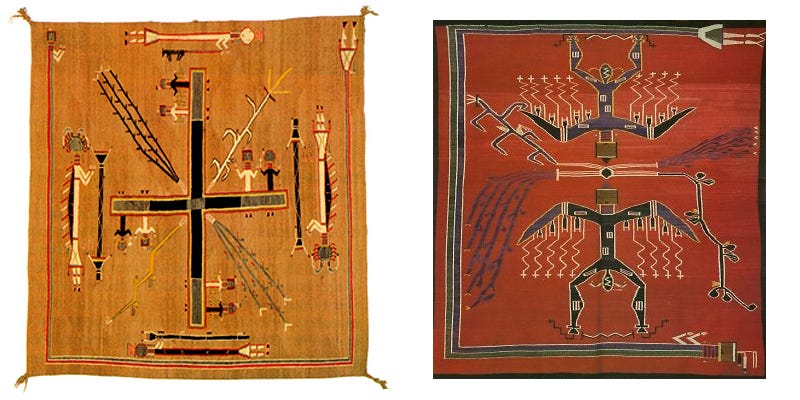

Klah first drew wider public attention when he demonstrated traditional sand-painting and weaving at the 1893 Chicago World Fair, which was held to commemorate the 400th anniversary of Christopher Columbus arriving in the New World. How ironic?
It seems Klah’s primary motivation for spreading his people’s traditions beyond the borders of their reservation was to preserve, or at least document, them for posterity. He found a few apprentices to whom he could teach healing chants, sand-painting, and weaving, but felt there were not enough to ensure the techniques would endure beyond a generation. He feared the imminent demise of the old ways which were being deliberately eroded by US governmental policies and schooling. His shamanic practices were also under orchestrated attack from the encroaching assimilationist culture and aggressive Christian missions.
Luckily, Hosteen Klah was adept at bridging cultural and socio-political boundaries. After all, that’s what a shaman does. Shamanism involves travelling between realms. This can be a physical journey as a shaman is expected to be at one with the land, to know it in minute and intimate detail. They can read the signs of nature and hold a map in their minds of where to find certain plants, water sources, shelter, rare minerals, hunting grounds, and places of power where the physical and spiritual worlds touch.
They also undertake non-corporeal journeys into the realms of the ancestors and the eternal spirits. They do this to learn from the collective knowledge of their clan and to bring back healing ‘spells’ to cure the sick in mind and body. These spells are then communicated via chants, dances, and symbolic art.
He did not go to state school and was instead raised and educated by his family on the reservation. Several things marked Klah as special from an early age. For one, he was ambidextrous, with left-hand dominance, one of several features that could identify a potential shaman.
When trained by the elders in the healing ways, he showed rare aptitude for learning the incredibly complex songs and could perform the advanced Hailway when he was just 10 years old. Apparently, most chanters can memorise two or three rituals in full, and he became adept at at least eight including the nine-day Nightway ceremony, which he was known to perform with impressive accuracy and spiritual stamina.
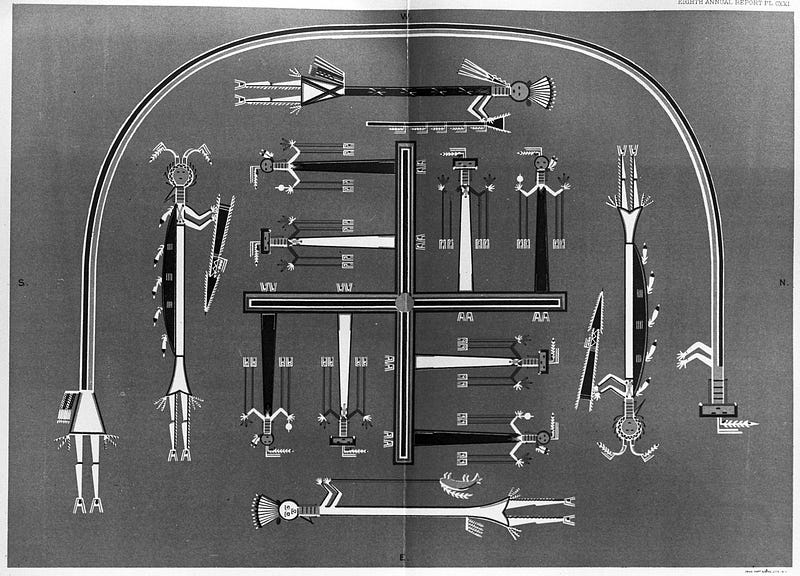
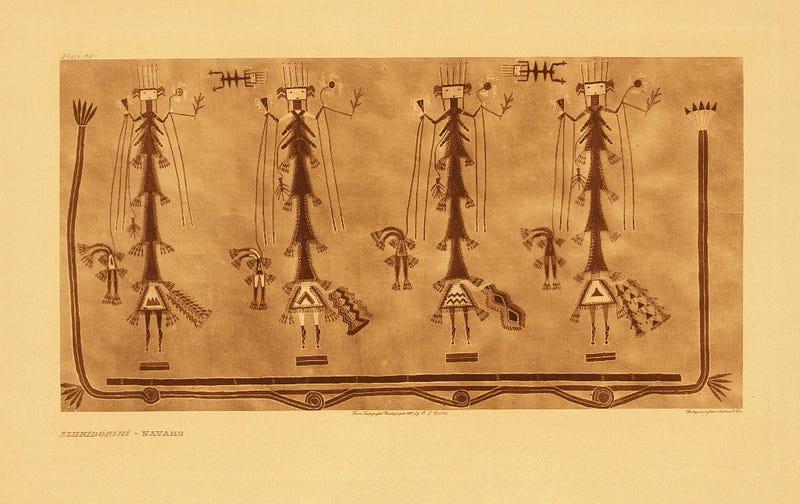
.jpg)

Such ceremonies involve long songs, movement, dance, and complex visual aspects, including the intricate ‘dry-sand-paintings’ of precise designs. Specific costumes and masks sometimes featured, but apart from those worn elements, everything involved was transient, only existing during the ritual. The sand designs were symbolic conduits for the spirits and were swept away after use to set them free once more.
The learning and singing of tribal songs was traditionally within the male domain. I suppose that’s why shamans are often generically referred to as ‘medicine men’. However, alongside learning the ancient chants and healing arts from his uncles, Klah was also trained in weaving by his mother and sister.
Thus he identified as nádleehi, which doesn’t easily translate but means something like ‘one-who-changes’ and was another factor that indicated a person with shamanic potential. The term often referred to those who did not settle in one traditional gender identity. Today, he would be counted among the ever-growing gender-fluid family and could choose preferred pronouns accordingly.
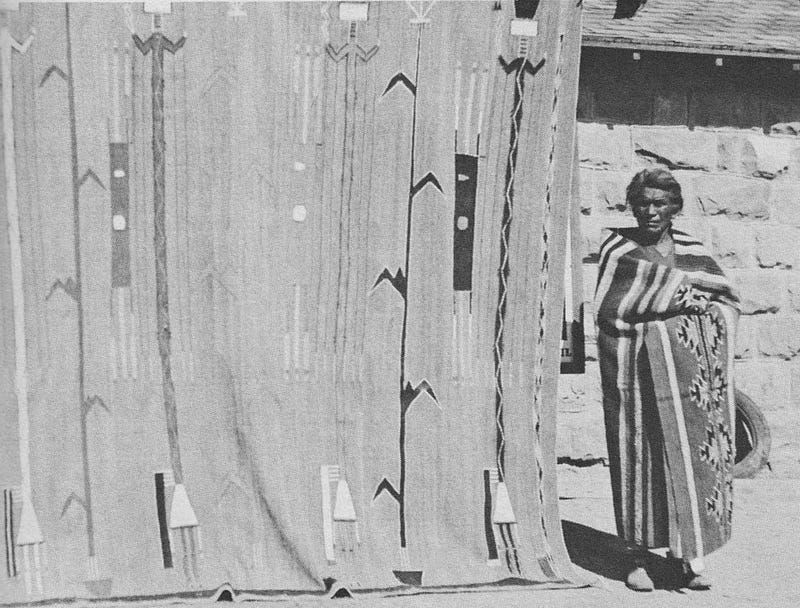
It is for blanket weaving that Hosteen Klah is now famous. Shortly after 1910, Klah began weaving blankets that, for the first time, incorporated ritual designs. One of the earliest examples of these depicted a ceremonial dance and sacred masks worn by the dancers. This was highly controversial and some of the other clan elders condemned it as sacrilegious. They demanded that he perform a kind of exorcism to free any spiritual powers that may have been trapped in the fabric and then for the threads to be unpicked. Klah took these things very seriously, probably more so than most. So, he performed a ritual to dispel any ill effects but stopped short of destroying the work. Instead, he sent it to be displayed in Washington.
When this experiment did not result in any misfortune, he began making blankets unlike any previously produced by Navajo weavers. Whilst using the many and varied traditional techniques, his designs began documenting figures from ceremonial sand-paintings. Whilst creating these fabrics, from raw wool through dying, carding, spinning, and weaving, he would meditate upon the meanings and recite the appropriate chants to ensure the cooperation of the spirits.
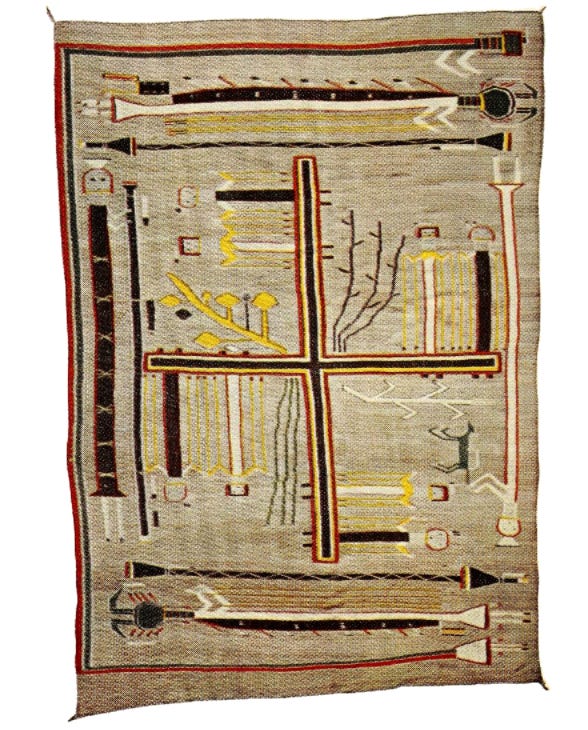
Remember, the dry-sand-paintings were always swept away at the close of a ceremony to free the spirits. So, fixing them in a permanent medium was believed to be incredibly brave or extremely foolish. However, Klah felt this was the best way to make sure the deities and their ancient motifs survived and were not left to fade into forgotten antiquity. His first tapestry to be based on an authentic sand-painting is known as The Whirling Log design as featured in the Nightway rituals.
He began trading these beautiful blankets and tapestries during the 1920s as a way of disseminating the designs. He hoped that spreading the traditions beyond the Navajo people would nurture greater awareness and help their ways to be more widely accepted, as well as preserving the arcane wisdom encode into the tapestries. Indeed, they attracted wealthy patrons for whom he also produced watercolours and oil paintings documenting ritual figures.
Boston heiress, Mary Cabot Wheelwright, began collecting Klah’s work and involved him with setting up a museum centred around her collection. Their Museum of Navajo Ceremonial Art was intended to preserve the old ways for future generations and opened to the public in 1937. It can be considered a success to some extent as, by 1977, much of its collection was repatriated to the Navajo Nation. The museum survives as the Wheelwright Museum of the American Indian in Santa Fe, New Mexico.
Hosteen Klah is a fine example of an unconventional individual with the power to transform the mind-set of the culture that surrounds them. He became a well-known and successful artist in his own right and taught weaving to his nieces, among others. So, the traditions survived, as well as the sacred designs he introduced to the craft. He leaves a significant legacy echoing through Modern and contemporary art.
It embodies many of the concepts that preoccupied Modern artists and influenced many interested in unusual methods of representation. A lingering resonance of such tribal designs can detected in the abstracted forms of Paul Klee, and Surrealism also looked to the ability of magical and religious art of this kind to represent what lies beyond the surface… of the painting… of ‘reality’.
* All images are used with permission or presented here for educational purposes under fair usage policy.