
The Art of Early Discovery (a short note)
Weaving the Mind and Clarifying the Order
This morning I revisited CALL’s Annual Review (2020–2021) and my recent 2023 annual review.
I’d like to share three related diagrams.
#1 — Oct 31, 2021
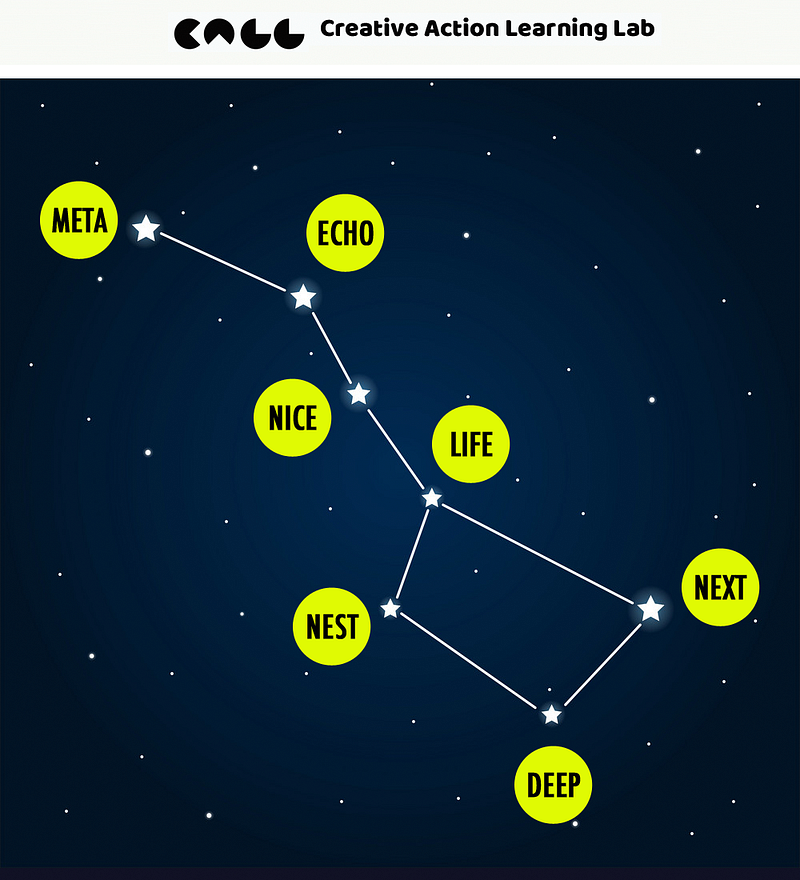
On Oct 31, 2021, I wrote CALL: Annual Review (2020–2021) with the above diagram.
CALL stands for Creative Action Learning Lab. I started it as a digital garage on Medium in Oct 2019.
From Oct 2020 to Oct 2021, CALL became a Knowledge Curation Studio which produces a set of knowledge frameworks and builds an ecology of ideas. I also wrote seven books which are drafts. In addition, I worked on four independent research projects to test concepts and frameworks.
How did I curate these creations into a meaningful whole?
In order to visualize this complicated network of ideas, I use Big Dipper as a metaphor to design the above diagram.
Inspired by Howard E. Gruber’s Evolving Systems Approach to the study of Creative Work (1974,1989), I use his idea “Network of Enterprise” to manage my creative work.
According to Gruber, “We use the term enterprise to stand for a group of related projects and activities broadly enough defined so that (1) the enterprise may continue when the creative person finds one path blocked but another open toward the same goal and (2) when success is achieved the enterprise does not come to an end but generates new tasks and projects that continue it.” (1989, p.11)
I sort my frameworks into seven enterprises. Each enterprise has a short nick name.
- CALL for ECHO → Boundary Innovation
- CALL for LIFE → Creative Life
- CALL for NICE → Creative Action
- CALL for NEST → Part — Whole
- CALL for DEEP → Supportive Development
- CALL for NEXT → Present — Future
- CALL for META → Meta-knowledge
Each enterprise has its primary theme. Each theme refers to a core framework and a set of related concepts, diagrams, and sub-frameworks.
#2 — Jan 5, 2024
From 2019 to Dec 2023, I wrote 26 possible books (drafts) and developed a set of knowledge frameworks.
From Jan 2, 2024 to Jan 6, 2024, I reflected on these possible books (drafts). Finally, I used a Tree to represent these possible books. See the diagram below.
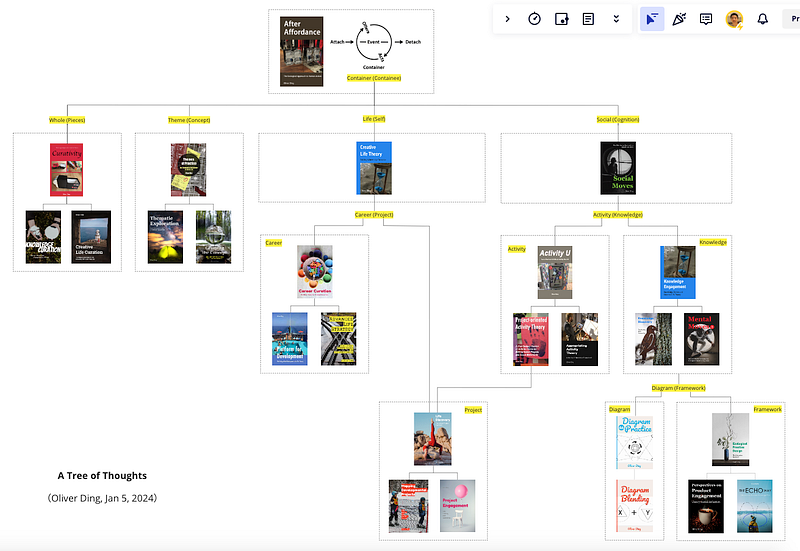
This tree represents the Ecological Practice Approach which is inspired by Ecological Psychology, Activity Theory, and other social practice theories.
You can find more details in Situational Note-taking: A Tree of Thoughts (Oliver Ding, 2023).
#3 — Dec 18, 2023
On Dec 18, 2023, I used the family of “Container Thinking”, the primary idea of the Ecological Practice Approach, as an example to explain the Ecological Formism Framework.
See the diagram below.
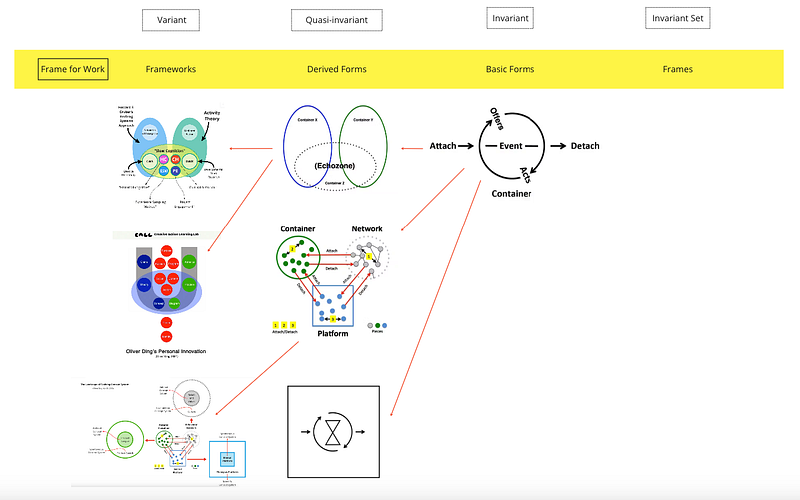
Network vs. Tree
The above three diagrams represent three ways of curating concept systems.
#1 — Oct 31, 2021
- Object: Knowledge Frameworks
- Method: Metaphor
#2 — Jan 5, 2024
- Object: Books (drafts)
- Method: A Fractal Tree
#3 — Dec 18, 2023
- Object: Knowledge Frameworks
- Method: The Ecological Formism Framework
From 2021 to 2024
In the past several years, my concept systems changed from a network to a tree.
Wow!
This is an example of EARLY DISCOVERY of a journey of knowledge engagement.
I consider Strategic Thematic Exploration and Conceptual Elaboration as two phases of EARLY DISCOVERY of the journey of knowledge Engagement. See the diagram below.
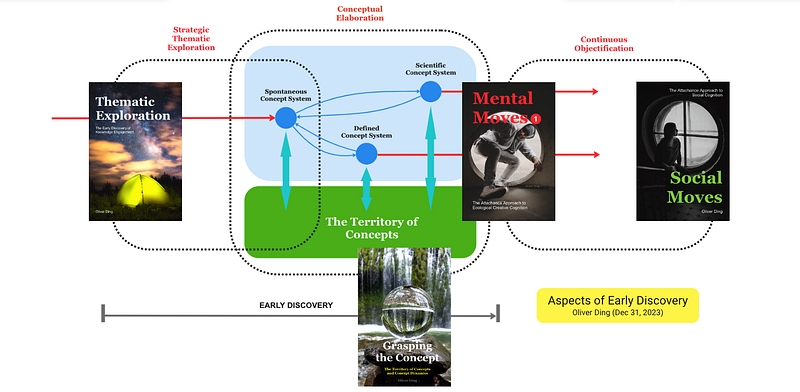
The further phase is Continuous Objectification which aims to turn a concept system into real things.
You can find more details in Aspects of Early Discovery (Series) and Beyond.


