
The Anti-Suffragettes’ Koolaid
How false feminine ideals still mislead us today

Note: To “drink the Koolaid” means to swallow lies, like the 909 members of the Peoples Temple who followed pastor Jim Jones from San Francisco to Guyana in the 1970s where he directed them to commit mass suicide via poisoned punch. It may look delicious, but…
I was surprised to read that 100 years ago there were many, many women who campaigned against woman’s suffrage — asserting that women should not be given the right to vote. In fact, most women did not want the vote, according to opinion polls of the time.
What on earth were they thinking?
A lot of the same palaver people peddle today — that women are men’s “better angels,” that they are innocent and thus morally superior to men, that this inherent ‘goodness’ needs protection, that their rightful place is the home, that being in the public sphere corrupts them, that they are are more effective when influencing men to act on their behalf than when acting on their own…
The false feminine ideal hurts both genders
It’s masterfully deceptive how describing women as angels is both flattering and condescending at the same time — placing men at the center of the world and women as something “other” sent to guide them to do the right thing.
I was reminded of this angel myth when I read Margaret Atwood’s short story “Happy Endings.”
Her friends tell her John is a rat, a pig, a dog, he isn’t good enough for her, but she can’t believe it. Inside John, she thinks, is another John, who is much nicer. This other John will emerge like a butterfly from a cocoon, a Jack from a box, a pit from a prune, if the first John is only squeezed enough.
I laughed out loud when I read those lines, because the idea was so ludicrous and so familiar at the same time. How many women have I seen in movies in precisely this role, helping men to find and express their better natures? How many times have I done the same — forgiving the outward behavior of a male friend or partner for the sake of the better person I believed was within?
Both men and women suffer in relationships based on this gendered “ideal.” Men never grow up to accept the true consequences of their behaviors. Women never realize their goals, devoting so much energy to another’s improvement that they don’t improve themselves.
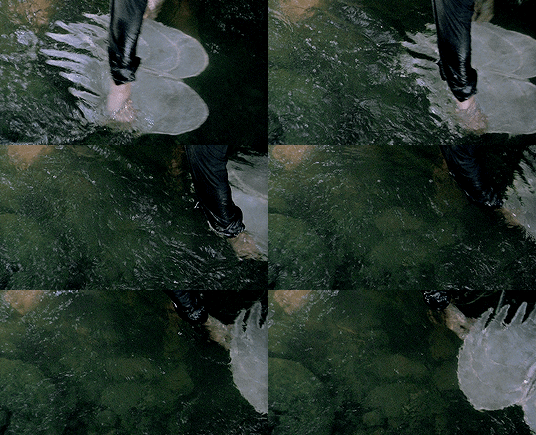
I was reminded of the angel myth again when I went to a Movie of the Moon Club class on Portrait of a Lady on Fire taught by Terry Ebinger, MS.
Before watching the film about two women falling in love in the 1700s, Ebinger defined the feminine principle, or the deep feminine, in many ways that surprised and delighted me.
The true feminine principle is not what you think
The true feminine principle has nothing to do with the childish innocence depicted so often in literature and film. Nor does it have to do with being a “better angel” or an inspirational muse for men — nor it’s shadowy opposite, the sinful seductress.
In fact, the feminine principle is available to both women and men, and its aggressive devaluation in Western Culture is one reason the world is in such terrible trouble today. Giving the feminine principle the respect it deserves will help us find our way out of these woods.
As described by Ebinger, the feminine principle can be represented by:
Silence, stillness, solitude Process orientation rather than goal orientation Holding paradox, rather than choosing one or the other Presence Receptivity and yielding The moon herself: reflected light, not direct light The quality of darkness, hidden treasures The quality of not knowing Mystery, gestation Questions, not answers The circuitous path, not the direct path Depth Slow unfolding Non-hierarchical traditions of sorority and equanimity
“All the things on the other (masculine) side of this list are also necessary, but we have overvalued them in modern culture,” Ebinger said.
And overvaluing the masculine principle has led us to horrific wars, gross inequalities, and violent struggles for supremacy — white and otherwise.
The role of media in upholding patriarchy
Ebinger also said she was committed to 5050 by 2020, meaning that 50 percent of the films we pay attention to (as of this year!) should be by women.
Why? Because films by men overvalue the masculine principle. And because overvaluing the masculine has led to this dystopian place.
As a passionate consumer of film and literature myself, I have another reason to support the “revolutionary” proposition of 50/50. Boredom. Because after a lifetime of watching television, going to the movies, and reading books, there is no story told from the male point of view that I haven’t already heard multiple times. I’ve seen it all. Every iteration. Yet the woman’s viewpoint is still new. Fresh!
This reminds me of a scene from Little Women, the book written by Louisa May Alcott in 1868 and most recently adapted by Greta Gerwig in 2019.
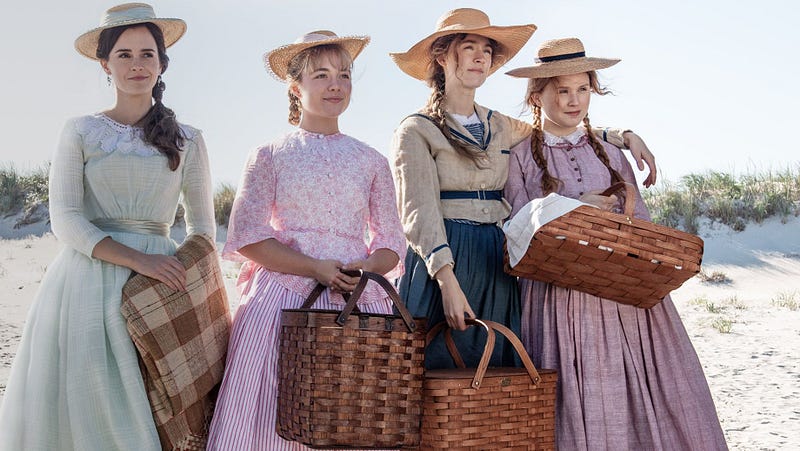
The main protagonist, Jo, is a writer and here she is talking about her latest endeavor with her sister, Amy.
“It’s just about our little life. Who will be interested in a story of domestic struggles and joys? It doesn’t have any real importance.”
“Maybe we don’t see these things as important because people don’t write about them.”
I don’t know whether Alcott or Gerwig wrote that line, but it speaks to me directly, because of course the experiences of half the world’s population have value! It’s absurd that we ever saw it any other way.
There was a time when movies centered on women were so rare they were called “chick flicks” (are they still?) and men were embarrassed to see them. The trivializing term is another masterful deception, suggesting that movies about women and human relationships are inconsequential when compared to movies about men blowing things up.
That topic in turn reminds me of a saying my brother-in-law attributes to his dead Irish mother. “The winners write the history books. The losers write the songs.”
And which of those are more often true, I wonder? More philosophical? More likely to lead us to a better place?
It’s masterfully deceptive how describing women as angels is both flattering and condescending at the same time — placing men at the center of the world and women as something “other” sent to guide them to do the right thing.
We’ve seen in 2020 in particular, when protestors were inspired to pull down monuments to “heroes” of the Confederacy — men who went to war to protect their “right” to keep people as slaves — how poorly history books are written, how much is left out, how much is plain aggrandizement and lies.
Part of the reason is most histories were written by men, the “winners” who overvalued the masculine ideals and left the feminine out. The same is true of most monuments, movies, and books.
The male vs. the female gaze
Ebinger also clarified the meaning of the “male gaze,” a feminist film theory developed by Laura Mulvey in the ’70s which is often referred to in movie reviews today.
“The male gaze is a conventionalized way of depicting women from a heteroxexual masculine perspective — especially in film, that’s what she was writing about — that presents and represents women in idealized, sexualized, fetishized forms of objectification, especially as sexual objects for the male viewer’s pleasure and dominance,” Ebinger said.
When making Portrait of a Lady on Fire, director Celine Sciamma was interested in creating something new and different from the “normal” masculine conventions of film. What a welcome relief!
To Sciamma, that meant making a love story in which there was no domination, in which the desire would develop slowly, contrary to the familiar “love at first sight” convention that derives from a patriarchal point of view. And, most interesting to me, it meant deconstructing the idea of a “muse.”
“The whole movie is about equality and how, when you’re looking at someone, they are also always looking at you,” Sciamma says in the clip above. “So, this whole process of reinventing the muse figure, and saying that there is no muse, there is only collaborators, and women aspiring in a mutual way, that was also the perspective.”
This idea spoke to me because I remember quite clearly in my youth in the ’70s dreaming of becoming some great artist’s muse. I didn’t dream of becoming a great artist myself, but inspiring a man.
Clearly, I had drunk the same koolaid as the anti-suffragettes.
We need a new drink
In thinking about the anti-suffragist postcard below, a few things come to mind. One, if the genders were reversed, no one would bat an eye. In fact, men commonly hobnob, drink, and take their leisure in one room while women work in another in cultures throughout the world.
Here the “Antis,” as they were called in the early 1900s, seek to appall the viewer by merely reversing the roles. How horrible it would be if women took their leisure in the front room while men worked in back!
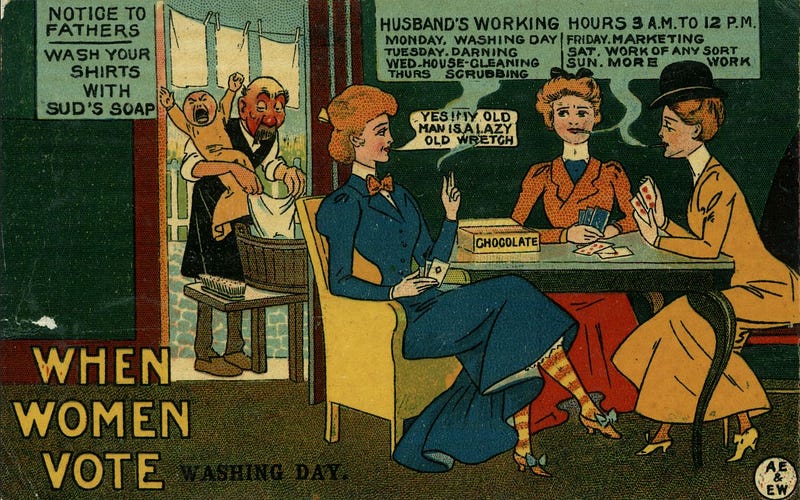
Although the fact that the mirror image would be acceptable to most people is degenerate, I agree on one point the postcard is trying to make. Encouraging women to be more masculine is not the answer to society’s ills.
Neither is making women more “feminine” according to false feminine ideals of innocence and angelic purity.
Instead, we need to honor and uplift the true feminine principles in all people. If you could put some of those in a refreshing beverage, that’s one koolaid I’d gladly drink.
For further reading:
My writing is free to readers who follow links from Twitter, Facebook, and LinkedIn, but if you’d like to read more, click here to join Medium for $5 a month and they’ll give me some of that money. (Yes!) For an email when I publish a new story, click here. Find more stories about Women & Feminism this List. And for more of the good stuff, follow Fourth Wave, where we’re changing the world for the better, one story at a time. Got one of your own? Submit to the Wave!


