
5 Reasons I’m Excited About the Nobel Prize in Chemistry
A random list of joyful responses to the news
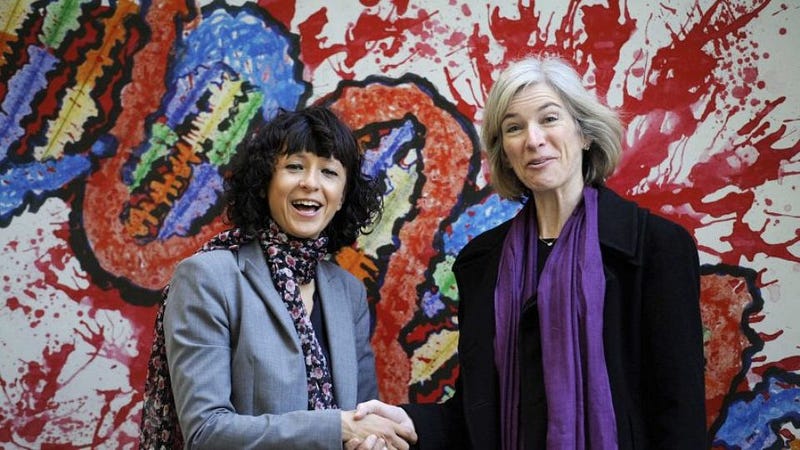
Two women won the Nobel Prize for Chemistry the first time in history on Oct. 7 and I’m pleased as punch for so many reasons. Here are the top five random reasons this particular award brings me joy.
1. TWO WOMEN
Women received the chemistry prize only five times before in the Nobel’s 119-year history, and then it was sometimes in collaboration with men. This is the first time an all-women team has won. And they absolutely deserve it! Their discovery is a complete game changer in genetics (see #3).
There have been many fine women scientists over the years, but just as with Black people and other disempowered groups, they haven’t been included in the history books, lauded in public monuments, or given prestigious prizes because of systemic bias for white men. In fact, I just read this story about 25 great women scientists who never got the credit they deserved.
This prize makes me hopeful that the world is evolving — that all people will someday get fair and equal treatment in the workplace, not only in science, but in every field.
2. UC BERKELEY BEATS HARVARD
I’m from the Bay Area and UC Berkeley is my dream school. When I die and go to heaven, I hope I’ll wake up to find myself enrolled at UCB. I didn’t go there (couldn’t get in), but my daughter did, as did one of my sisters. It’s a public school which welcomed women almost from the outset (in 1871, two years after opening), and when my sister went there, it was free!
Harvard, on the other hand, is an elite private school that was built with slave labor, disallowed women for 250 years (until 1894, when Radcliffe opened to educate women while still keeping them separate from men), and promoted racist propaganda throughout its history.
So what does this have to do with this year’s Nobel Prize? Berkeley and Harvard are in a legal dispute over who owns the patent to the invention for which the prize was awarded.
Even though Dr. Doudna from UC Berkley and her partner Dr. Charpentier from the Max Planck Institute for the Science of Pathogens in Berlin published first and applied for the patent first, a team from Harvard and MIT also applied for the patent, and paid extra to get an expedited review, so their patent was awarded first. Typical privileged class cheat!
Not only that, but as a public university, anything invented at UCB belongs to UCB, so if UCB wins the dispute, the many gazillions of dollars which are bound to be generated by this invention will be used for the public good, not to make a few more men rich.
Getting the prize is an indication of where the science community stands on the dispute, which is still in the courts.
3. THE INVENTION IS AWESOME
What Doudna and Charpentier invented is sometimes called “genetic scissors.” It’s official name is CRISPR-cas9. It allows for precise editing of DNA, which could eventually lead to cures for genetic diseases.
I’m not a scientist, so any description I try to throw together here is bound to fall short. But I found a fantastic set of pictures in The Nib that outline the legal dispute and also explain the invention.
Bad Blood | The Nib
Who gets credit for the technology to cut-and-paste the human genome?
thenib.com
One story referenced in the “comic” linked above is about how a man wrote a paper describing the invention of CRISPR and left the women scientists out! Unbelievable. Find that story here.
Other stories describe fears that the new technology will be used to make “designer babies,” as one scientist in China claimed to do and was sent to jail for. He said he made a pair of twins resistant to HIV. Certainly, there are ethical issues still to be worked out about its use. Still, there’s no denying that the invention is awesome and hopefully will be harnessed for good.
4. GIRLS NEED SCIENTIST ROLE MODELS
I’m currently reading Lab Girl for my book group and was struck by the ways American culture discouraged her from becoming a scientist in her youth. Here are a few quotes from the first 20 pages.
When I was five I came to understand that I was not a boy. I still wasn’t sure what I was, but it became clear that whatever I was, it was less than a boy.
My father looked just like a scientist was supposed to. He was tall and pale and clean-shaven, thin-almost-gaunt in his khakis and white shirt and horn-rimmed glasses, complete with a pronounced Adam’s apple. When I was five I also decided that the real me looked exactly like that, even though on the outside I was disguised as a girl.
My desire to become a scientist was founded upon a deep instinct and nothing more; I never heard a single story about a living female scientist, never met one or even saw one on television.
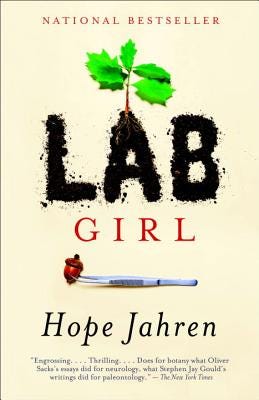
Hope Jahren was lucky that her father was a scientist, so she had a clear model of what she wanted to become.
Most children don’t have parents who are scientists. They need to see both male and female scientists in books, school, society, and the media in order to imagine that role for themselves.
5. MY DAUGHTER IS A SCIENTIST
I’m not a scientist. Neither is my husband. But our daughter became one after learning to love science in school. Seeing these two women scientists get the Nobel Prize makes me joyful because I can imagine my daughter winning global acclaim someday. And even if she doesn’t make a world-changing discovery, my guess is the accolades earned by doctors Doudna and Charpentier will make it more likely that my daughter will get the respect, credit, and rewards she deserves in her chosen field.
For more of the good stuff, follow Fourth Wave, where we’re changing the world for the better, one story at a time. Got one of your own? Submit to the Wave!
For more by this author, try:


