
The Anatomy Of A $1000 Article
A pragmatic look at what can potentially make an article profitable…

A few things I will never do as a writer is share my earnings, give you blueprints for how to write viral articles, or feed you any kind of bullshit. I consider myself a pragmatic programmer, but that stems from being a pragmatic person first and foremost. This article will not be your average clickbait story that says a lot without saying anything, so get comfortable, pour yourself a glass of beer or a cup of tea, get a couple of custard biscuits on the side, as I’m not planning to make this short. Beyond that, I also hope this will make you pause a few times as you read and ponder on the various aspects I am going to touch on. Enjoy the read and perhaps share your thoughts in the comments.
Context and competition
I am a tech writer but have been writing other stuff in the past as well. Just like on YouTube the vloggers, there are plenty of tech writers here and many of them quite impressive. It’s not a small niche by any means, but certainly, one that attracts plenty of attention in an increasingly tech-dominated world. It’s no surprise then that all my best-performing stories are tech related, and the one I am going to give as an example is a tech story.
Timing and topic
I have seen folks attempting to crack the timing aspect of a story for years. Often it won’t matter, but in tech it could be the differentiator between success and total irrelevance. My story — though just by sheer coincidence — was published after a year of owning the 13” MacBook Pro with the new M1 architecture, and just days before the rumoured launch of the new M1 versions.
Generally speaking, early reviews are interesting to read, but everyone takes them with a pinch of salt. Six or twelve months reviews, however, tend to be popular because the information presented is likely more reliable, less hyped and will be based on lengthy day-to-day experience, and you cannot beat that. These are the reviews that many serious shoppers will seek out and read carefully, thus increasing read time.
Additionally, it being so close to the next Apple event, there was a general appetite in the tech community for reading anything and everything around Apple’s new M1 architecture. This, of course, brought even more eyes onto the story, both in the form of casual readers and tech speculators. I have to stress, that in this particular case, it was coincidence. When publishing the story, I wasn’t even yet on the MPP, though was planning to join sometime in October 2021. The timing was entirely coincidental, but nevertheless played a massive role in making the article popular.
Of course, we can’t bring up topic and timing without factoring in the heading. While the content — in hindsight — could be improved upon, I think the title is still spot on. It illustrates my internal struggle with the new technology, the tone suggests I went from hype to something more reserved and realistic, all the while not giving away the punchline or the resolve to the story. It was only half-intentional. When writing the title, I certainly didn’t think much about it other than wanting to highlight the fact that this was a story where I’m reviewing the product after a long cooling-down period.
The invisible side of the iceberg
Now, before you start taking notes and charting graphs on how to write your next popular story, I’ll have to throw some ice-cold water at you. When this story was published, I had 7 years on the platform, access to several high-ranking publications and 1.5K followers, all of which 100% organic. Never asked for a single follower, and never will.
While I used to write less than I do now, over the years — up until October 2021 — I still had at least a 300–400 hours spent on just writing, without ever seeing a cent from it. As usual, mostly about tech and programming. The exact number I cannot tell, as my writing system is quite chaotic and doesn’t allow for easy time-keeping, but you’re welcome to check it out below.
But that’s fine, what is important to understand is that I had a decent organic following, had access to a great publication with tens of thousands more genuine readers and years of experience on the platform.
Finally, I think it’s essential to mention writing style. Most people, who are repeat readers of my stories, already recognise my style. I have been writing for over 16 years now, the style that fits me the most is the column style. I mix fluff with humour, candour, and pragmatism, and in every story there is a little bit of my personality. It’s deliberate and a style I crafted over many years. It’s meant to bring the reader into a place where this is all a thought-provoking conversation rather than just an article. New readers often give me feedback saying they found it refreshing, different from the many others they’ve read before. Again, it’s intentional and organic.
There are 154000 technology writers on Medium alone. But me, my style and my voice have to create a unique reading experience, for my stories to matter.
Views, read count and read time
Ahh, the mystical numbers that every writer is so insatiably curious about, only second to “what is sex like” before their first time. This is probably one of the extremely few times you’ll see stats from me, but you can bet it’s not going to involve money. Others have covered that in more than a thousand disgustingly exhibitionist ways. I refuse to take part in that sad orgy, but I do think that understanding the relationship between revenue, views, reads and read time is crucial to get an accurate picture of what a $1000+ article means.
At its absolute height, this story made in a single day:
- 6.7K total views, out of which 91% were internal
- its highest ever read time was 82 hours and 15 minutes
In terms of total numbers, we’re looking at:
- 47K views out of which 82% are internal
- 637h and 16 minutes of read time
- average reading time is 3 minutes and 37 seconds for a 6-minute story
But what about trends? I think it’s relevant to understand them because tech articles can have a very interesting life over time. Here’s a summary in chronological order:
- A full week of constant upward trend
- 20 days of downward trend
- Stabilising at an average of 200 views/day (80% internal)
- The winter holidays period brought an uptick in the trends of tripling the previous average to around 600 views/day (80% internal), for a total of 12 days (December 14 to December 26) — likely all the potential holiday shoppers.
- In January, another downward trend to an average of 70 views/day (80% internal)
- Another somewhat expected uptick in trends soon after Apple’s 8th of March event, which so far has been holding for 4 days, adding another 50 views/day to the previous average and also raising the internal readership ratio to 87%.
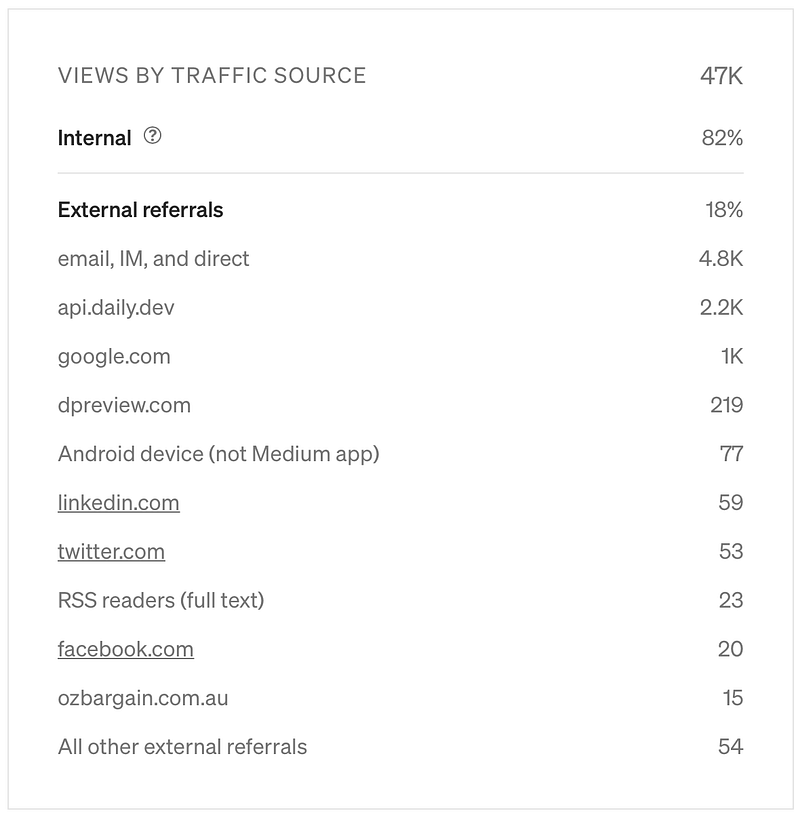
The external traffic sources are another intriguing table to look at, but I would argue it generated relatively little income. Still, why it’s important is because it proves the importance of organic content. Back when I wrote this article, I didn’t even have Twitter. I only shared it on LinkedIn, where it received some moderate attention. DpReview, Twitter and Facebook are all platforms where people themselves decided to share the content.
Returns analysis
The question whether this article was profitable or not, is perhaps valid. But no. Not on its own. What most writers want to avoid hearing is that writing, blogging, making videos on YouTube, TikTok, photos on Instagram, all this is not a job where you show up, and you get paid for x hours of work. Doing any of this is virtually a business of your own, and every business requires investment.
My investment was 7 years of light but active Medium presence and contribution. If I calculate my previously spent 300 hours of writing at just $25/h, that is $7500 of investment out of which this article only covers a little over a $1000. Currently, if this were an actual public company, I’d be doing very poorly and all my shareholders would probably be screaming at my door, holding pitchforks. If I calculate by what I actually think my time is worth — $100/h (before tax) — then this article barely makes a dent in my initial $30.000 investment.
For writing to just cover my investment, I would have to write another 30 of these articles, and that’s not yet even profit. That’s not to say it cannot become profitable. I do think that spending years writing, finding your voice, tone, niche and organically growing an audience around you can result in an ethical writing business, but it requires stamina. Lots of it. So, it begs the question…
Is it reproducible?
If you didn’t get it yet, unlike most, I am not trying to sell you writing as a profitable gig. If anything, this article should make you seriously question whether writing is for you at all. For me, becoming a more active Medium writer and going behind the paywall was and for the time being still is a one-year experiment. Whatever the outcome is, I can afford it. I am happy to invest the time and understand what potential technical and technology writing has, not because I want to change careers, but rather because I felt I might have a talent, and wanted to test whether it’s one that also pays.
For you, however, this wasn’t a how-to article on getting rich from writing, and while $1000 might sound like a big number, I can already tell you there are tons of more profitable ways to make money, even with a standard 9–5 job, and I am planning to write in a while a story on just how “profitable” can writing be here, so stay tuned for that. This is also not a bragging or humble-bragging story. There is nothing to brag about. The whole point of the article is to make you see those $1000 from a highly realistic perspective and realise there’s no magic bullet to writing stories that make more than a couple hundred bucks in a year. If you come up with some “blueprint” for yourself to follow from this story, it’s your prerogative, all the power to you if it works out, but make no mistake, that’s not what I am giving you.
Not to disappoint, but being a writer is not a copy-paste career. It’s dedication, hard work, and all you might see at the end of a very long tunnel is a thousand bucks. If you find the prospect of that disappointing, stop writing, and go flip burgers. It genuinely makes more money!
So, do you still want to write?
If so, here’s a few potentially inspiring stories to read, before you embark on one of the toughest journeys you ever embarked on… 😉
Attila Vago — Software Engineer improving the world one line of code at a time. Cool nerd since forever, writer of codes and blogs. Web accessibility advocate, Lego fan, vinyl record collector. Loves craft beer!