
The Amazing Quepos!
By way of the Playa Naranjo Ferry
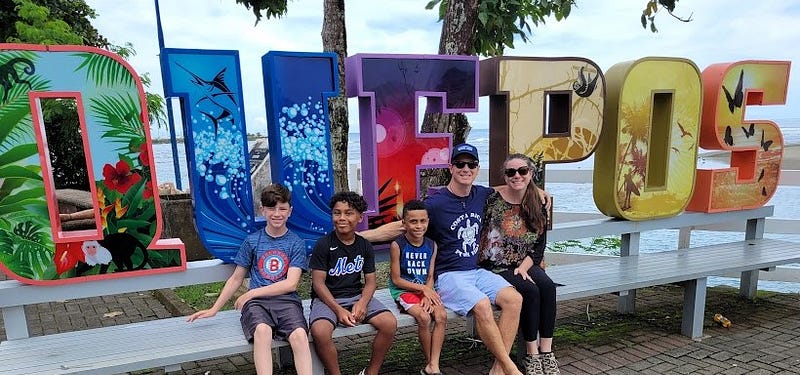
As my family of five continues to journey across Costa Rica in search of a settling point, we’re keeping our goals in mind. We’re on a mission to find a spot that feels right for our family to spend three to six months. Wherever we land, we’ll be looking for our essentials for education, strong local economy and values, rental and investment opportunities, and many other “nice to haves.” Ultimately, we need good schools, safety, and growth opportunities. We want a place that can support us, so we can, in turn, support it. We’re making progress.
Here are some of the chronicles so far:
For a few tips on driving in Costa Rica:
Leaving Guanacaste
So far, we’ve managed to explore three or four resort towns in the Guanacaste Region. Playas Tamarindo and Langosta were nice but probably a bit too touristy (and pricey) for us. Playas Brasilito and Portrero were too small. During our first trip here in 2019, we visited Playa Carillo which was beautiful but probably too remote.
Departing Tamarindo, from the northwestern side of the Nicoya peninsula, we left at about 11 am and headed toward the town of Playa Naranjo. There are several Playa Naranjo’s in Costa Rica but this one is in Puntarenas, a calm port with nothing more than a ferry dock.
We (we=my wife) did some research about the path from Tamarindo and discovered a ferry, upon which we could pull the rental car. It crosses Nicoya Bay from Playa Naranjo to Playa Puntarenas. Amazingly, taking this ferry would save us about two hours compared to the alternative which had us driving around the Bay to Puntarenas, across Guanacaste’s eastern side.
Playa Naranjo
When we arrived in Playa Naranjo at the ferry port, two hours before departure time, no one was there. Since we were early so we decided to take a quick detour and find a beach called Playa Blanca. We mapped the road and drove up and down it, painstakingly. We knew it was there but google Maps doesn’t tell you when there’s the private property between you and the destination. We suspected that we would have had to trespass if we were to make it to the beach so instead, we decided just to go back to the ferry.
We were still an hour early but when we got back, to our surprise, we found tons of cars lined up all the way back to the top of the hill. This was way more cars than could fit on the boat! Where did they all come from? What if we couldn't fit? I was worried that we weren’t going to get a spot. If we couldn’t get on this boat, we’d have to drive an additional two hours in what would certainly be a dark night with tons of rain, I started panicking.
The good news was that my wife had pre-purchased our spot on the ferry the day before. I was shocked that it cost just $25 American for the passage for all five of us and the car! After I spoke with a Police Officer and showed him our tickets on my phone, he directed us around all the rest of the cars on the line…every one of them… right up to the head of the line!
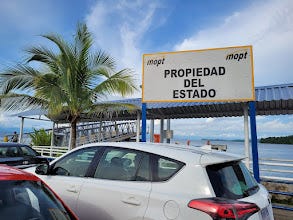
I remember thinking how bad it would suck to get there and not get a spot on the ferry. As we sailed away from the dock, I felt dumb when I realized that those cars were just there to pick people up from the returning ferry. Duh... Phew!!
The ferry from Playa Naranjo takes about an hour to get to Playa Puntarenas but it’s an awesome ride. Jammin to Costa Rican music, there were beverages, food, and a few games for the kids onboard.
Playa Puntarenas is a port city and while small, it’s the only populated area that can be seen from anywhere on the water as you approach. All the surrounding islands and coastlines are preserved land and undeveloped. We got to see some unique-looking birds and some abandoned structures on the shorelines as we cruised slowly across Nicoya Bay.
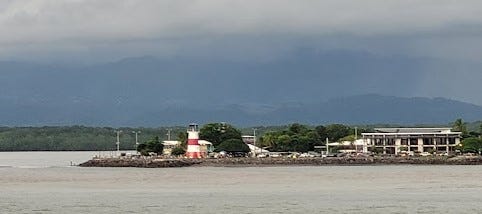
When I’m in a place like this, I always wonder how the ancient explorers did anything. As I wondered, I also noticed that there are no buoys in the water in Costa Rica. Not one. I guess the navigators twenty years ago, before GPS, had to also be very good!
Playa Puntarenas — This might be Costa Rica’s Mos Eisley
With all due respect, it may be a nice town and there may be nice places there, but I didn’t see any of that. The area around the ferry dock was just dive bars and fishing boats. The vibe was seedy though, through the pouring dusk rain, I suppose I could have misjudged the place, but I don't think so. The activity in the streets was significant and there was a lot of garbage. The beach looked dirty and there were no signs of tourists. The sheet metal walled buildings, gates, and bars blocked most of the views. I wanted out of there as fast as we could. We sped away through the raindrops and the mopeds, trying not to die driving in Costa Rica!
Quepos Charm
We arrived at Quepos after dark at about 7 pm. We had been driving all day, plus the boat ride. The town looks similar to many small Costa Rican cities. Sections of it have a lot of connected row homes. There are lots of metal roofs, bars, and fences that border the sidewalks in some of the residential areas. There’s a school and a Futbol (soccer) field in the city center. The downtown area is a bustling little city during the week.
The center-city streets don’t look terribly welcoming at first glance, but after you’ve been there a while, the town really seems to change. I think it’s the people. Once we started to experience their manners, their attitudes, and their culture, Quepos really grew on us.
I’m thinking we’re finally getting to see what everyday life looks like for Ticos (Costa Ricans are called Ticos). Kids in white button-down shirts on the way to and from school, farmers’ markets set up in the city center, and loads of hole-in-the-wall cafes, bars, restaurants, and Sodas. Sodas are the Costa Rican equivalent to diners in the US but are usually smaller than most. Maybe they have 4 or 5 tables and you can usually order anything from the breakfast lunch or dinner menu.
I’ll explore the Sodas Supers and Mini Supers more in another piece where I cover the food here in Costa Rica. Stay tuned…
Dia De Las Madres
It just so happened that we were here during a Costa Rican holiday, Dia De Las Madres, or Mother’s Day! Dia De Las Madres is a national holiday here so many people had off from work. The downtown area was busy and filled with so many mothers, daughters, and grandmas all dressed up and out on the town or out to eat together. As such a rich cultural example, it was a lucky bonus to get to be here on that day.
There are countless other businesses in Quepos, many have hotels nestled into the second floors, above. Apartments and cafes can also be found on the overhanging second levels. Parking can be tricky so watch out for the large ditches on the sides of the streets. Many are two feet deep in order to handle the sheer volume of water that needs to run through them during the rainy season.
Quepos is proving to be a very promising destination so far. Stay tuned!
Pura Vida!
Thank you for reading! I write about how I see the world through my husband/father/investor/headcase-shaded glasses. Please consider following me on Medium. Subscribe to receive an alert each time I publish.


