avatarGregory G Fox

Free AI web copilot to create summaries, insights and extended knowledge, download it at here

4353

Abstract

erations.</p><h2 id="71ea">Impact on Science and Technology</h2><p id="3145">The Enlightenment was a golden era for science and technology. It was a time when the methods of scientific inquiry were refined and systematized, leading to groundbreaking discoveries and inventions. The period saw figures like Isaac Newton revolutionize the world of physics with his laws of motion and universal gravitation.</p><figure id="8810"><img src="https://cdn-images-1.readmedium.com/v2/resize:fit:800/1*rWijDgtBOHTaaSaiagMlaA.png"><figcaption>Image by Gregory G. Fox | Generated by DALLE</figcaption></figure><p id="90d9">These advances were not confined to pure science alone. Practical applications flourished, leading to agriculture, manufacturing, and transportation improvements. This period’s spirit of inquiry and experimentation laid the foundations for the Industrial Revolution and the modern technological world.</p><p id="6807">The Enlightenment’s emphasis on empirical evidence and the scientific method also helped dispel many superstitions and myths, fostering a culture where knowledge was derived from observation and rational analysis rather than inherited dogmas.</p><h2 id="14bb">Influence on Politics and Society</h2><p id="d899">The political landscape was one of the most visibly transformed areas during the Enlightenment. Philosophers like John Locke and Montesquieu proposed governance ideas that strongly influenced the development of modern political systems. The concepts of the separation of powers, the social contract, and individual rights were revolutionary, challenging the divine right of kings and traditional hierarchies.</p><figure id="3c10"><img src="https://cdn-images-1.readmedium.com/v2/resize:fit:800/1*tW6-DUbvhkHopfjULLSupw.png"><figcaption>Image by Gregory G. Fox | Generated by DALLE</figcaption></figure><p id="3c4c">These ideas found their most dramatic expression in the American and French Revolutions. The Declaration of Independence and the French Declaration of the Rights of Man and the Citizen were inspired by Enlightenment principles, emphasizing liberty, equality, and fraternity.</p><p id="b499">On a societal level, the Enlightenment encouraged a move away from feudal structures towards more egalitarian societies. While it didn’t immediately dismantle existing class systems, it planted the seeds for future social reforms and movements advocating equality and human rights.</p><h2 id="66d5">Cultural and Artistic Contributions</h2><p id="5490">The Enlightenment also left an indelible mark on culture and the arts. Literature flourished with writers like Voltaire and Daniel Defoe, who used satire and realism to critique society and politics. In music, composers like Wolfgang Amadeus Mozart broke away from strict conventions, introducing a greater expression of emotion and individualism in their compositions.</p><p id="b8d1">The period also saw the rise of the novel as a literary form, reflecting the Enlightenment’s emphasis on individual experience and psychological depth. During this time, the arts were not just for entertainment but also mediums for spreading Enlightenment ideas, often encapsulating the era’s spirit of questioning and exploration.</p><h2 id="a303">Legacy and Modern Relevance</h2><p id="831d">The legacy of the Enlightenment is vast and enduring. It laid the foundation for modern science, politics, and philosophy. The emphasis on reason and empirical evidence is a cornerstone of contemporary thought, influencing everything from governance to educational systems.</p><p id="d973">Today’s concepts of human rights, equality, and freedom trace back to this remarkable period. The Enlightenment’s spirit of inquiry and scepticism inspires progress and innovation, reminding us of the power of human intellect and the importance of challenging established norms.</p><figure id="ad64"><img src="https://cdn-images-1.readmedium.com/v2/resize:fit:800/1*DonlCikOQL5F4c28FKaWVg.png"><figcaption>Image by Gregory G. Fox | Generated by DALLE</figcaption></figure><p id="0070">As we reflect on the Age of Enlightenment, it’s evident that this was not just a historical period but a profound transformation in how we perceive and interact with the world. It was when humanity took a significant step forward, embracing reason and science and laying the groundwork for the modern

Options

world. The ideas and principles born from the Enlightenment continue to influence us as a reminder of our potential to evolve, question, and understand the world around us.</p><p id="2cc6"><i>Thank you for reading! If you enjoy my writing, it will help me to follow and subscribe so I can keep contributing engaging content.</i></p><p id="5ad5"><a href="https://gregorygfox.medium.com/subscribe"><b>Subscribe Here For an Email Reminder of my next post.</b></a></p><h2 id="50ce">Thanks for reading</h2><ul><li>👏<i> <b>Please clap for the story (50 claps) to help the article to be spread</b></i></li><li>🌐 <i>Share the story on Social Media</i></li><li>📝 <i>Join the Medium Membership Program for only 5$ a month, and support other writers and me to keep up the tremendous work.</i></li></ul><div id="2f7e" class="link-block"> <a href="https://readmedium.com/the-world-economic-forum-and-global-order-14c19aa81937"> <div> <div> <h2>The World Economic Forum and Global Order</h2> <div><h3>Conspiracies, Utopian Vision or Dystopian Future?</h3></div> <div><p>medium.com</p></div> </div> <div> <div style="background-image: url(https://miro.readmedium.com/v2/resize:fit:320/0*l1qIbw_Lr_32BaZv.jpg)"></div> </div> </div> </a> </div><div id="3db1" class="link-block"> <a href="https://readmedium.com/navigating-the-uncheck-urban-expansion-da86414157eb"> <div> <div> <h2>Navigating the Uncheck Urban Expansion</h2> <div><h3>Unraveling the Complexities of Sustainable Growth</h3></div> <div><p>medium.com</p></div> </div> <div> <div style="background-image: url(https://miro.readmedium.com/v2/resize:fit:320/0*cW4mst8_zWGpUJwN)"></div> </div> </div> </a> </div><div id="ce22" class="link-block"> <a href="https://readmedium.com/navigating-troubled-waters-de83f3d37c6c"> <div> <div> <h2>Navigating Troubled Waters</h2> <div><h3>The Multifaceted Impact of Houthi Attacks on Global Trade</h3></div> <div><p>medium.com</p></div> </div> <div> <div style="background-image: url(https://miro.readmedium.com/v2/resize:fit:320/1*2RYr0o9-fqVJDA5k1zAmRw.png)"></div> </div> </div> </a> </div><div id="e8bb" class="link-block"> <a href="https://readmedium.com/balancing-tradition-and-change-f80352e96f89"> <div> <div> <h2>Balancing Tradition and Change</h2> <div><h3>Exploring the End and Future of the Nuclear Family</h3></div> <div><p>medium.com</p></div> </div> <div> <div style="background-image: url(https://miro.readmedium.com/v2/resize:fit:320/0*kpd_QnKhrM6vtLES.jpg)"></div> </div> </div> </a> </div><div id="275e" class="link-block"> <a href="https://readmedium.com/nanoworld-unleashed-f02b2856bc19"> <div> <div> <h2>Nanoworld Unleashed</h2> <div><h3>Charting the Course of a Microscopic Revolution</h3></div> <div><p>medium.com</p></div> </div> <div> <div style="background-image: url(https://miro.readmedium.com/v2/resize:fit:320/0*pWLhIilgdIH7yYY8)"></div> </div> </div> </a> </div><div id="9867" class="link-block"> <a href="https://readmedium.com/mastering-the-art-of-interview-preparation-1762b858e946"> <div> <div> <h2>Mastering the Art of Interview Preparation</h2> <div><h3>Proven Strategies for Success</h3></div> <div><p>medium.com</p></div> </div> <div> <div style="background-image: url(https://miro.readmedium.com/v2/resize:fit:320/1*[email protected])"></div> </div> </div> </a> </div></article></body>

The Age of Enlightenment

A Journey Through Intellectual Awakening
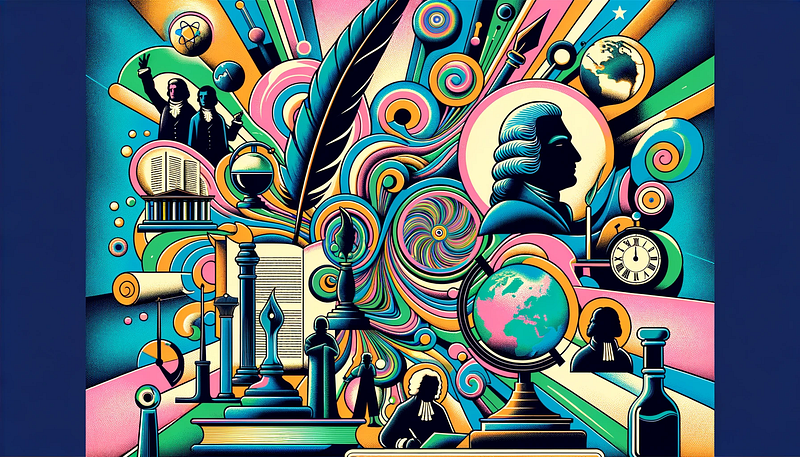
Image by Gregory G. Fox | Generated by DALLE

The Age of Enlightenment, a beacon in the history of human thought, emerged as a transformative movement that reshaped the landscape of ideas and values. From the late 17th to the 18th century, this era transcended geographical boundaries, influencing Europe and, eventually, the world. Its echoes are still felt today, as it laid the groundwork for much of our modern philosophy, scientific reasoning, and political thought.

Often referred to as the ‘Age of Reason,’ the Enlightenment was characterized by an unprecedented faith in the power of knowledge and rational thought. At that time, thinkers began to question traditional doctrines and dogmas, advocating for a new approach to understanding the world — one driven by observation, logic, and scientific inquiry rather than blind faith or superstition and this period stood out as a remarkable pivot from the mysticism and religious dominance of the Middle Ages to an era where reason and empirical evidence began to take the front seat.

Let’s delve into the fascinating journey of the Enlightenment. We’ll explore its historical backdrop, the groundbreaking ideas it brought forth, its profound impact on various fields like science, politics, and culture, and ultimately, its lasting legacy that continues to influence our lives today.

Historical Background

The seeds of the Enlightenment were sown in a soil rich with the developments of the preceding centuries. The Renaissance, a period of renewed interest in the arts and sciences, along with the Scientific Revolution, had already started to erode the rigid structures of medieval thought. During this time, Europe was a tapestry of emerging nation-states, marked by significant technological advancements and an expanding worldview due to exploration and trade.
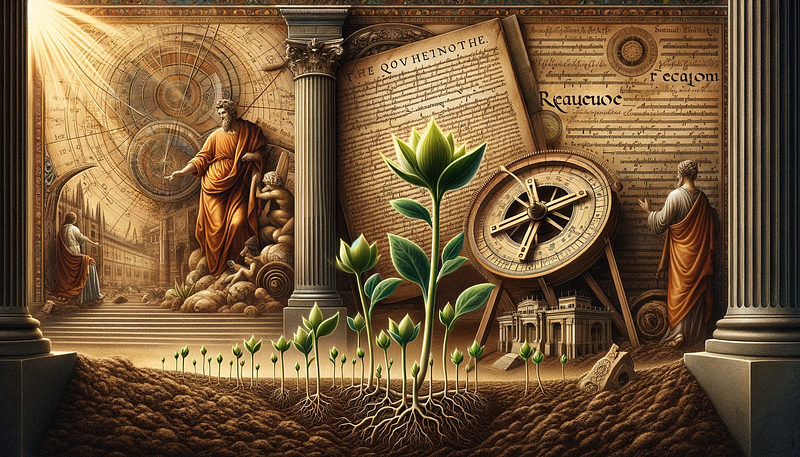
Image by Gregory G. Fox | Generated by DALLE

This era witnessed a gradual shift from feudal societies to more centralized forms of governance. The rise of absolutism, though contradictory to Enlightenment principles, paradoxically provided the stability necessary for intellectual pursuits. Meanwhile, the Protestant Reformation had challenged the Catholic Church’s authority, paving the way for an environment where questioning established norms became increasingly acceptable.

The Enlightenment, therefore, didn’t emerge in a vacuum. It was the product of these accumulating changes — a response to the desire for a more rational and humane society. As we venture into the heart of this period, it’s crucial to recognize this historical canvas, as it profoundly influenced the thoughts and works of the Enlightenment philosophers.

Key Philosophies and Ideas

Central to the Enlightenment was a galaxy of ideas and philosophies that have become cornerstones of modern thought. Rationalism, the belief in reason as the primary source of knowledge, stood as a defining feature. Empiricism also gained prominence, emphasizing observation and experience over innate ideas. Together, these approaches fostered a scientific outlook towards understanding the world.

Prominent figures like Voltaire championed religious tolerance and criticized dogmatism and superstition. Jean-Jacques Rousseau proposed ideas about personal freedom and social contracts, which impacted political thought. Immanuel Kant, with his assertion ‘Dare to know,’ encouraged individuals to use their understanding without guidance from others.

These philosophers and many others challenged the traditional authorities of the church and state, advocating for individual rights and freedoms. Their ideas laid the groundwork for modern democracy, ethical reasoning, and educational methods. Their writings and debates created a ripple effect, influencing their contemporaries and generations.

Impact on Science and Technology

The Enlightenment was a golden era for science and technology. It was a time when the methods of scientific inquiry were refined and systematized, leading to groundbreaking discoveries and inventions. The period saw figures like Isaac Newton revolutionize the world of physics with his laws of motion and universal gravitation.

Image by Gregory G. Fox | Generated by DALLE

These advances were not confined to pure science alone. Practical applications flourished, leading to agriculture, manufacturing, and transportation improvements. This period’s spirit of inquiry and experimentation laid the foundations for the Industrial Revolution and the modern technological world.

The Enlightenment’s emphasis on empirical evidence and the scientific method also helped dispel many superstitions and myths, fostering a culture where knowledge was derived from observation and rational analysis rather than inherited dogmas.

Influence on Politics and Society

The political landscape was one of the most visibly transformed areas during the Enlightenment. Philosophers like John Locke and Montesquieu proposed governance ideas that strongly influenced the development of modern political systems. The concepts of the separation of powers, the social contract, and individual rights were revolutionary, challenging the divine right of kings and traditional hierarchies.
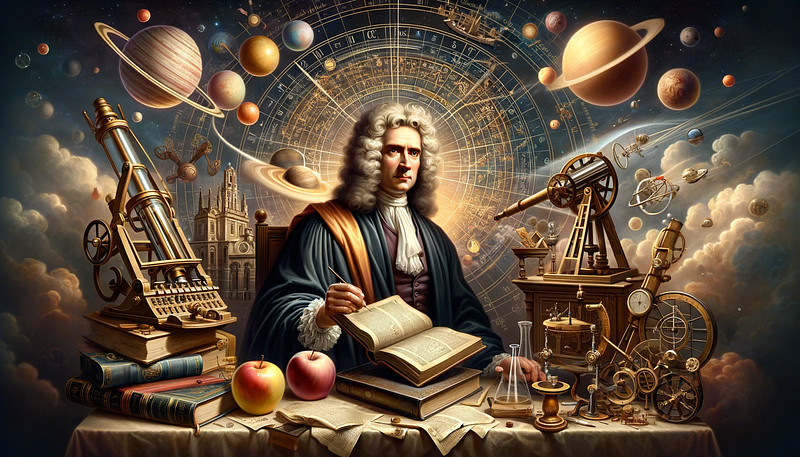
Image by Gregory G. Fox | Generated by DALLE

These ideas found their most dramatic expression in the American and French Revolutions. The Declaration of Independence and the French Declaration of the Rights of Man and the Citizen were inspired by Enlightenment principles, emphasizing liberty, equality, and fraternity.

On a societal level, the Enlightenment encouraged a move away from feudal structures towards more egalitarian societies. While it didn’t immediately dismantle existing class systems, it planted the seeds for future social reforms and movements advocating equality and human rights.

Cultural and Artistic Contributions

The Enlightenment also left an indelible mark on culture and the arts. Literature flourished with writers like Voltaire and Daniel Defoe, who used satire and realism to critique society and politics. In music, composers like Wolfgang Amadeus Mozart broke away from strict conventions, introducing a greater expression of emotion and individualism in their compositions.

The period also saw the rise of the novel as a literary form, reflecting the Enlightenment’s emphasis on individual experience and psychological depth. During this time, the arts were not just for entertainment but also mediums for spreading Enlightenment ideas, often encapsulating the era’s spirit of questioning and exploration.

Legacy and Modern Relevance

The legacy of the Enlightenment is vast and enduring. It laid the foundation for modern science, politics, and philosophy. The emphasis on reason and empirical evidence is a cornerstone of contemporary thought, influencing everything from governance to educational systems.

Today’s concepts of human rights, equality, and freedom trace back to this remarkable period. The Enlightenment’s spirit of inquiry and scepticism inspires progress and innovation, reminding us of the power of human intellect and the importance of challenging established norms.
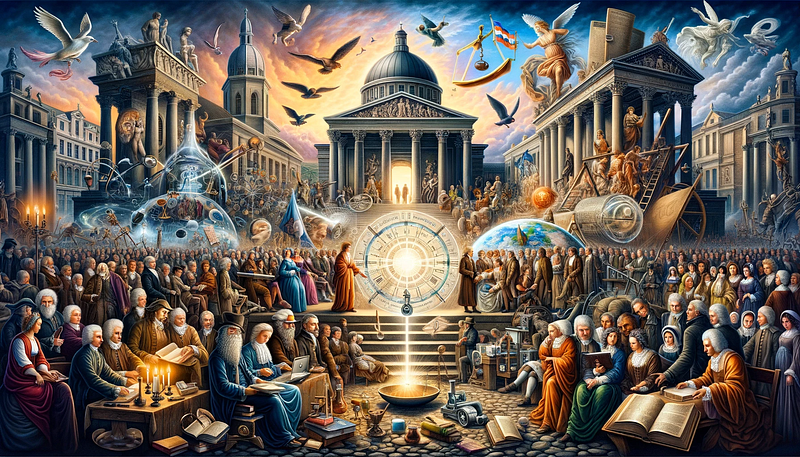
Image by Gregory G. Fox | Generated by DALLE

As we reflect on the Age of Enlightenment, it’s evident that this was not just a historical period but a profound transformation in how we perceive and interact with the world. It was when humanity took a significant step forward, embracing reason and science and laying the groundwork for the modern world. The ideas and principles born from the Enlightenment continue to influence us as a reminder of our potential to evolve, question, and understand the world around us.

Thank you for reading! If you enjoy my writing, it will help me to follow and subscribe so I can keep contributing engaging content.

Subscribe Here For an Email Reminder of my next post.

Thanks for reading

  • 👏 Please clap for the story (50 claps) to help the article to be spread
  • 🌐 Share the story on Social Media
  • 📝 Join the Medium Membership Program for only 5$ a month, and support other writers and me to keep up the tremendous work.
Science
Society
Politics
Humanity
History
Recommended from ReadMedium