
LIFE | RACE | POLITICS
The Plot Against John Lewis
How It Escalated After His Death
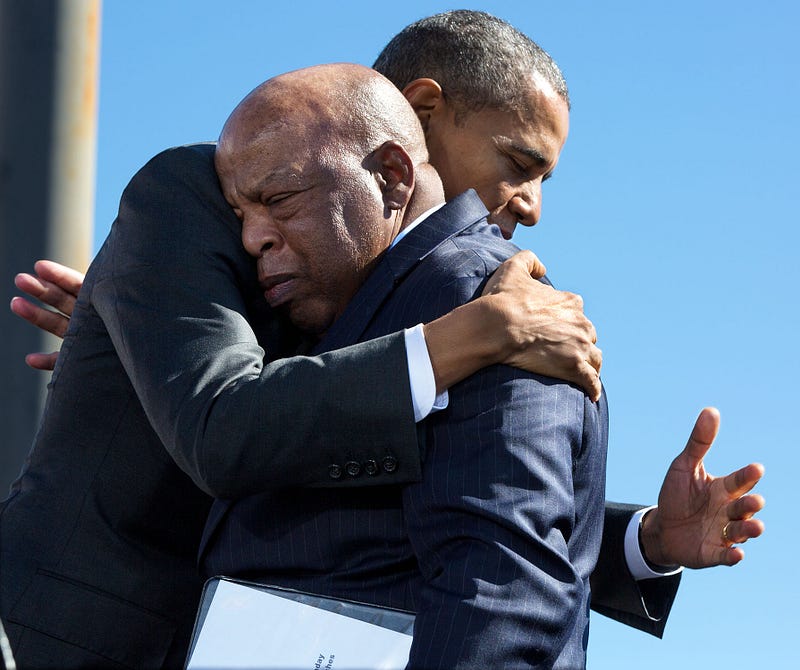
Earlier this year, the nation rightly spent an entire week remembering the life and legacy of the late Congressman John Lewis. We watched as his body was carried up the Capitol steps to lie in state within the rotunda, where he was honored as part of the “Pantheon of Patriots.” We listened to countless tributes to the man and his work. Heard songs sung in his honor all across the country. Even some of his political adversaries turned out to pay their respects. It was a beautiful thing to see.
Shortly before his death, I came across a transcript of a telephone interview I did with him years ago. At the time, he was Executive Director of the Voter Education Project. I worked as a reporter and news anchor at the CBS television station in San Francisco. The discussion was professional. But it also felt good to be speaking with an old friend.
The first time I met John Lewis, I was a cub reporter trying to find my footing in the Atlanta of 1972. At twenty-three, I had landed a gig at one of the first news/talk radio stations in the country — its only African American on-air talk-show host. It was my first job in broadcasting, and I was out of my depth.
In a matter of weeks, I went from private citizen and recent college graduate to the target of hate mail telling me I was “being watched” and describing me as a black hairy nigger, overgrown pickaninny, and worse.
But a job like that also came with perks that took me by surprise. All of a sudden, I was on a first-name basis with people of influence. Politicians, a few celebrities, and veterans of the Civil Rights Movement. This too was a bit unsettling. I soon became wise to the symbiotic relationship between politicians and the press. How do you hold onto your center with such extremes tugging at you?
What made John Lewis stand out in this milieu was his sincerity. He wasn’t a politician when I met him. Just a man with a cause, a straight shooter, still trying to get people to understand the importance of the vote. Although I met others with similar Civil Rights credentials during that time, he was the only one who invited me to his home.
When I arrived, he greeted me like a long-lost friend. His wife Lillian put food on the table, and we spent a convivial evening talking of this and that. Mostly John told stories about his experiences.
He was only thirty-one when we met. But he’d already co-founded the Student Nonviolent Coordinating Committee (SNCC) and addressed the 1963 March on Washington for Jobs and Freedom. When I was still a high school sophomore, he’d gotten his skull bashed in during the Freedom Rides and attempting to cross the Edmund Pettus Bridge on Bloody Sunday in 1965.
The man had a lot to say. And he said it with conviction. A born preacher and storyteller, he gave me that highest and rarest form of generosity — his full attention. He made me feel that I was doing good work and would succeed, regardless of the conflicting forces around me.
Although he would eventually go on to become a national icon — the “conscience of Congress” —I believe his truest legacy will always be his personal story. I was glad that all eyes were once again on his heroic contributions to the American experiment and the values that have held it together for 244 years.
But I was also troubled as I looked over the transcript of our conversation years ago. Although much of it was dated, much of it was also disturbingly relevant to today’s political environment. What bothered me most was the two-faced relentlessness of John’s adversaries to undo his legacy.
To their credit, some of his worst foes behaved respectfully and honored his life’s work during the week-long memorial services in his honor. But this struck me as a forked-tongue maneuver. They turned right around and intensified their efforts to suppress the vote, attacking the very marrow of the late congressman’s legacy.
It’s a legacy that bears repeating, at least in part. If for no other reason than to be reminded of what’s at stake in 2020. And what it has taken to get this far.
LEWIS: My own involvement led me to the conclusion…we wouldn’t be able to have any real say, any control over our own destiny until we got the vote. …
I grew up in a situation where there were hundreds of thousands of black people all around me, and most of them could not register. They could not vote simply because of their color. They couldn’t pass the so-called literacy test. We had [Black] people teaching in the public school system, but at the same time they could not read or write well enough to pass a so-called literacy test. It didn’t make sense. And I became resentful of that dual system where white people, some with an education and some who couldn’t read and write, going down to vote to decide on how Black people were going to live and function.
I guess all of that came to a head a few years later when I got involved with SNCC trying to convince people that they should not be afraid. That they should go down to the county court house and attempt to register, and then vote, knowing at the same time that in the past some people had been shot, beaten, and even killed for attempting to register to vote.
Part of the effort was to convince people in spite of that fear, in spite of all the problems and difficulties, that we must use the power of the ballot, that something must be good about it if white people in the South did not want us to register, did not want us to vote.
I’ll never forget how 800 people stood in line all day one day at the Dallas County Court House in Selma, Alabama, trying to register. At the end of the day, only five people had passed through the line to take the so-called literacy test. And they all failed it.… This all came to a head in 1965 when we attempted to march from Selma to Montgomery. And we were beaten. Some of us were tear-gassed and left lying in the streets of Selma.
A few months later, the Voting Rights Act was passed. Since then I’ve seen progress in terms of the number of black registered voters, the number of black elected officials. Some of the people who were denied the right to vote in 1965 are now black elected officials in a state like Mississippi.
QUESTION: There has certainly been progress, but in other ways it looks like Black people are standing still. What is this paradox, this contradiction?
LEWIS: We have made progress. There is no question about that. Probably the greatest progress has been made in the political arena where you see an increase in registration, and increase in the number of black elected officials. But the majority of black people in this country, the masses, particularly in the Southern United States, are still in the same shape, are still at the bottom, are still the people left behind.
QUESTION: What about this paradox?
LEWIS: In terms of numbers, we have an increase in registration and in the number of black elected officials…But I don’t think the progress that we have made, the gains that we’ve made, are in proportion to the needs, to the resources, to the time, the money, the effort and to the lives which have been invested in this whole struggle for change through the past few years.
QUESTION: But you are still working at it?
LEWIS: Well, we have to hang in there.You have to have hope because if a man loses hope, as Dr. King used to say, you are finished, you’re dead. You’re walking around, but you are not alive. So I think black people still must hope. And still must believe. And it’s that hope and that spirit that came out of the Civil Rights Movement that keeps people going.
The hopefulness Lewis referred to seemed to crest in 2008 and 2012 with the election of Barack Obama for whom HOPE was a central campaign theme. This optimism was buoyantly evident in 2017 when high turnout among African American women in Alabama helped elect Democrat Doug Jones to the U.S. Senate during a special election for the seat Jeff Sessions vacated to become Donald Trump’s Attorney General.
But just one year later in Georgia, hope took a major hit. That’s when Secretary of State Brian Kemp removed as many as 560 thousand voters from the rolls in what may have been the largest voter purge in U. S. history.
Of that number, it is estimated that about 107 thousand of those voters were in fact eligible to vote.
Kemp, who was also a candidate for governor that year, beat his African American opponent Stacey Abrams by only 57,723 votes.
If all 107 thousand of those deemed eligible had cast their ballots for Abrams, she would have won by 52,277, making her the first Black woman in history to become governor of any state. That’s a big IF, of course, since there’s no way to know how those purged from the rolls might have voted.
But that did’t remove the stench from Kemp’s gubernatorial campaign, which reeked of conflict of interest. That’s because he presided over an election in which he was also a candidate.
The stink was so bad that Jimmy Carter called for Kemp to resign his position as Secretary of State and appoint a neutral authority to oversee the election. Not only did Kemp refuse to step aside, his office placed 53 thousand voter registrations on hold shortly before the election, 70 percent of which were from African Americans.
As if these things were not egregious enough, Georgia’s Republican majority in the state legislature set aside $150 million for new electronic voting machines. The money went to Denver-based Dominion Voting Systems, despite expert advice from computer scientists and professional security consultants that the machines are vulnerable to hacking.
Kemp’s GOP successor, Secretary of State Brad Raffensberger, argues that the machines are safe because they provide a paper printout. But his argument ignores a critical fact. Voters cannot use the printout to verify their voting choices. That information is embedded in a QR code that can only be read by computerized auditing systems. There is no way for a voter to know if the QR code is an accurate representation of the actual ballot. Raffensberger says it’s possible to confirm that the QR code matches the ballot through an audit. But it would require an audit of every ballot in the state to confirm every result.
All reliable evidence indicates that the only safe ballot is a hand-marked paper ballot. But Georgia and 26 other states have opted for electronic devices, which are especially vulnerable to hackers should they be connected to the Internet, even in the wake of Russia’s ongoing attempts to compromise U.S. elections.
These 21st-century strategies to disenfranchise nonwhite Black voters amount to the same thing white supremacists have been doing ever since the end of Reconstruction. Before computers, they used literacy tests and Jim Crow. When people like John Lewis tried to cross the Edmund Pettus Bridge, they used Billy clubs and tear gas.
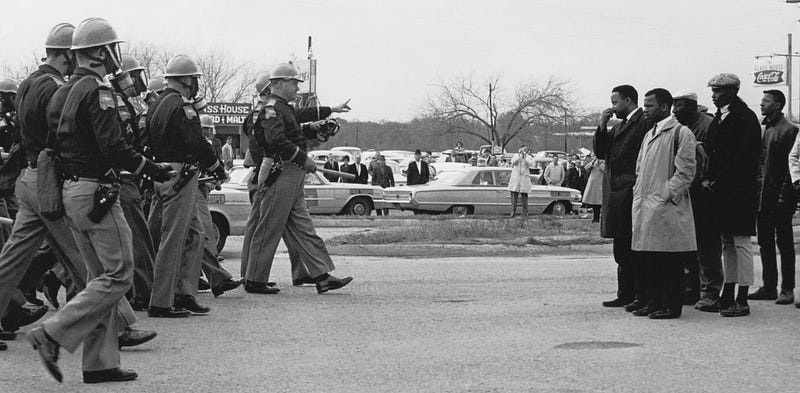
That Was Then — This Is Now
Now they install hackable computers, purge voter rolls, reduce the number of polling places in precincts with African American majorities, and undermine our faith in the United States Postal Service. On Election Day 2020, a federal judge ordered a sweep of 12 postal districts for undelivered mail-in votes after the Postal Service reported that 300 thousand ballots had not been scanned for delivery.
Before the 1965 Voting Rights Act was gutted by the Supreme Court in 2013, Black people believed they finally had the vote John Lewis risked his life for. But now there is a new Edmund Pettus Bridge — a moving target made of digital ones and zeros and seismic shifts in the number of polling stations.
This new bridge spans the divide between registering to vote and having the vote counted. The gatekeepers blocking access to the state capital no longer rely on Billy clubs. They use gerrymandered districts.
Their white-controlled legislatures enact Stand Your Ground Laws that allow white vigilantes to believe they can kill Black people like Trayvon Martin and Ahmaud Arbery with impunity.
They hire policemen who kill unarmed Black citizens like George Floyd, Breonna Taylor, and violinist Elijah McClain.
They decimate Black populations with anti-crime laws that incarcerate African Americans for drug use at five times the rate of whites who commit the same crime. Innocent Black people are about 12 times more likely to be convicted of drug crimes than innocent white people. When you get out of prison, they use the felony conviction to take away your right to vote. And now with the onslaught of COVID-19, they have a new ally.
On the night before week-long funeral observances began for Congressman Lewis, the PBS NewsHour reported that most of Alabama’s COVID-19 cases occur in areas that were inhabited by the highest number of slaves in 1860.
According to the State’s Public Health Director, the legacy of slavery in that state can be seen in disproportionately high rates of chronic illnesses within the Black population, making it especially vulnerable to coronavirus. African Americans in Alabama comprise one-third of COVID-19 cases — and 45% of all COVID-19 deaths.
Thus, what John Lewis said during our interview years ago remains true today. The majority of Black people in this country — the masses, particularly in the Southern United States — are still in the same shape, are still at the bottom, are still the people left behind.
What’s clear to me is that these combined efforts to suppress the vote amount to an ongoing plot against John’s legacy. Orchestrated by people who say one thing and do another.
What’s also clear is that the spirit of John Lewis is at least as strong as they are. Just look at the millions of people who turned out for early voting this year in spite of these ridiculously overt efforts to suppress the vote. According to the PBS NewsHour, nearly 100 million Americans nationwide voted early in the 2020 election so far, accounting for 70% of the total turnout in 2016.
It is impossible to destroy the spirit of John Lewis. His spirit is surely present in all those voters who have responded to the current threats against his legacy by standing in line for hours to exercise the franchise. During a pandemic.
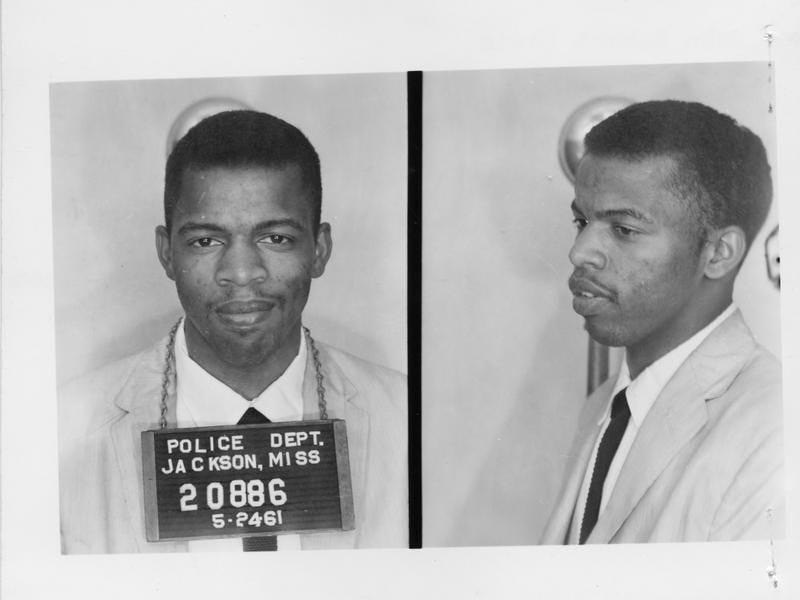
What that says to me is that Congressman Lewis and Dr. King have left us with one thing that continues to hold us in good stead. We have hope. When I look at John’s mugshot from his Freedom Riders arrest in 1961, I see the confident face of that hope. Those who would undo the pillars and promise of American democracy underestimate the power of that spirit. We are not finished. We are not dead. Nor do we intend to be.
© 2020 jazprose.com All Rights Reserved
Originally published at https://www.jazprose.com on November 2, 2020.
Thank you for reading. If you found anything of value in this piece, you might also be interested in my other recent stories.


