
How to Use the 80/20 Rule to Lose Weight Without Dieting
Don’t ban foods, moderate them… 20% of the time, you can eat whatever you want!

Many of us want to lose weight. But it’s hard.
We get on a diet. But it's too difficult to maintain in the long term.
The problem is, that diets restrict what we’re “allowed” to eat. For example, Keto cuts out pretty much everything with carbs.
Diets are complicated. Eating shouldn’t be complicated — it should be enjoyable.
We should be able to enjoy food and keep in shape. And we can!
With the 80/20 diet, we can eat anything we want!
But how?
Moderation. Let me explain.
The Problem With Many Diets
Of the most asked “How” questions on Google from 2019 to 2020, “How to lose weight” came in eighth.
The problem is that diets can often restrict and complicate the process of losing weight and then keeping it off. We have to follow certain rules or guidelines with our eating.
These rules of what we can and cannot eat compromise dinner with friends, office drinks, family gatherings… We often find ourselves in situations when we want to “cheat” on our diets.
Furthermore, we don’t like people telling us not to do something — that’s human nature. Especially if we’re told, we cannot eat our favourite foods.
This study on people with a tendency to overeat found that “banning” foods a person enjoys, such as chocolate or candy, led to them consuming around 133% more over 24 hours.
As a knee-jerk reaction, people decide they’d rather be overweight than “diet.”
Research has shown that the more diet attempts a person makes, the more likely they will gain more weight in the future.
A review of the current literature assessed the long-term implications and effectiveness of diets. It revealed that after finishing a diet, between one and two-thirds of people regained more weight than they lost. Short-term diets don’t lead to “lasting weight loss or health benefits.”
“Dieters regain, on average, more than half of what they lose within two years.” — Scientific American, 2020
People lose the motivation to diet when they fail, or the weight comes back. It seems too hard. This is a real problem given the obesity levels growing around the globe.
So, how can we sustain a diet long-term if the science says we’re so doomed to fail?
The 80/20 diet.

How the 80/20 Diet Works
If we make good choices 80% of the time, the other 20% doesn’t matter so much—the 20% we can enjoy and indulge a little.
That’s essentially it. Healthy and low-calorie options are in the 80% group, and unhealthy and high-calorie foods such as fast food, candy and alcohol (yes, that has calories) go into the 20% group. We’ll explore more of these foods later.
The Pareto Principle popularised the 80/20 concept. This rule asserts that 80% of outcomes (or outputs) result from 20% of all causes (or inputs) for any given event.
The rule used in this way would stipulate we consume 20% of calories from 80% of food; or, 20% of our food intake provides 80% of our calories. Neither of these makes practical sense.
However, the ideology of the 80/20 rule for diet works differently. Instead, there are two main food groups: foods we eat 80% of the time and those we’re only allowed 20% of the time.
The 80/20 ratio is a general guide — it might become 60/40, 90/10 or 95/5 — depending on whether our aim is maintaining the same weight, muscle gain or fat loss. We become more strict with our diets to lose more weight or/and lose it faster.
Assuming you eat five meals, roughly, one “cheat meal” a day. You can still enjoy your favourite foods and not stress.
This system allows a lot more flexibility, and the best thing is, that we can eat whatever we want. Nothing is restricted, making this diet far easy to follow.
According to Virtua Health:
“Eating 80/20 is more “real-life” and easier to follow than other diet plans because it allows you to enjoy your favourite foods in moderation while eating healthy at the same time.”
The Benefits of 80/20 — Simple and Sustainable
The key to the 80/20 “diet” is its simplicity and lack of food restrictions, making it easy to do long-term. It becomes a lifestyle.
Everybody can lose weight. Many people do lose weight over their lifetime. But, they often put it back on after their initial diet.
Maintaining weight loss is the most difficult part for most.
Why? I think a big part of the issue is that dieting is considered a short-term thing. Most diets restrict us from foods most of us commonly think, so we associate dieting with restrictions.
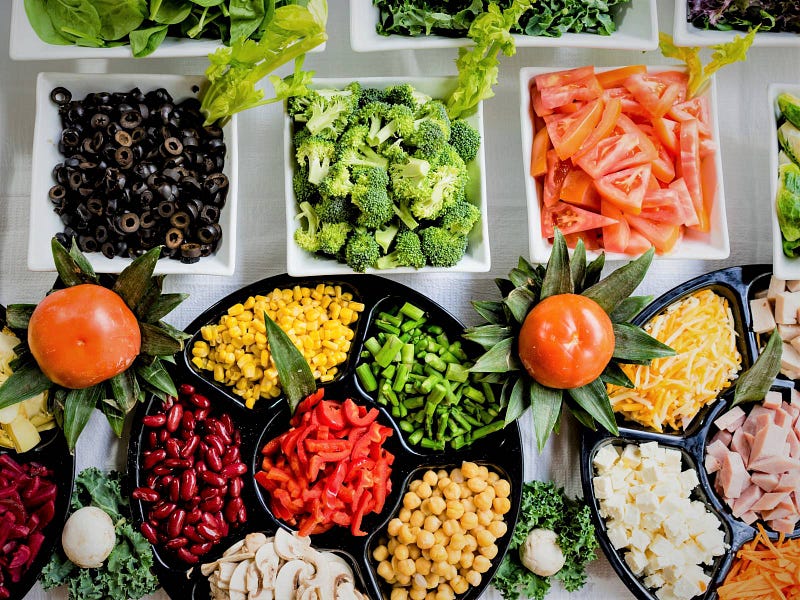
What to Include in Your Diet
80% of the time, we should choose healthy and low-calorie options.
Fill our diets with foods with (per 100 grams) moderate to high protein (10+), low to moderate carbs (< 40g), and low to moderate fat (<10g).
Studies show there is little difference in fat loss/gain between people on a low-fat diet and those on a low-carb diet. What matters is the total number of calories we eat. So eat the foods you enjoy.
Aim to get plenty of micronutrients (vitamins and minerals) and fibre into our diets from eating fruit and vegetables and other whole foods. As well as being packed with nutrition, fruit and vegetables have the benefit of being low in calories.
You can eat a massive bowl of salad that will fill you up with a small number of calories, compared to eating the same number of calories in foods from the 20% category, where the portion would be tiny.
Below is a table giving examples of food types and whether they belong in the 80% or 20% group.
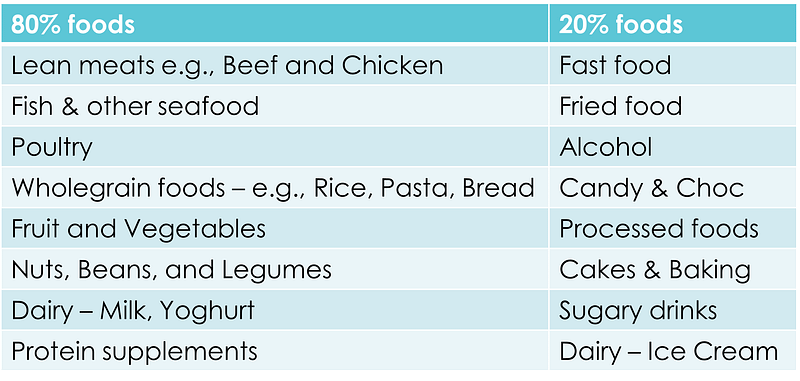
Examples of foods from the 80% category — calories per 100 grams:
- Strawberries — 33 calories
- Chicken breast — 165 calories
- Carrots — 41 calories
- Eggs— 155 calories
Examples of foods from the 20% category — calories per 100 grams:
- Candy — 384 calories
- Chocolate — 546 calories
- Ice cream — 207 calories
- Pizza — 266 calories
As you can see, the healthy options are far lower in calories than the unhealthy options from the 20% group.
Foods from the 80% category have two benefits. They’re low in calories but high in nutrition. Either high in protein for repairing muscle, high in fibre for gut health or high in vitamins and minerals for general health.
On the other hand, the 20% options are high in calories but low in nutrition. So we want to minimise how much of these we eat — which is tricky because they taste so good!
Think of it as the traditional food pyramid.
Foods in the 20% Group
Foods that a high in calories and low in nutrition, we consume in moderation. They belong in the 20% category.
A lot of the foods that belong in the 20% category are obvious. Anything filled with refined sugar is going to be high in calories. Any fried foods and most fast foods are full of saturated and trans fats and, therefore, calories.
McDonald’s, KFC, Pizza, Mexican food, Chinese food…
This category isn’t absolute. For example, some fast food can be healthy and low in calories, baking with low-calorie ingredients or making burgers with low-fat meats and other quality ingredients.
Alcohol contains calories, so even hard liquor has energy content. Beer, wine and other alcoholic beverages have added sugar, so again are high in calories.
The majority of baking belongs in this category. Yes, it may be fun to make and delicious; but, it’s filled with carbs. Or fats. Or, both.
And it doesn’t matter if it’s gluten-free! Or paleo. Even if we use “healthier” ingredients, chances are it’s still loaded with calories.
The final one is processed foods, and it’s an encompassing category, which includes meats, snack foods like potato chips, and “white” grain-based foods such as rice, pasta, or bread. These are lower in nutritional content than their whole-grain equivalent.
There will be other foods that belong in the 20% category, but this covers most bases.
Final Thoughts
In conclusion, many diets complicate food and restrict what we can eat.
People fail diets, as they become too difficult to follow and still enjoy food and life. As well as making it hard to sustain the diet, we are likely to put the weight right back on afterwards.
The 80/20 diet has been presented as a solution.
By making good choices with what we eat and drink 80% of the time, the remaining 20% doesn’t matter so much.
Think of it as a lifestyle rather than a diet. You still get to eat whatever you want, but only 20% of the time.
The 80/20 diet makes weight loss and weight management as simple as possible by controlling the frequency of eating “bad” and “unhealthy” food options rather than outright banning them.
The 80/20 diet makes a healthy lifestyle far more achievable.
Thanks for reading.
If you enjoyed the content, you might enjoy the article about uncomplicated weight loss.
Subscribe to be notified when I publish new content.


