
The 3 Must-have DevOps Certifications to Boost Your Career
These 3 DevOps Certifications Will Catapult Your Career to New Heights!
Certifications are your way of proving to a world of potential employers that you really do in fact know your stuff. They can help you stand out from a crowd of applicants or in some cases be a straight-up requirement to get in the door.
But since you’ve likely only got a limited training budget available to you, the question must be asked…
Which are the best certifications to get?
In this guide, we’ll go through my top three DevOps certifications you can get right now that will help catapult your career to the next level and get you that job of your dreams (and the salary that comes with it).

1. AWS Certified DevOps Engineer
AWS is undeniably the biggest name in cloud right now with a 32% market share over its closest competitor (Azure) of 23%. (Data from Statistica) So it’s no wonder this is our number one on this list.
Right now it feels like it’s becoming nearly essential to have some level of cloud experience under your belt. But how true is that?
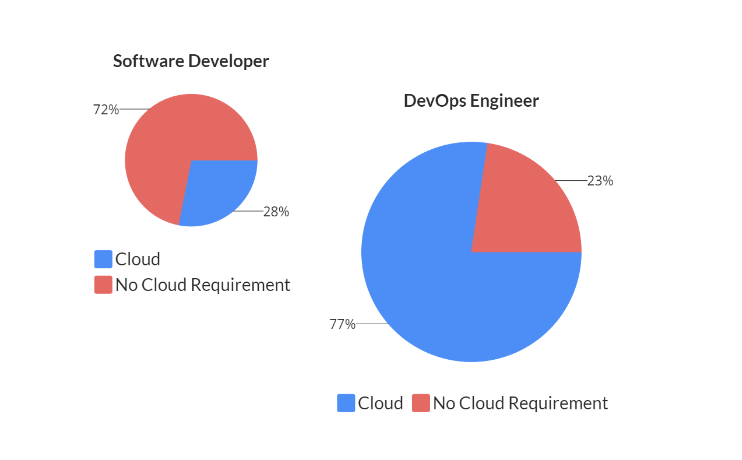
Well … I analyzed over 2000 different job postings for DevOps-related roles on indeed.com and found that Cloud is mentioned as a required or desired skill in 77% of them.
That’s a huge amount in comparison to a regular software engineering role with nearly triple the jobs requiring at least some knowledge of a cloud platform.
So, Let’s get onto the certification itself.
Name: certified-devops-engineer-professional
Level: Professional Length: 180 minutes to complete the exam Cost: 300 USD Visit Exam pricing for additional cost information.
Format: 75 questions, either multiple choice or multiple response.
The AWS Certified DevOps Engineer certification covers a range of essential topics, including:
- Designing and implementing continuous integration and continuous delivery (CI/CD) pipelines.
- Building and managing scalable and highly available systems on AWS.
- Utilizing infrastructure as code (IaC) principles to provision and manage infrastructure resources.
- Implementing and managing monitoring and logging systems to gain insights into system performance and troubleshoot issues effectively.
- Applying security best practices to secure AWS environments and protect data and resources
- Designing and implementing automation and orchestration processes to streamline operations
- Working with AWS services and tools such as AWS CloudFormation, AWS Elastic Beanstalk, AWS Lambda, AWS CodeDeploy, AWS CloudWatch, and AWS Identity and Access Management (IAM)
With these topics, the AWS Certified DevOps Engineer certification equips you with the skills and knowledge necessary to excel in architecting and managing robust and efficient DevOps solutions on the AWS platform.
2. Docker Certified Associate
So many companies have moved towards the cloud-native approach for software, and with that rise in demand comes an increased value for Docker. Having applications made highly available and scalable is a must for any organization looking to build a future-proof tech stack.
“The most powerful tool we have as developers is automation. Docker is the automation tool for developers that can change the way we build, ship, and run applications. It empowers us to focus on what matters most — creating innovative solutions and pushing the boundaries of what’s possible.”
— Solomon Hykes, Founder of Docker
Name: Docker Certified Associate (DCA)
Level: Professional Length: 90 minutes to complete the exam Cost: USD $195 or Euro €200 purchased online
Format: 13 multiple choice and 42 discrete option multiple choice (DOMC) questions
The Docker Certified Associate certification is a comprehensive validation of your knowledge and skills in utilizing Docker technology to develop, deploy, and manage containerized applications. This certification showcases your expertise in a wide range of critical areas:
- Understanding Docker architecture and components, including Docker Engine, Docker images, Docker containers, and Docker networks.
- Designing and building Docker images efficiently, using best practices for optimizing image size and performance.
- Implementing container orchestration using Docker Swarm, including managing services, scaling applications, and configuring load balancing.
- Utilizing Docker volumes and networking to enable data persistence and connectivity between containers.
- Implementing Docker networking concepts, such as overlay networks, network drivers, and multi-host networking.
By acquiring the Docker Certified Associate certification, you demonstrate your ability to effectively leverage Docker technology to build, deploy, and manage containerized applications.
With this certification, you become a trusted professional capable of utilizing Docker’s powerful features to streamline application development and deployment processes, improve scalability and resource utilization, and enhance the overall efficiency of software delivery.
3. Kubernetes Certified Administrator (CKA)
Now having just spoken about Docker it seems only fair that we come to Kubernetes next. If Docker were a musician, playing its singular instrument to perfection then Kubernetes would be the conductor. Coordinating and managing our musicians to create a harmonious performance.
As the demand for Docker grows so does the demand for our favourite conductor and there is no better certification to certify your Kubernetes than the CKA.
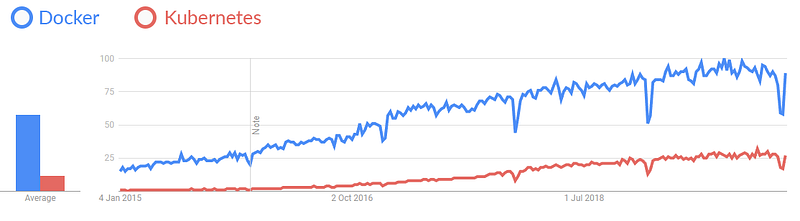
Side note — Who knew everybody lost interest in Docker during the festive period?
Name: Kubernetes Certified Administrator
Level: Intermediate Length: 120 minutes to complete the exam Cost: 395 USD
Format: Performance-based test that requires solving multiple tasks from a command line running Kubernetes.
Here are the key areas covered by the CKA certification:
- Cluster Architecture, Installation, and Configuration: Understanding the architecture of Kubernetes, installing and configuring Kubernetes clusters, and managing various components like kube-apiserver, kube-controller-manager, kube-scheduler, etcd, etc.
- Core Kubernetes Concepts: Familiarity with essential Kubernetes concepts such as pods, deployments, services, volumes, and namespaces. Understanding how these components interact and work together within a cluster.
- Cluster Maintenance: Performing ongoing maintenance tasks like upgrading Kubernetes, managing node components, troubleshooting cluster issues, and handling backups and disaster recovery.
- Networking: Configuring and managing networking within Kubernetes clusters, including creating and troubleshooting network policies, load balancing, and service discovery.
- Scheduling: Understanding how Kubernetes schedules workloads onto nodes, including configuring resource limits, scheduling policies, and managing workload placement.
- Storage: Configuring and managing storage options within Kubernetes, including persistent volumes, storage classes, and dynamic provisioning.
- Application Lifecycle Management: Understanding deployment strategies, rolling updates, and scaling applications within Kubernetes, as well as managing secrets and configuration data.
The CKA certification validates your proficiency in these areas, showcasing your ability to effectively manage and operate Kubernetes clusters in production environments.
By earning this certification, you demonstrate your expertise in deploying and maintaining highly available and scalable Kubernetes infrastructure, ensuring smooth application deployment and management.
Conclusion:
Obtaining a DevOps certification can be a game-changer for your career, providing you with the necessary skills and recognition in a competitive job market.
The AWS Certified DevOps Engineer, Docker Certified Associate, and Kubernetes Certified Administrator (CKA), all offer unique opportunities to expand your knowledge and demonstrate your expertise in essential DevOps tools and methodologies.
Thanks for reading, If you enjoyed this, I regularly post DevOps articles exclusively on Medium — If you would like to read more I recommend checking out the stories below.


