
The 13-Letter Alphabet … It’s real!
I tried to say my name (FRED), but it all went wrong!
This is one of my “Me and …” stories … true stories from my life. №.13: ‘Me and a 13-letter alphabet’.
This story is true!
When I found myself in a new country (Kiribati), and having to live and work amongst the locals, I decided to learn something of the language spoken there. Though I’m not much of a linguist, I wanted to learn a little bit of the local language … you know, the usual intro greetings etc. like “Hello, how are you today?”; “My name is Fred”; “I come from England”; “My wife’s name is Katie”; “I speak English … I am learning your language” … and to use these phrases if I ever needed to speak at the meeting house in any village.
I needed help:
My work in this new country would require me from time-to-time, to visit new villages where I would always be met warmly (with local-language greetings). and of course, I needed to respond (briefly … thankfully!) with a similarly-warm reply, so I needed to quickly learn a few mini responses that I would be able to remember. And I really did need to ‘remember’, because, as I said: “I’m no linguist!”
What I discovered when I attempted to ‘learn’ the language:
It didn’t take me long to observe that most of the local language seemed to be quite full of vowel sounds, and the vowels tended to be sounded out phonetically, making speaking almost musical. For example:
“What language are you learning now?” becomes: “Tera te taetae ae ko reireiniko iai ngkai”
Once, when a I asked a local teacher for help, she asked me this question: “Irua te bentira aika i rarikin te taibora?” Sounds beautiful hey? Well, this is what it means: “How many pencils are beside the table? … What a let-down … Sorry!
‘Why so many vowel sounds?’ I wondered. I discovered the reason when I looked at the total alphabet used for this country’s indigenous language. It contains all five vowels, but only 13 letters in total, hence the vowels seem to dominate most words, and, in that they are sounded out individually and phonetically, the words seem to have a ‘musicality’ about them.
The complete alphabet:
Note: there are very minor variations in some regional areas, but for most of the country, here is the complete alphabet:
a,b,e,i,k,m,n,o,p,r,t,u,w … 13 letters … + 2 ‘sounds’ (‘ti’ & ‘ng’).
You will notice that there is no ‘s’ in the alphabet, but there is an s sound! Because ‘ti’ is not pronounced ti or tee, but ‘ss’ … so that it becomes an ‘s’. The ng sound is pronounced ‘as is’ i.e. ‘ng’ (as is in some African countries).
So, in reality, the alphabet contains 14 letters (if ‘ti’ is accepted as ‘s’), + ng.
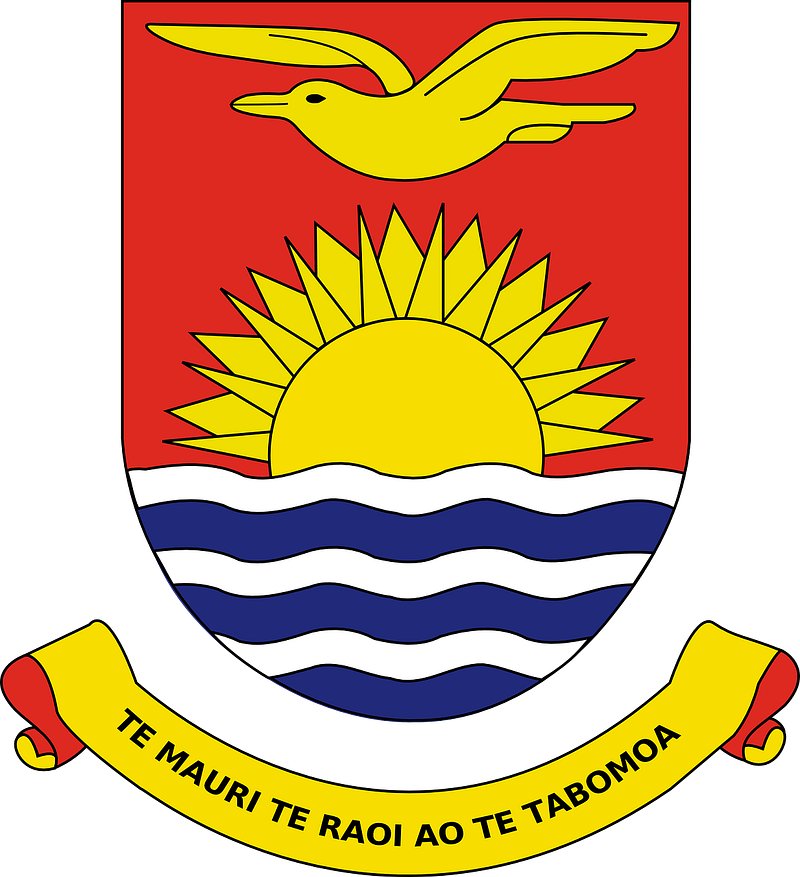
As mentioned, the spoken language has a lovely (musical) sound to it. Try sounding out the motto in this National emblem picture below:
Speaking in a Village Meeting-House (an embarrassing occasion):
I said at the outset of this article that I am not a linguist and that I needed helpful prompts if I was to ‘speak’ at an official village gathering, and I decided that I needed to learn (and remember) the following very basic statements if I was to leave any positive impression on the villagers:
“ I come from England” “ My wife comes from India; her name is Katie” “ My name is Fred”
Simple enough hey? Well, not for me, because, as you may have worked out already, there’s no F or D in the alphabet. FRED, containing only 4 letters, cannot be ‘said’ using the local language! And I really did want to tell them my name.
I had a crafty solution … (what would yours be?) … mine was a total cheat, and here’s how I did it: I actually waited until I was seated alongside one of my local colleagues in the circle around the edge of the meeting house (the traditional format for these meetings), and before I was required to stand and deliver my intro mini speech, I turned to him and said: “How would I say ‘Fred’ in your language?”.
He understood my dilemma, and suggested a word that (to me), sounded like ‘Bress’, (I presumed that it would be spelled something like ‘Breti’ in the local language, using the ti ‘s’ sound along with the b, the r, and the e, that would be pronounced phonetically). It seems to make sense … what do you think?
And so, when it came time for me to ‘deliver’, I rose to my feet, gave the traditional opening remark: “Mauri, mauri”, and the whole assembly clapped and shouted back: “Mauri”. We were on the same wavelength … I was there!!
So, I continued ‘as planned’ with my weakly-learned statements, like: “I kabongana te taetae ni I-Matang” … (‘I speak English’) “Kainabau boni kaiin Inria; aram Ketti” … (‘My wife is Indian; she’s called Katie’)
And then the big one … my name in the local language: I focused my mind on ‘Breti’, (thinking Bress, Bress, Bress), and with a great deal of confidence I said: “Arau Bress” (I am called ‘Fred’) … and then it happened: The whole meeting place erupted in laughter!
What had I said wrong? Why were they laughing? Surely the name Fred wasn’t comical (was it?). So, after I’d sat down, alongside the colleague who had instructed me about the ‘Bress’ sound. I turned to him and said: “Why did they all laugh when I told them that I was called Fred?”
He said: “You pronounced it slightly wrong” , and afterwards he explained: “For example: when you sound out the six letters r e f u s & e in English, you have two choices … If you emphasis the last four letters of r e f u s e, you say ‘re-fuse’, and it means ‘to decline to do’, but if you emphasise only the u, s & e, you pronounce it ‘ref-use’, and it then means ‘waste material’.
I got that, so I asked: “What was wrong with my ‘Bress-sound’ pronunciation?” He then sounded out the word again, saying: “When you said it, it came out with a slightly different sound emphasis, and the sound you made, means ‘Ugly’.
He said: … “Fred, you just said to the crowd: “I’m called ‘Ugly’ !”.
Now don’t start laughing.
My name is Fred, and don’t you ever forget! Maybe you can call me ‘Fred: Almost Famous’, and wonder whether I chose that nom-de-plume so as to avoid being called ‘Ugly’ … Mmmm!
Postscript to the story:
Another interesting fact around this county’s name: The word ‘KIRIBATI’ is pronounced ‘KIRIBASS’ … and if you’ve followed the story you should now know why! … Remember? … ‘ti’ is pronounced ‘ss’ because there’s no letter ‘s’ in the county’s 13-letter alphabet.
This is a true story.
***********************
“Me” Story №13: “Me and a 13-letter Alphabet” by Fred: writer on Medium * * * * * © Fred Ogden 2022 * * * * *

* * * (Feel free to share it on social media if that’s your scene) * * *
You can also Clap & Comment (via icons at top or bottom of this article)
******************************************
NAVIGATION PANEL: TO EVERYTHING FRED: (clickable links)
- All You Need to Know About Fred (including an Index to Fred’s Stories)
- New Index to ALL Fred’s Story Collections
- Get Fred’s new stories delivered to your email inbox … There’s no charge
- Fred’s Email: [email protected]
******************************************
- Follow Fred on Medium: 👉 Fred’s Follow-button (top of all his stories), and he’ll click YOUR ‘follow’ button if he finds your stories appealing.


