
The 100th Monkey
How to bring about Social Change
Many of us may feel sorry when we see the state of the world and wish things were different. We all want more love, less fear, more inclusion, less division, more compassion, less abuse. We all want to see a world where people live together as one family(which we truly are). A place where nature and people are not abused but instead, loved, taken care of, and revered from the heart.
Quite often people see the state of the world and wonder, what can we do? How can we contribute to a better world?
Before we dig into these questions, let's consider the below case study, from the book, the 100th Monkey by Ken Keyes.
The Japanese monkey, Macaca Fuscata, had been observed in the wild for a period of over 30 years.
In 1952, on the island of Koshima, scientists were providing monkeys with sweet potatoes dropped in the sand. The monkey liked the taste of the raw sweet potatoes, but they found the dirt unpleasant.
An 18-month-old female named Imo found she could solve the problem by washing the potatoes in a nearby stream. She taught this trick to her mother. Her playmates also learned this new way and they taught their mothers too.
This cultural innovation was gradually picked up by various monkeys before the eyes of the scientists. Between 1952 and 1958 all the young monkeys learned to wash the sandy sweet potatoes to make them more palatable. Only the adults who imitated their children learned this social improvement. Other adults kept eating the dirty sweet potatoes.
Then something startling took place. In the autumn of 1958, a certain number of Koshima monkeys were washing sweet potatoes — the exact number is not known. Let us suppose that when the sun rose one morning there were 99 monkeys on Koshima Island who had learned to wash their sweet potatoes. Let’s further suppose that later that morning, the hundredth monkey learned to wash potatoes.
THEN IT HAPPENED!
By that evening almost everyone in the tribe was washing sweet potatoes before eating them. The added energy of this hundredth monkey somehow created an ideological breakthrough!
But notice: A most surprising thing observed by these scientists was that the habit of washing sweet potatoes then jumped over the sea…Colonies of monkeys on other islands and the mainland troop of monkeys at Takasakiyama began washing their sweet potatoes.
Thus, when a certain critical number achieves an awareness, this new awareness may be communicated from mind to mind.
Although the exact number may vary, this Hundredth Monkey Phenomenon means that when only a limited number of people know of a new way, it may remain the conscious property of these people.
But there is a point at which if only one more person tunes-in to a new awareness, a field is strengthened so that this awareness is picked up by almost everyone!
Ken Keyes's book was on the nuclear holocaust and the point he was trying to make was; if enough of us believe that there will be a nuclear war, then there will be one, without a doubt. This highlights the importance of our thoughts and emotions, individually as well as collectively.
There are various studies that have highlighted how our thoughts and feelings are vibrations that reverberate across the universe. How we feel has a direct impact on the collective consciousness of the world.
Impact of Feelings on Matter
There are various studies that have highlighted how our thoughts and feelings are vibrations that reverberate across the universe. How we feel has a direct impact on the collective consciousness of the world.
Scientists in recent years have come to the conclusion that even matter is nothing but vibrations and vibrations in proximity sync up and they end up being vibrating at a similar frequency. So one affects another! The vibrations we create have a direct impact on everything around us including matter too!
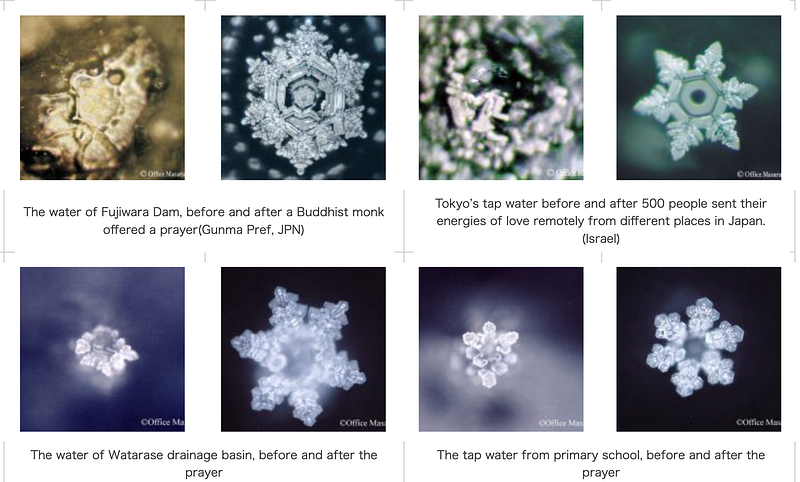
There are a lot of experiments done by Dr. Masaru Emoto, Japan, on the impact of thoughts and vibrations on water. He experimented with water from various sources and subjected to them with words with different vibrations(love, hate), different music, and prayers. He captured the water samples before and after the exercise and what is observed was absolutely flabbergasting! The water samples which were subjected to high energy vibrations then had a very beautiful crystal formation and the samples subjected to low vibrations had a very inconsistent formation. Just imagine the impact our thoughts and feelings have on the five elements. Even our body is nothing but these elements with 70% of it being water. How we feel has a tremendous impact on our body and health too!
So What Can We Do?
Our consciousness is a contribution to the collective consciousness of the world. The collective consciousness in turn impacts other minds as well as matter! Notice the kind of thoughts and feelings you have when you are in a meditation center or a temple or some place of worship, and the thoughts and feelings you have when you are in a crowded mall or a bar perhaps. There is a difference in the energy of the place. You are the same, but in different places, there are different vibrations that catalyze different kinds of thoughts and feelings.
Knowing this gives us a huge sense of responsibility. When we are creating suffering for ourselves, we are sending that energy to the world. When we practice violence towards self and other organisms, that is what we are contributing to the world and you will see more of that happening.
Your own Self-Realization is the greatest service you can render the world.
— Sri Ramana Maharishi
So we cant ask this question — till when? Till when the world will act like this. Till when we will fight wars, till when? The question is on us, when will I transform. When will I be love? When will I be compassionate towards self and other organisms? My transformation will fuel world transformation.
So when we see anger, hatred, violence in the world, use that as a reminder to check ourselves. Am I holding any of those energies within me?
When enough of us establish the kingdom of heaven inside our hearts; matter, as well as this whole earth, will turn into paradise. It is just like reaching that ‘critical number’, that ‘tipping point’, just like that 100th Monkey, then this transformation will take place outside too. Heaven is not someplace else, it is a potential inside of us. Once we establish that within, everything outside also will start vibrating in that frequency too.
The kingdom of God is within you. - Luke 17:20–21
When I change, MY world changes; when enough of us change THE world changes.
Thank you for stopping by. If you enjoyed this, explore few of my other poems / articles.


