
The 10% Rule
How to achieve financial freedom in less than 10 years starting from scratch

The term “financial freedom” gets thrown out a lot by personal finance writers (myself included.) But it’s often unclear what the exact definition of financial freedom is and how someone can know if they have achieved it.
Here is my simple Definition of financial freedom: You have achieved financial freedom when you can spend your days doing work that you love without worrying about how you will pay the bills.
The best part of the above definition of financial freedom is that it does not require you to amass a massive amount of wealth. It simply requires you to find a way to pay for all of your living expenses, plus a little extra for retirement savings, by doing work that you truly love.
By that definition, an artist making $38,000 per year could have more financial freedom than an investment banker making $380,000 per year.
In this article, I will review how anyone can achieve financial freedom in less than 10 years using what I call “the 10% rule.” I’ll also review some tips on how you can speed up your timeline to financial freedom, even if you are starting from scratch.
The 10% Rule
The amount of time it takes to achieve financial freedom comes down to one factor; the amount of money you can make doing work you love relative to your living expenses.
If you have a 9–5 job that you don’t love, the only path to financial freedom is finding work that you love and are truly passionate about.
That does NOT mean you should go out and quit your job. The income from your job can provide financial security for you and your family, and that is not something you should take for granted.
Instead of quitting your job, why not pick up a side-hustle doing something you love and have a goal of earning 10% of your current income from your side hustle over the next 12 months.
Then in the second year of your side-hustle, aim to earn 20% of the income you earn from your day job.
If you keep going at that rate, you can put yourself on the fast track to financial freedom.
Which brings me to the 10% rule: If every year you can replace an additional 10% of your current income doing work you love, you can achieve financial freedom in no more than 10 years.
How to figure out exactly when you’ll be financially free following the 10% rule
The easiest way to understand how the 10% rule works is with an example.
Let’s assume the following.
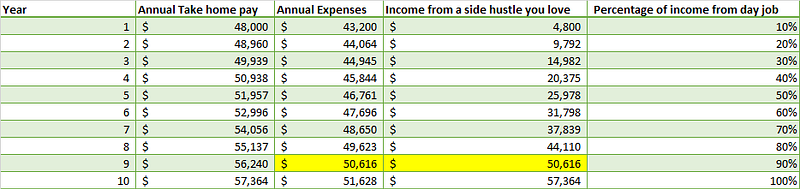
- You have a corporate job that pays you $70,000 per year.
- After taxes and deductions, your annual take-home pay is $48,000.
- Your annual expenses are equal to 90% of your take-home pay or $43,200.
- Each year, your take-home pay and your expenses rise by 2%.
- Maybe you love cooking. Being in the kitchen and preparing fantastic dishes for you and others to enjoy is one of your favorite things to do. So, you pick up a side hustle writing and making videos about cooking recipes.
- Your goal in the first year of launching your cooking side-hustle is to replace 10% of your take-home pay or $4,800.
- In your second year, your goal is to replace 20% of your take-home pay (which has increased by 2%) for a total of $9,792 with your side-hustle.
- Each year you scale the income of your side-hustle to replace an additional 10% of the take-home pay your day job provides you.
- After year nine, the income you receive from your side-hustle and your annual expenses are equal at $50,616.
This is summarized in the following table.
When you can cover all of your living expenses doing work you love, you have achieved financial freedom.
To be clear, to make sure you are comparing apples to apples, the income you earn from your side hustle should be calculated net of taxes because it is replacing your net income from your day job.
Living frugally will dramatically reduce your timeline to financial freedom
If nine years sounds like a really long time, then I have good news; you don’t have to wait nine years.
Remember, the point of financial freedom is when you can cover all of your living expenses with income from work you love. You do not need to replace all of the income from your day job or even 90% of it.
In the example above, where it took nine years to achieve financial freedom, we assumed that in year one, your living expenses were 90% of your take-home pay.
The lower your living expenses are as a percentage of your take-home pay, the less of your current income you’ll need to replace from your side hustle.
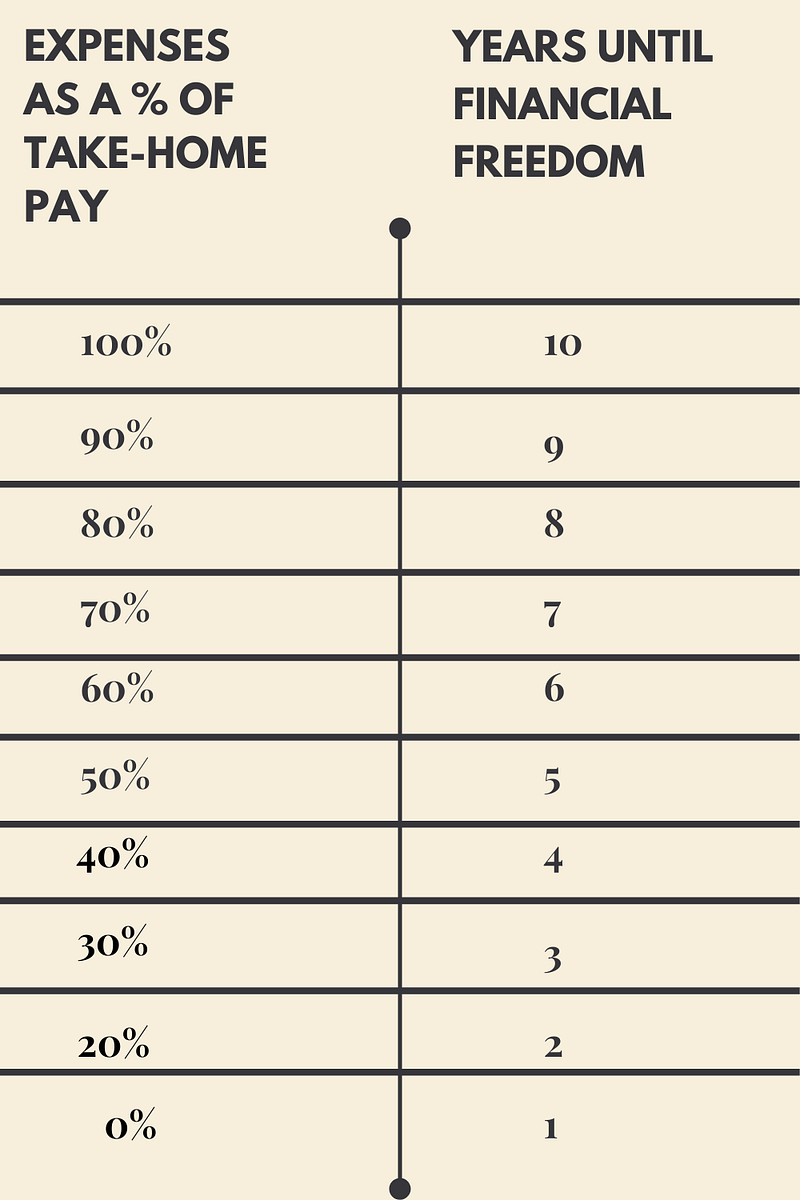
- If your living expenses are 80% of your take-home pay, you can achieve financial freedom in 8 years.
- If your living expenses are 70% of your take-home pay, you can achieve financial freedom in 7 years.
Assuming you can replace an additional 10% of your take-home pay every year through your side hustle, the lower your living expenses are the faster you will achieve financial freedom.
This is summarized in the following chart.
The faster you can scale your income, the faster you’ll achieve financial freedom
The 10% rule assumes that you are replacing an additional 10% of the income from your day job with your side-hustle or passion project each year. I picked 10% for two reasons.
- It sets realistic expectations (it can take a long time to make real money pursuing your passions.)
- 10% is a round number, and people like round numbers.
My point is that there is nothing magical, about 10%. If you can replace more than 10% of the income you make from your day job each year, you will achieve financial freedom much faster.
The only magic number is the difference between your annual expenses and net income generated from doing work you love; once that number is $0, you have achieved financial freedom.
What counts as “living expenses”
I keep using the term living expenses, but what exactly do I mean by that?
This is simple: we will consider living expenses to include literally any transaction where money leaves your pocket or your bank account.
- That means all of your traditional living expenses like housing, food, transportation, entertainment, travel, etc.
- Seasonal spending on things like birthdays and holidays.
- It also includes any short-term savings, for example, money put into an emergency fund, house repair fund, or a travel fund.
- Finally, it will include a basic amount for how much you need to save and invest for long-term retirement planning.
Yes, you need to include an allotment for retirement savings. If you’re doing work you love, you might think, “I never need to retire.” But here’s the thing, it may not be up to you.
By the time you reach traditional retirement age, your health or the state of the economy may not allow you to continue working.
So, you need to be able to save a basic amount for retirement from your side-hustle before you can be considered financially free.
There are two ways you can do this.
- The very unscientific way of simply budgeting to save 10% of your income for retirement.
- Taking the time to actually figure out how much you need to save for retirement based on your situation. It takes a lot more effort but is worth it. I have some tips on how to do that in this article.
So, once you can cover all of your living expenses and savings requirements from income generated doing something you love, you are financially free.
Financial freedom is not a lifetime guarantee
Since Financial freedom is dependent on the income you can generate from doing something you love; it is a fluid situation. Achieving financial freedom does not guarantee you a lifetime of freedom.
If you can no longer generate enough income to cover your spending from work you love, you could lose your financial freedom.
This could be a temporary situation if you have a few bad earning months, or it could be a permanent situation in which case you would need to pick up either part-time or full-time work at a 9–5 job that you may not “love” but need to keep paying the bills.
That is why many people would not choose to actually “claim” their financial freedom as soon as their side-hustle income surpasses their living expenses.
I would count myself among that group of people. My side-hustle generates enough income to cover most of my living expenses, but I am very happy to continue working a great 9–5 job that I like to help me accumulate more assets and give myself a bigger cushion.
Right now, I take every penny I earn from my side-hustle, and I invest it. As my portfolio builds, it begins to produce its own income, which could help supplement my side-hustle income in lean months if I ever choose to grab financial freedom and make my side-hustle my main hustle.
It’s not going to be easy, and there is no guarantee of success, but you need to know that it is absolutely possible for you to achieve financial freedom one day. Start with the first step of replacing 10% of your income from doing work that you love and build on that success.
The 10% rule is a concept, I discuss in my book “The Financial Freedom Equation.” If you want to learn more about financial freedom, pick up your copy here.
This article is for informational purposes only. It should not be considered Financial or Legal Advice. Not all information will be accurate. Consult a financial professional before making any major financial decisions.


