
That’s Not a Promise, It’s a Threat
The parable of the lost sheep reconsidered

This article follows from one in which a list of seven parables was presented. Each of those seven parables supposedly possesses a secret meaning which can be discerned through careful study. This article will focus on an examination of the first parable from that list: The Shepherds.
It was determined that the only parable this could refer to is the Parable of Lost Sheep:
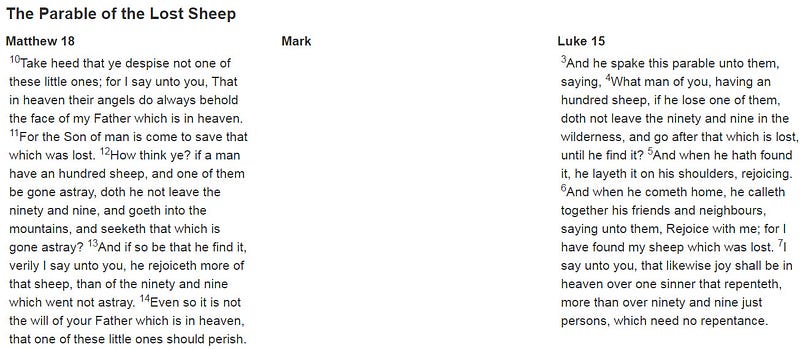
I’m not seeing any secret layers of meaning jump out at me here. What I do see is a parable that does not first appear in Mark. This tells us that Matthew is originating the idea for his own purposes. We need to examine the context to get a better idea of what he is up to.
1 At the same time came the disciples unto Jesus, saying, Who is the greatest in the kingdom of heaven? 2 And Jesus called a little child unto him, and set him in the midst of them, 3 And said, Verily I say unto you, Except ye be converted, and become as little children, ye shall not enter into the kingdom of heaven. 4 Whosoever therefore shall humble himself as this little child, the same is greatest in the kingdom of heaven. 5 And whoso shall receive one such little child in my name receiveth me. 6 But whoso shall offend one of these little ones which believe in me, it were better for him that a millstone were hanged about his neck, and that he were drowned in the depth of the sea. 7 Woe unto the world because of offences! for it must needs be that offences come; but woe to that man by whom the offence cometh! 8 Wherefore if thy hand or thy foot offend thee, cut them off, and cast them from thee: it is better for thee to enter into life halt or maimed, rather than having two hands or two feet to be cast into everlasting fire. 9 And if thine eye offend thee, pluck it out, and cast it from thee: it is better for thee to enter into life with one eye, rather than having two eyes to be cast into hell fire. 10 Take heed that ye despise not one of these little ones; for I say unto you, That in heaven their angels do always behold the face of my Father which is in heaven. (Mat 18:1–10 KJV)
Matthew begins the chapter by constructing a metaphor in which a child represents someone who has just converted to Christianity. Then the text threatens anyone who would dare to offend these ‘children’.
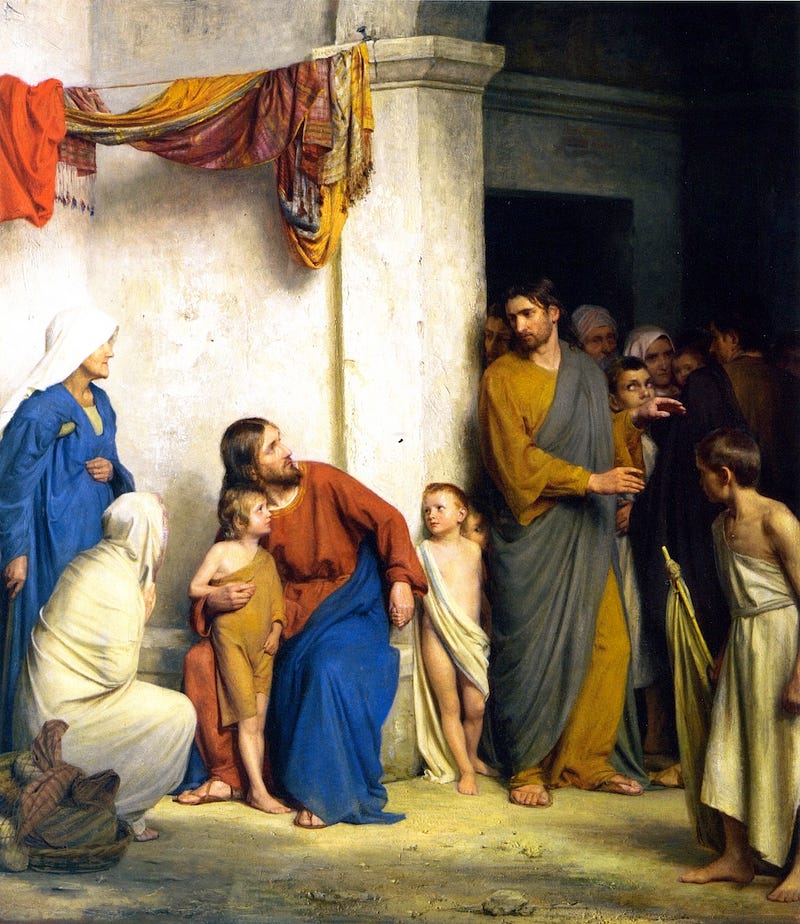

These offenses were likely anything that challenged their fresh Christian beliefs, but I am going to assume for the sake of the narrative that the text is actually referring to the sort of secrets contained in the texts that I have been revealing in my articles.
So Jesus is giving a warning to any of us who might be thinking of revealing a bit of what we have learned to a normie, that that would be a very, very bad idea. And then he completes the warning by adding:
12 What think ye? If a certain man should have a hundred sheep, and one of them be gone astray, does he not, leaving the ninety and nine on the mountains, go and seek the one that has gone astray? 13 And if it should come to pass that he find it, verily I say unto you, he rejoices more because of it than because of the ninety and nine not gone astray. (Mat 18:12–13 DBY)
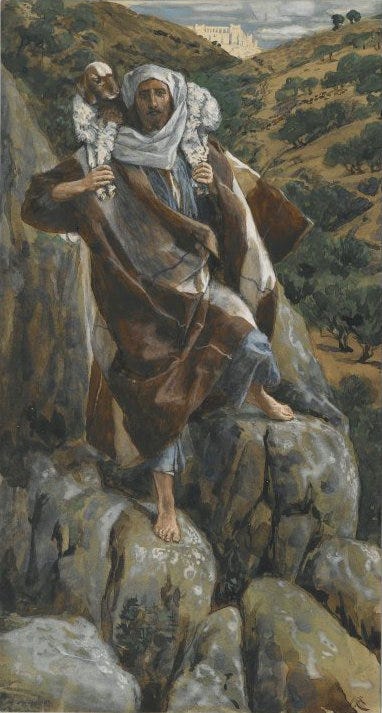
Jesus seems to be telling us, look, if any of you go leaking this stuff around to the amateur Christians, I am going to come after you like a shepherd going after that one missing sheep. And when I find that one lone sheep that strayed from the path, that moment is going to be sweeter than when all of you other fools keep your damn mouths shut. Because that sheep is going to be punished to the fullest extent of the terms as set out within the Gospels themselves.
But then Matthew decides to conceal the threat. Think of it like a bully telling how she is going to hunt someone down and what she is going to do when she finds them, and then, right in the middle of an especially illustrative parable, a couple of nuns stroll within earshot and linger to hear what is being said:
_-_James_Tissot_-_overall.jpg)
12 ‘What think ye? if a man may have an hundred sheep, and there may go astray one of them, doth he not — having left the ninety-nine, having gone on the mountains — seek that which is gone astray? 13 and if it may come to pass that he doth find it, verily I say to you, that he doth rejoice over it more than over the ninety-nine that have not gone astray; 14 so it is not will in presence of your Father who is in the heavens, that one of these little ones may perish. 15 ‘And if thy brother may sin against thee, go and show him his fault between thee and him alone, if he may hear thee, thou didst gain thy brother; 16 and if he may not hear, take with thee yet one or two, that by the mouth of two witnesses or three every word may stand. 17 ‘And if he may not hear them, say it to the assembly, and if also the assembly he may not hear, let him be to thee as the heathen man and the tax-gatherer. (Mat 18:12–17 YLT)
By this deft use of shifting context, the missing sheep becomes equated with a child who symbolizes a member of the Christian community with whom you have a disagreement. It does seem, however, that the hidden warning was still a bit too obvious to a later editor of Matthew who added a verse to clearly separate the parable of the lost sheep from the threat that immediately proceeds it.
10 See that ye do not despise one of these little ones; for I say unto you that their angels in the heavens continually behold the face of my Father who is in the heavens. 11 For the Son of man has come to save that which was lost. 12 What think ye? If a certain man should have a hundred sheep, and one of them be gone astray, does he not, leaving the ninety and nine on the mountains, go and seek the one that has gone astray? (Mat 18:10–12 DBY)
With the addition of the spurious verse, seen above in bold, there can be no question that Jesus means that the lost sheep is to be saved and not punished. Such a clarification would have only been seen as necessary if there existed some who interpreted the text as a threat and not a promise.
In the next article where we will explore the context surrounding the parable in Luke. More disturbing revelations await.