
That We May See No Evil, Prepare
Here’s how you can avoid becoming another statistic
I vividly remember where I was and what I was doing when the tragedy of the Challenger Space Shuttle explosion occurred in 1986. The name of one astronaut in that ill-fated flight has stuck to me ever since — her name sounds like mine. No, I wasn’t in America. I was then into my first year at the university — in Nigeria.
The term “normalisation of deviance” originated from Professor Diane Vaughan. It is defined as “the gradual process through which unacceptable practises or standards become acceptable. As deviant behavior is repeated without catastrophic results, it becomes the social norm for the organisation.”
While investigating the 1986 space shuttle Challenger accident Professor Vaughan observed that the cause of the disaster was traceable to known design flaws in O-rings used in the solid rocket booster of the space shuttle. The reports had it that NASA officials continued to allow space shuttle flights despite the known design flaw with these O-rings.
Why did NASA give the go-ahead for all the launches prior to the disaster?
Prior to the disaster, NASA has successfully launched many space shuttle flights. Unfortunately, during the launch of the Challenger flight in 1986, the gases burned through the O-rings and ignited the main fuel tank.
The flaws with the O-rings were known long before the disaster occurred. However, Professor Vaughan observed that the fact that no mishap resulted from previous flights led to inaction, which led to deviance becoming normalized in the culture then present at NASA before the accident.
As it is for organizations, so it is for individuals. I witnessed a smaller incident that played out howbeit on a lower scale, but no less tragic in its consequences some months back.
“Anything that can go wrong will go wrong” ~ Murphy’s Law
Her house was near the top of the hill. It was a routine she has repeated hundreds of time before now. On that day, she and her kids just got back home from the day’s “schools closed” runs. She parked the car off the road directly opposite the entrance gate to her house, which was just a few yards across. Her kids were at the back of the parked car.
With the transmission shifted to neutral, she turned the engine off. The parking brake was engaged. With the engine switched off and the car ignition key in her hands, she stepped out of the car. All she needed to do was was to cross over the road, open the gate before returning to drive the car with her denizens into her house. This was a no brainier routine she has gone through repeatedly in the past.
Every family knows that kids will play whenever they want to play. This time around, one of her kids decided to give reins to her innocent, curious imagination. In the brief interval, while her mum was out of the car, she jacked down the handbrake! Her curious experiment went awry. Lo-and-behold, the car coasted down the slope! All the kids started screaming helplessly as the driverless car picked up speed. There was no driver behind the wheels!
All the four kids were at the back seats! Hardly has she opened the main gate when she noticed the mishap. A clear and imminent disaster was in sight. She ran after the car and tried to physically stop the driverless car that was gathering speed for a plunge down the hill. That her efforts were as futile as one will expect when you pitch a woman against a machine is anybody’s guess.
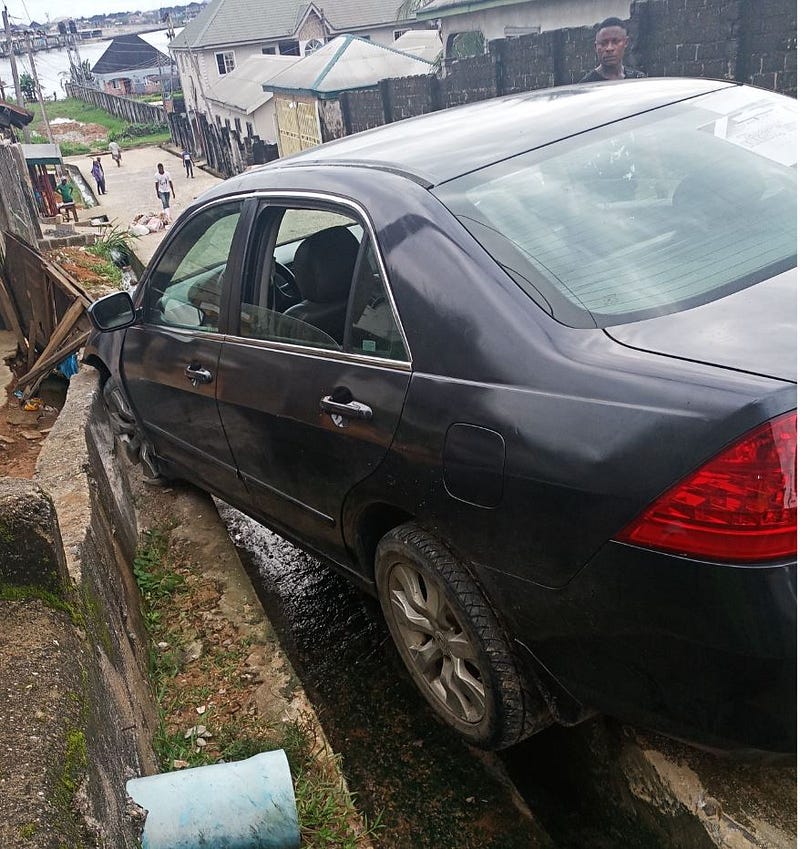
The good news: The car coasted for over 50 feet before ramming on the concrete wall of the fence behind the drainage. None of the kids suffered any serious noticeable injury. Nevertheless, the mother wisely took the kids for medical checkup after the ordeal. All the kids were okay. The road is fairly busy, and some schools have just closed for the day. Miraculously, there was no collision with oncoming vehicles or other road users.
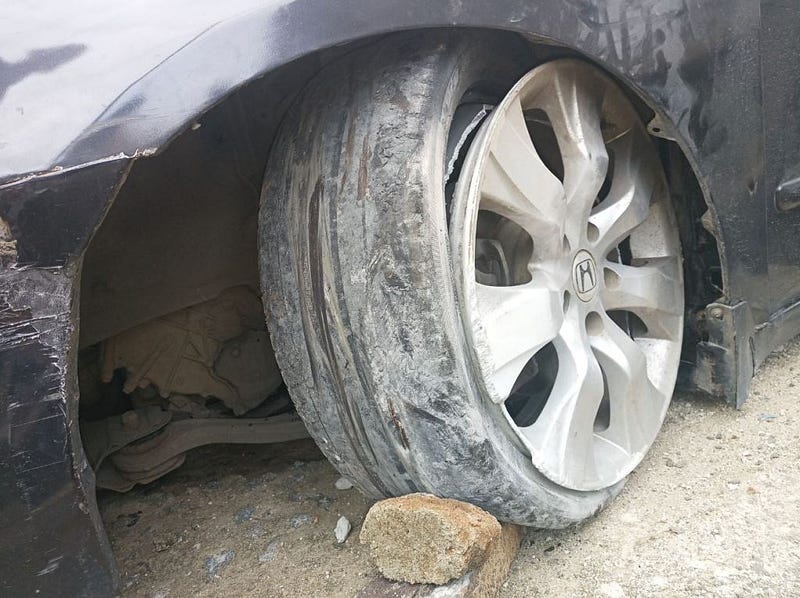
The ugly news: The mum sustained a deep cut under her foot — bloody while trying to run after and stop the car. The car suffered serious damages.
How could this have been prevented? By following the simple rules of correctly positioning the front tyres when parking on a hill. This entails the front tyres being deliberately misaligned at the base or crest of the hill. With this, should in case of the car rolls down the hill, it will quickly jam the kerb that will then act as a stopper.
Either at the base or crest of the hill, with good practice, the car will not have moved over two or three human paces before coming to a stop. This way, you will always avert serious damage or accidents should the car start unattended motion.
After this incident, I drove and park near the same spot. The (worn-out) parking brake did not stop the car from its intent of rolling down. The car stopped because I shifted the transmission stick to P — Parking.
It is very easy to compromise on safety when speed, cost and greater efficiencies are given greater priority over safety. Under such circumstances, once-safe practices get jettisoned or completely replaced by shortcuts. The normal and safe practices are forgotten or thrown overboard, and the unsafe deviant practices subsequently become the norm.
Repeated risk-taking and safety violations do not frequently result in minor or significant disasters. But do not push your luck too far. For individuals and organizations, any disaster that occurs after such violations could be very significant. Think of this possibility anytime you are tempted to overlook a know or potentially risky condition.
Lessons
- If there is a one in a thousand chances that something will fail, the safe rule to follow is to assume that it can fail the very next moment you use it.
- Be prepared and ensure there are no safety infractions at the human, organizational and technical level.
- Regularly carry out personal and home audits to ensure there are no driving or life-endangering safety issues.
- All mechanical contraptions are susceptible to failures and they will not always notify you when any failure is about to happen.
- Don’t cut corners. Always abide by all known, new and extant safety rules.
Sources
- Copyright by © Diane Vaughan, The Challenger Launch Decision: Risky Technology, Culture and Deviance at NASA, University of Chicago Press, 1996
- Follow this link for the proper and safe way to park your car on a hill.