
Pragmatic Approaches to Projects Cost Estimation Success
2 practical views that will give you more wins

A cost estimate is the determination of the likely future cost of a product or service based on an analysis of data. Estimating that future cost involves employing inter-disciplinary quantitative analytic techniques. It is partly science, art and judgment.
The need for project cost estimation
Without reliable project cost estimation, project resources cannot be allocated correctly. Armed with it, the PM can give;
- order of magnitude estimates for size, cost and dates needed for project completion.
- Reliable values for estimated project costs enables long term and strategic planning.
- Estimated costs are needed for budgeting activities – preparation, justification and amendment as circumstances change on the project.
- Provides the basis for selecting from among alternatives. (E.g. rent or buy decisions, internal or contractor source, sole source or competitive)
- Who to blame when things go wrong.
Cost Estimation Types
Fundamentally, cost Estimation focuses on the costs and not the price. Project management costs fall into these broad categories • Recurring versus Non-Recurring • Direct versus Indirect • Fixed versus Variable • Overhead Cost • Sunk Cost • Opportunity Cost • Life Cycles Cost
Why do project cost estimates and projections often fail?
- Estimates and projections are based on information available when the estimate was being made.
- External events beyond the project manager’s control to which he has to make adjustments.
The project will likely face external events and circumstances different from the ones planned for. (“unknown unknowns”)
Unknown unknowns – risks that cannot be anticipated based on past experience or investigations
Donald Rumsfeld Former US Defense Secretary Author of: Known and Unknown,

Traditional approaches to cost estimation
- Parametric Estimation: Historical data is used to calculate the estimation. It works well and saves time.
- Bottom-Up (Definitive Technique): All the project activities are broken up to the microscope level where the cost estimation is done. It is the most accurate but could be more costly and time consuming.
- Three Point or PERT (Program Evaluation and Review Technique) This encompasses all the possibilities, assumptions and uncertainties in cost estimation. PERT Formula Ec = Co + 4Cm + Cp Ec = Expected Cost Co = Optimistic Cost - everything work better than planned. Cm = Pessimistic Cost – Everything works against the plan Cp = Most Likely Cost – Everything goes well The PERT method is considered as the best and most accurate method to calculate the project cost estimation. However, as a project manager, it is your responsibility to identify which method would work better for your project. Sometimes combination of all three would work well.
The Cost Estimation Process
Various industries have various approaches. Broadly, the following steps are encompassed: • The purpose of the estimate • Defining the system • Establish the ground rules and assumptions • The base year • Participants including contractors • Specific inflation indices • Scope and possible limitations • Determining relationship and dependencies • Determining logistics and maintenance support concepts • Selecting the estimation method (already discussed) • Data collection • Formulation of the estimate • Review and documentation
Doing It Right
You do not want to wait until you have gone far into the project before you know if your estimates were wrong or correct. How then will you know if you are doing it right?
- The estimation is based on data from previous or similar projects.
- It accommodate current and future potential process improvements.
- The cost drivers used in the estimation are understood by the program and business leaders.
- The estimation is based on sound underlying statistics
- The assumptions and rules upon which it is based are understood.
- The likely risks in the project lifecycle are understood.
- A clear understanding of the goal is known to all.
- The project is well defined along with the risks areas.
- Project estimates can be validated by third parties or independent means.
- The cost estimates and the basis upon which they are based are traceable and auditable
What is the The Pragmatic Approach?
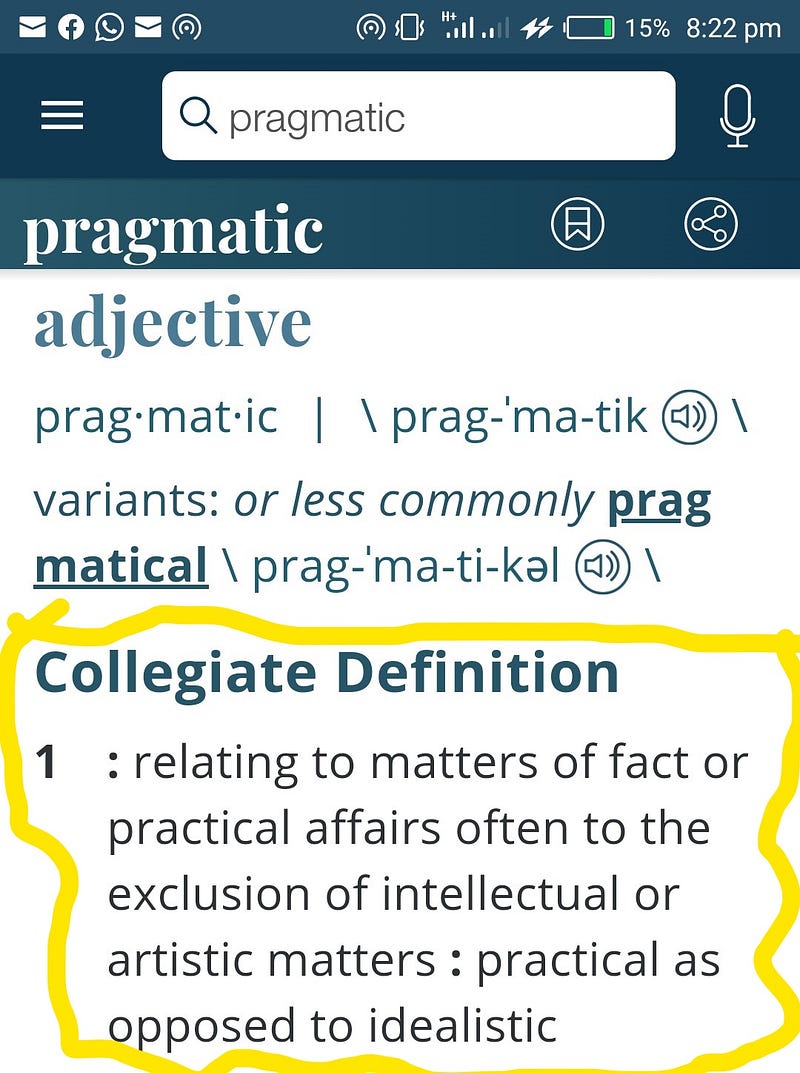
Pragmatic — relating to matters of fact or practical affairs often to the exclusion of intellectual or artistic matters: practical as opposed to idealistic
Source: © 2020 Meriam Webster Inc Professor Daniel Kahneman in his book, Thinking Fast and Thinking Slow cited examples of projects with catastrophically high cost overruns and lessons learnt from them.
- Scottish Parliament building. (Estimated cost in 1997 = £40m; Completed in 2004 at a cost of ~ £431m
- Study in 2005; Worldwide railway projects costs overruns by 45%. Passenger utilization overestimated by 106%
- 2002 Survey; Kitchen remodeling by American homeowners; Expected Costs $18,658; Actual Costs of than 207% increase to $38,709 average.
The two views from Professor Daniel upon which the pragmatic approach is based are;
- The Inside View &
- The Outside View
The Inside View is the approach that will generally be spontaneously adopted to assess the project. With this approach, plans tend to be sketchy and overly dependent and extrapolating on presently available information based on the false assumption that What You See Is All There Is (WYSIATI)
The Outside View to project costs estimation entails directing the attention away from what is available in-house to a class of similar projects external to the organization. This is done with these goals in mind;
- To answer the question, "What is the base rate of success?"
- Not relying exclusively on the information available in-house.
Comparing the Outside View with the Inside View helps to avoid overly optimistic forecasts (planning fallacy).
Two key features of the planning fallacy
- The plans are unrealistically close to best case scenarios.
- The plans could be improved upon by consulting the statistics of similar cases.
These previously identified pragmatic approaches to project cost estimation make it more likely for the project manager to avoid the pitfalls of planning fallacy by;
- Helping to identify appropriate reference classes (road construction, railway projects, buildings etc.) to which a project belongs.
- Equipping the project manager with vital statistics of the reference class (in terms of cost per mile of road or railway or the percentage by which expenditure exceeded budgets).
- Enabling the project manager and his team to use specific information about known cases to adjust the baseline prediction for his own project.
Inferring from this two views approach, the project manager and his team will know if there are particular reasons to expect the optimistic bias to be more or less pronounced in this project than in others of the same type.
Summary
- Project cost estimation enables the project manager to allocate resources and make budgeting decisions needed for successful project.
- Executives and project managers often take on risky projects because they are over optimistic about the odds they face. These uninformed positive biases lead to overestimating project benefits, underestimating project costs and down-playing pitfalls, mistakes and miscalculations. All these lead to failure at delivering the project on budget.
- Employing the pragmatic approach will help project managers and executives to arrive at more realistic cost estimates for their projects.
Sources
- Copyright by © Donald Rumsfeld, Known and Unknown — A Memoir, Penguin Books, 2011
- Copyright by © Gregory K. Mislick; Daniel A. Nussbaum; Cost Estimation – Methods and Tools, John Wiley & Sons Inc, 2015
- Copyright by © Daniel Kahneman; Thinking Fast and Slow, Farrar, Strauss & Giroux, 2011
- Copyright by © Johanna Rothman; Predicting the Unpredictable - Pragmatic Approaches to Estimating Project Schedule or Cost, Practical Ink, 2015
- Pragmatic Approaches to Estimating Project Schedule or Cost
- Copyright 2017 by ©Project Management Institute, Project Management Body of Knowledge — PMBOK® Guide 6th Edition, PMI®, 2017