
That Little Girl Was Me
The First African American Vice Presidential Nominee
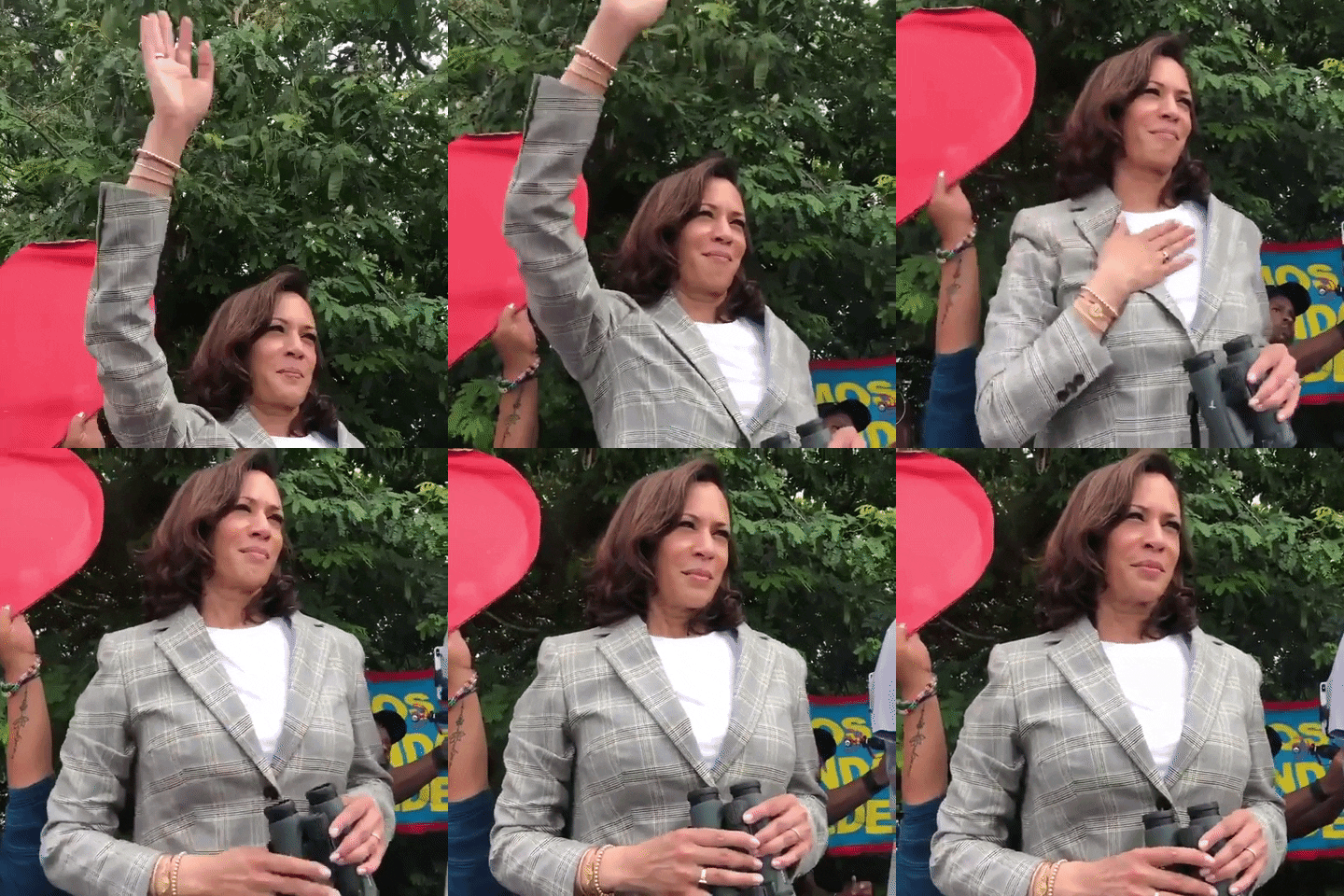
In a decision that will go down in history, Joe Biden captivated the Obama Coalition by picking Kamala Harris to be his Vice Presidential Nominee. Their ticket makes history by providing representation. Traditionally overlooked, women of color do not hold as many leadership roles as other groups of Americans. Yet, with one decision, America tilted the arc of the moral universe towards justice.
As an African and Asian American woman, she will face unique challenges on her journey to the White House. To be clear, no candidate is perfect. However, the media treats female politicians differently, compounding the natural obstacles to fighting stereotypes about women who work.
“Racialized women break the political mould in two ways: once on account of their gender and again on account of their race. Their media coverage bears the marker of their intersecting identities” (Tolley, 2019).
As a member of three marginalized groups, Kamala Harris will face incoming attacks from misogynoir who target her for her race and gender. The language used to describe women and women of color, particularly on the campaign trail, will provide a test for intersectional feminism. Whether or not feministas rally around Kamala Harris will define the American Women’s Liberation movement going forward.
That Little Girl Was Me
Born in 1964 to a Jamaican father and Indian mother, Kamala Harris represents America’s diversity, the complexity of its history, and the potential of its destiny. During her career, she worked as a prosecutor, the Attorney General of California, and Senator of California. Now, she can add something new to her resume: Vice Presidential Nominee.
On the Democratic Presidential debate stage, she stole the scene and, perhaps, the hearts of some Americans when she stood up to the Vice President and challenged his record on race. See, working together does not mean submission. This fierce advocate for progressive policies never shrank away from the challenges facing African American people.
“I would like to speak on the issue of race,” Kamala Harris said Thursday night, an hour into the Democratic-primary debate. She turned to Joe Biden, who, less than two weeks ago, had spoken warmly about his work across ideological lines with two of the last segregationists in the Senate. “I do not believe you are a racist,” she began. But then: “It was actually very hurtful to hear you talk about the reputations of two U.S. senators who built their reputations and careers on the segregation of race in this country. And it was not only that but you also worked with them to oppose busing.” Harris looked at Biden; Biden looked straight ahead. She described a little girl who had been part of the second class bused to integrate public schools in Berkeley, California. “That little girl was me” (Wallace-Wells, 2019).
The phrase, “That little girl was me,” was found on all major newspapers, blogs, and on all forms of social media. It resonated because the same Kamala Harris on the debate stage was a schoolgirl when Biden worked as a Congressman. She brought up her awareness of how his compromises with Southern Segregationists impacted little Black school children.
She stood up to him. Critics cannot call her window dressing in part because of her fiery rhetoric on stage. Her infamous cross-examination of U.S. Attorney General Bill Barr defined her ability to hold men to account.
One of the problematic aspects of Kamala Harris’s record is her role as a prosecutor. Many liberals assert this violates the commitment to reform policing in America. However, movies like When They See Us demonstrate the danger of using only white prosecutors. They often fail to recognize the humanity of Black people as in the case with the Central Park 5, George Floyd, Breonna Taylor, Sandra Bland, and Michael Brown. Many refuse to press charges against officers who violate the law. Lack of representation in the criminal justice system contributes to systematic racism. She will need to thread the needle, producing deliverables of activists who justifiably feel skeptical of her record.
Another point of contention is the color of her skin. Unfortunately, colorism is a concern in America. Some people will contend that she is not dark enough while others will say she is too light skinned. This type of rhetoric is already spreading through mainstream and social media. Still, Americans should respect that Kamala Harris’s parents are Jamaican and Indian. On the Democratic Presidential Primary stage, she identified herself as Black. If this is who she identifies as, it is obtuse and racist to contradict that. As a woman, she will also face sexism by her opponents and the media. Donald Trump already used the word “nasty” to describe her several times. This word is one he only uses to describe women.
Nevertheless, the majority of the Democratic Party is overjoyed. With her fiery personality, intelligence, and experience as a prosecutor should provide an interesting debate against Republican Vice President Mike Pence on October 7, 2020. Her career in law enforcement makes it difficult for those on the right to claim that Democrats are soft on crime, as they did to Michael Dukakis in 1988. While not the most liberal candidate, Kamala Harris advocates for progressive values. If she can thread the needle, she will demonstrate her pragmatism.
A Few Progressive Policies on the Biden-Harris Ticket
“Ensure Workers of Color Are Compensated Fairly and Treated With Dignity
Improve and expand the Small Business Administration programs that most effectively support women-owned businesses, especially those owned by women of color
Provide two years of community college or other high-quality training available without debt, invest in community college students’ success, and tackle the barriers that prevent students from obtaining their degree or credential
Expand and use the power of the U.S. Justice Department to address systemic misconduct in police departments and prosecutors’ offices
Establish an independent Task Force on Prosecutorial Discretion
Invest in public defenders’ offices to ensure defendants’ access to quality counsel
Eliminate mandatory minimums” (Biden & Harris, 2020).
These policies demonstrate a left-leaning ticket, willing to produce deliverables for African Americans and people of color. As an African American and Indian American woman, she can coalesce support from many women of color who want to create a more inclusive country for themselves and their children.
“Let’s speak the truth: People are protesting because Black people have been treated as less than human in America. Because our country has never fully addressed the systemic racism that has plagued our country since its earliest days. It is the duty of every American to fix. No longer can some wait on the sidelines, hoping for incremental change. In times like this, silence is complicity.” — Kamala Harris Cosmopolitan.com | June 4, 2020
Kamala Harris, if elected, will hold the highest office by any person who graduated from a HBSU. In doing so, Joe Biden’s selection made history. Where her story goes from here depends on Americans, their voices, their opinions, and their desire to make it to the polls. With support and determination by supporters, Kamala Harris can break a new glass ceiling for women.
More Articles Curated in Race, Equality, and Education
References:
Biden, J., & Harris, K. (2020, July 29). Joe Biden’s Criminal Justice Policy: Joe Biden. Retrieved August 13, 2020, from https://joebiden.com/justice/
Harris, K. (2020, June 04). Kamala Harris: “To Be Silent Is to Be Complicit”. Retrieved August 12, 2020, from https://www.cosmopolitan.com/politics/a32766156/kamala-harris-black-lives-matter-protests/
Tolley, E. (2019). Racialized and women politicians still get different news treatment. Retrieved August 12, 2020, from https://policyoptions.irpp.org/magazines/march-2019/racialized-women-politicians-still-get-different-news-treatment/
Wallace-Wells, B. (2019, June 28). Democratic Debate 2019: Kamala Harris Won the Night. Retrieved August 12, 2020, from https://www.newyorker.com/news/current/democratic-debate-2019-kamala-harris-won-the-night


