flower&qid=1698850053&s=books&sprefix=philbrick+mayflower%2Cstripbooks%2C97&sr=1-1">Mayflower,’</a> we see the Pilgrims landing on Cape Cod, finding buried stashes of corn, which they interpreted as Divine Providence, while, in reality, they were taking Native American corn.</p><p id="566d"><i>But if you’re Chosen and Eurocentric, does that even matter? Do other people and customs matter?</i></p><figure id="dca4"><img src="https://cdn-images-1.readmedium.com/v2/resize:fit:800/1*IJ8sBDMFTxT7_xwBtBfx7Q.png"><figcaption><a href="https://www.worldhistory.org/image/13125/landing-of-the-pilgrims-by-charles-lucy/">“Landing of the Pilgrims”, also known as “The Landing of the Pilgrim Fathers in America, A. D. 1620”</a>, (1848 CE) is a painting by Charles Lucy (1814–1873 CE).</figcaption></figure><p id="a682">Here’s another image with a similar romanticized portrayal of the birth of a nation. It creates an origin story or mythos. Notice the characters, the women, the men, and the religious elements. It’s important to understand the agenda behind these depictions and question the accuracy.</p><figure id="5c46"><img src="https://cdn-images-1.readmedium.com/v2/resize:fit:800/1*AcEnAHpfgblXKD7M2xAX0A.jpeg"><figcaption><b>Landing of the Pilgrims, Plymouth, Mass. <a href="https://nypl.getarchive.net/media/landing-of-the-pilgrims-plymouth-mass-acdba3">(link)</a></b></figcaption></figure><p id="2476">In the next image, we can see the first indication of the presence of other people. There’s a contrast between the Pilgrims and the Native Americans, portrayed as evil villains — primitive heathen. This is long before the Romantic Ideal of the Noble Savage.</p><p id="aa9e">This kind of depiction has influenced the way we perceive history.</p><figure id="c856"><img src="https://cdn-images-1.readmedium.com/v2/resize:fit:800/1*An1EIBku1QgxYyVl63Yr0w.png"><figcaption>“<a href="https://www.worldhistory.org/image/13122/embarkation-of-the-pilgrims/">Embarkation of the Pilgrims</a>”, a painting by Robert Walter Weir (1803–1889 CE).</figcaption></figure><p id="eb7b">Another image presents a romanticized view of religious devotion. The minister with the Bible is featured prominently. The weapons used against Native Americans as defense are removed, highlighting the Pilgrims’ religious nature but also their readiness to use force.</p><p id="50da">The upper right corner of this picture likely depicts the Pilgrims in Holland before they left. They were asking God for help, showcasing their faith in divine providence.</p><figure id="feae"><img src="https://cdn-images-1.readmedium.com/v2/resize:fit:800/1*klGHomRiwgsRPeydYYq35A.png"><figcaption><a href="https://en.wikipedia.org/wiki/Mayflower_Compact"><i>Signing the Mayflower Compact 1620</i></a>, an 1899 painting by <a href="https://en.wikipedia.org/wiki/Jean_Leon_Gerome_Ferris">Jean Leon Gerome Ferris</a></figcaption></figure><p id="f69d">Here, we can see what might be the Mayflower Compact, an agreement that heavily favored the Pilgrims. The pen and sword, they say — especially when one has both.</p><p id="bce8">This document laid the foundation for their interactions with Native Americans, emphasizing the importance of understanding historical documents in their context.</p><p id="faaa">Here is the agreement between the Puritans and Sachem, called <i>Massasoyt </i>— leader of the <a href="https://en.wikipedia.org/wiki/Wampanoag">Wampanoag</a> confederacy.</p><ol><li><i>That neither he nor any of his, should injurie or doe hurte to any of their peopl.</i></li><li><i>That if any of his did any hurte to any of theirs, he should send ye offender, that they might punish him.</i></li><li><i>\That if any thing were taken away from any of theirs, he should cause it to be restored; and they should doe ye like to his.</i></li><li><i>If any did unjustly warr against him, they would aide him; if any did warr against them, he should aide them.</i></li><li><i>He should send to his neighbours confederats, to certifie them of this, that they might not wrong them, but might be likewise comprised in ye conditions of peace.</i></li><li><i>That when ther men came to them, they should leave their bows & arrows behind them. (<a href="https://www.gutenberg.org/files/24950/24950-h/24950-h.htm#The_10_Chap">Link</a>).</i></li></ol><p id="7883"><i>“European explorers and invaders discovered an inhabited land had it been pristine Wilderness then it would possibly be still, for neither the technology nor the social organization of Europe in the 16th and 17th centuries had the capacity to maintain of its own resources Outpost colonies thousands of miles from home” <b>— Francis Jennings</b></i></p><figure id="229
Options
8"><img src="https://cdn-images-1.readmedium.com/v2/resize:fit:800/1*BbsjPLhvMpiN1trMhgh-nA.png"><figcaption><a href="https://www.worldhistory.org/image/13163/the-first-thanksgiving/">“The First Thanksgiving”</a> (1621) by Painting by JLG Ferris, 1932 CE.</figcaption></figure><p id="e53f">The well-known image of the first Thanksgiving also holds numerous inaccuracies. It portrays Native Americans and Pilgrims in ways that differ from historical reality. The truth is more complex, with Native Americans teaching the newcomers about farming and fertilization.</p><p id="2111">The patriarchal depiction of the first Thanksgiving reinforces the National Myth, focusing on the gratitude of the Pilgrims and downplaying the role of Native Americans — and the extermination of the Native People.</p><p id="5550"><i>“Thanksgiving Dinner is a ritual with all the characteristics that Mircea Eliade assigns to the ritual observances of origin myths. (<a href="https://press.princeton.edu/books/paperback/9780691182971/the-myth-of-the-eternal-return">The Myth of the Eternal Return</a>)</i></p><p id="6589"><i>1. It constitutes the history of the acts of the founders, The Supernaturals.
2. It is considered to be true.
3. It tells how an institution came into existence.
4. It performs the ritual associated with the myth one experiences knowledge of the origin and claims one’s patriarchy.
5. One lives the myth as a religion.”</i></p><p id="b3f4">When Squanto found his way back after years of slavery and bondage, he found his people dead — and really had no other option but to assist the “Colonizers.”</p><p id="e014">We need to question these depictions and their accuracy. Michael Dorris asks why the American psyche clings to such myths when they lack authenticity and cross-cultural perspective. European colonists didn’t conquer America through military genius but, in part, due to biological warfare.</p><p id="c53b">And all those “fields” in New England — Enfield and Springfield — well, the Native People actually had those fields plowed, and the Pilgrims gave thanks to God for destroying the tribes to bestow such production fields for their salvation and survival. This is where we get the idea of Providence — and the capital of Rhode Island.</p><p id="fc39">Within three years, a plague wiped out a significant portion of the Native American population, and King Philip’s War was brutal and often overlooked in history classes — the war actually killed a larger percentage of the population than any other American conflict.</p><p id="8f80">Thanksgiving, like Independence Day or Columbus Day, celebrates ethnocentrism. There is nothing wrong about giving “Thanks” and celebrating “Freedom and Individual Liberties.” But what happens when one’s freedom and gratitude intrudes of the life and liberty of others?</p><p id="65b5"><i>As Malcolm X said in 1964: “We didn’t land on Plymouth Rock. Plymouth Rock landed on us” (<a href="http://www.vlib.us/amdocs/texts/malcolmx0364.html#:~:text=We%20didn't%20land%20on,speak%20so%20beautifully%20about%20today.">The Ballot or the Bullet</a>).</i></p><p id="853d">It’s crucial to confront the uncomfortable truths and facts of history, the agendas behind these myths, and the many sides of the story that are missing or deleted in our national discourse, our “Holy Days,” and our history textbooks.</p><h2 id="79dd">For more of Walter Bowne on Illumination, check out:</h2><div id="a249" class="link-block">
<a href="https://readmedium.com/ten-minutes-of-lockdown-ad718b76158d">
<div>
<div>
<h2>Ten Minutes of Lockdown</h2>
<div><h3>The lesson for class changed once the announcement was made</h3></div>
<div><p>medium.com</p></div>
</div>
<div>
<div style="background-image: url(https://miro.readmedium.com/v2/resize:fit:320/1*rksDHii05_CTjFgJPCJsYw.jpeg)"></div>
</div>
</div>
</a>
</div><div id="fb2c" class="link-block">
<a href="https://readmedium.com/learning-economics-by-playing-animal-farm-with-fisher-price-people-2de0261fba39">
<div>
<div>
<h2>Learning Economics By Playing ‘Animal Farm’ with Fisher Price People</h2>
<div><h3>How I re-enacted George Orwell’s fable with my daughters</h3></div>
<div><p>medium.com</p></div>
</div>
<div>
<div style="background-image: url(https://miro.readmedium.com/v2/resize:fit:320/1*5ZqI-8jTafzrY7WUn1yCeQ.png)"></div>
</div>
</div>
</a>
</div></article></body>
Uncomfortable Truths
Thanksgiving v. Truth: Exploring the Darker Side of an American Tradition
Examining the Impact of Colonialism on Native Americans
“Considering that virtually none of the standard fare surrounding Thanksgiving contains an ounce of authenticity, historical accuracy, or cross-cultural perception, why is it so apparently ingrained? Is it necessary to the American psyche to perpetually exploit and debase its victims in order to justify its history?” — Michael Dorris
Hey, everyone.
So we’ve been reading William Bradford’s Of Plymouth Plantation. It’s one of the early historical narratives that begins the narrative of American Exceptionalism — as well as John Smith’s self-serving and largely fictionalized “account” of the foundation of Jamestown in Virginia.
Bradford writes in the “plain style” of 1630 about those early days in 1620. It’s the only “thorough history of Plymouth Colony that was written by a Mayflower passenger” (link).
Excerpt: “Men, Indeans, Indeans”; and wthall, their arowes came flying amongst them. Their men rane with all speed to recover their armes, as by ye good providence of God they did. In ye mean time, of those that were ther ready, tow muskets were discharged at them . . . Aterwards they gave God sollamne thanks & praise for their deliverance (Chapter 10).
Bradford’s perspective, and of course, his agenda. Let’s take another view.
To cynics or realists, we could say that history is often written by the winners. Consider if Nazi Germany and Imperial Japan had won World War II. How would that shape the historical record — one essential reason for writing?
Not that I’m saying there is a moral equivalency. However, we have to critically examine historical writing in context. As Italo Calvino says, we need to read “receptively and resistantly.”
We should absorb the information but also question it, understanding the author’s agenda, the target audience, and the desired message. Great books like Lies My Teacher Told Me reveal errors or omissions in history class or books that may have a hidden agenda that promotes certain ideas.
“The Europeans were able to conquer America not because of their military genius or their religious motivation or their ambition or their greed they conquered it by waging on premeditated biological warfare.” — Howard Simpson
Let’s take the example of Plymouth Rock.
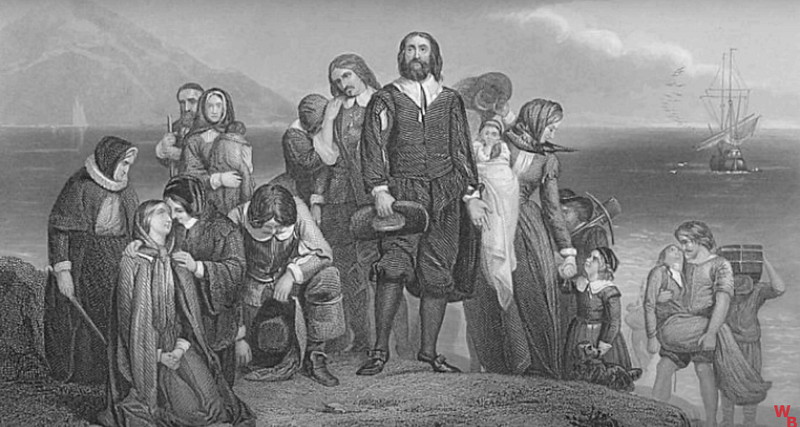
It’s our Touchstone. In this image, we see the Mayflower in the background, the landing party arriving on Cape Cod. There’s a sense of divine providence, almost like Moses coming into Egypt, thanking God for deliverance. But it’s essential to note that this interpretation is often inaccurate.
For instance, in Nathaniel Philbrick’s ‘Mayflower,’ we see the Pilgrims landing on Cape Cod, finding buried stashes of corn, which they interpreted as Divine Providence, while, in reality, they were taking Native American corn.
But if you’re Chosen and Eurocentric, does that even matter? Do other people and customs matter?
Here’s another image with a similar romanticized portrayal of the birth of a nation. It creates an origin story or mythos. Notice the characters, the women, the men, and the religious elements. It’s important to understand the agenda behind these depictions and question the accuracy.
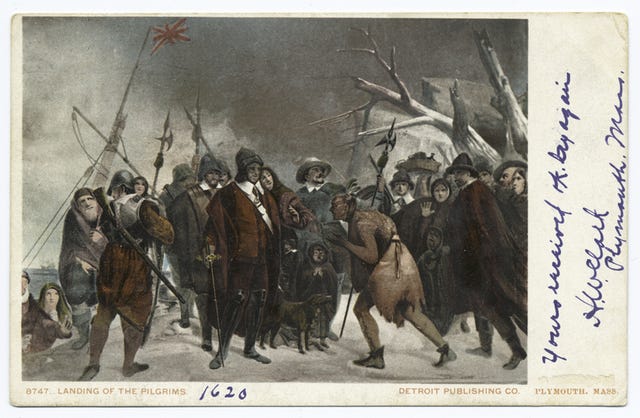
In the next image, we can see the first indication of the presence of other people. There’s a contrast between the Pilgrims and the Native Americans, portrayed as evil villains — primitive heathen. This is long before the Romantic Ideal of the Noble Savage.
This kind of depiction has influenced the way we perceive history.
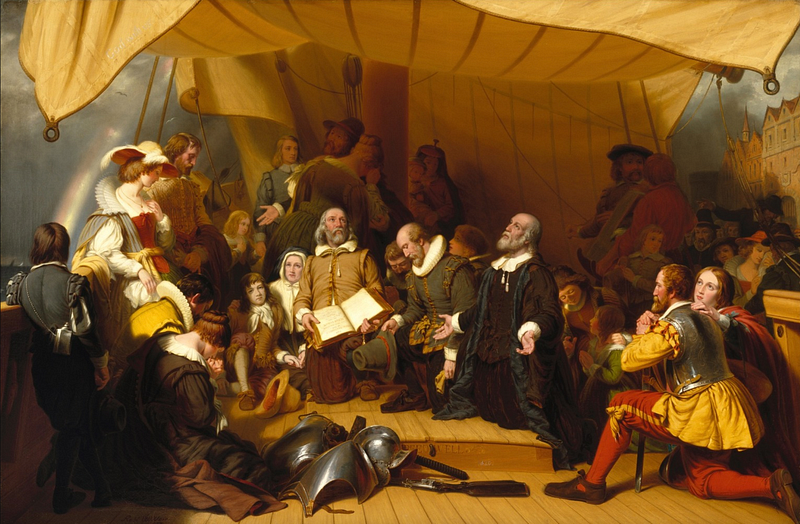
Another image presents a romanticized view of religious devotion. The minister with the Bible is featured prominently. The weapons used against Native Americans as defense are removed, highlighting the Pilgrims’ religious nature but also their readiness to use force.
The upper right corner of this picture likely depicts the Pilgrims in Holland before they left. They were asking God for help, showcasing their faith in divine providence.
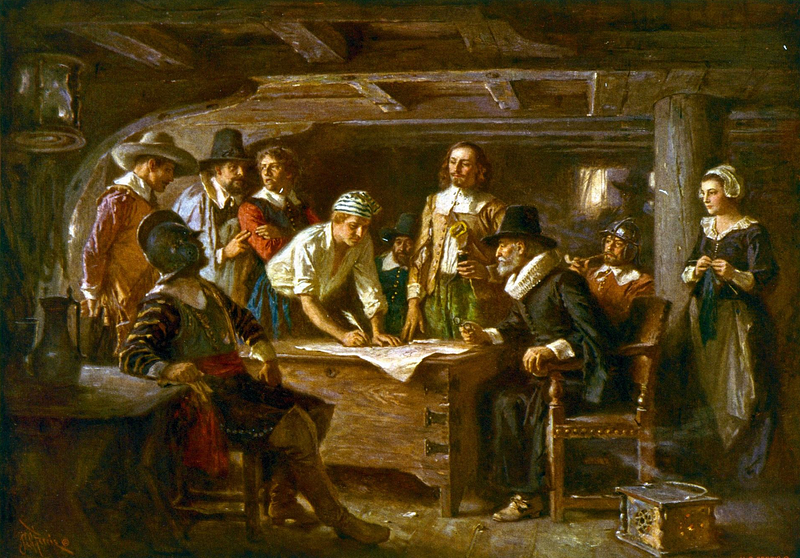
Here, we can see what might be the Mayflower Compact, an agreement that heavily favored the Pilgrims. The pen and sword, they say — especially when one has both.
This document laid the foundation for their interactions with Native Americans, emphasizing the importance of understanding historical documents in their context.
Here is the agreement between the Puritans and Sachem, called Massasoyt — leader of the Wampanoag confederacy.
That neither he nor any of his, should injurie or doe hurte to any of their peopl.
That if any of his did any hurte to any of theirs, he should send ye offender, that they might punish him.
\That if any thing were taken away from any of theirs, he should cause it to be restored; and they should doe ye like to his.
If any did unjustly warr against him, they would aide him; if any did warr against them, he should aide them.
He should send to his neighbours confederats, to certifie them of this, that they might not wrong them, but might be likewise comprised in ye conditions of peace.
That when ther men came to them, they should leave their bows & arrows behind them. (Link).
“European explorers and invaders discovered an inhabited land had it been pristine Wilderness then it would possibly be still, for neither the technology nor the social organization of Europe in the 16th and 17th centuries had the capacity to maintain of its own resources Outpost colonies thousands of miles from home” — Francis Jennings
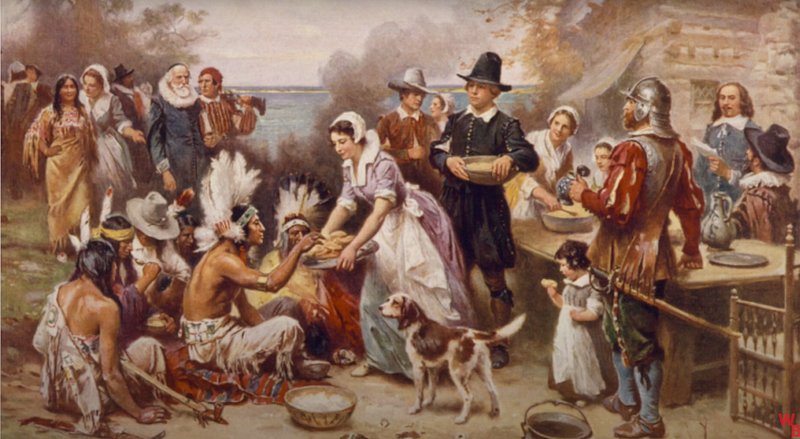
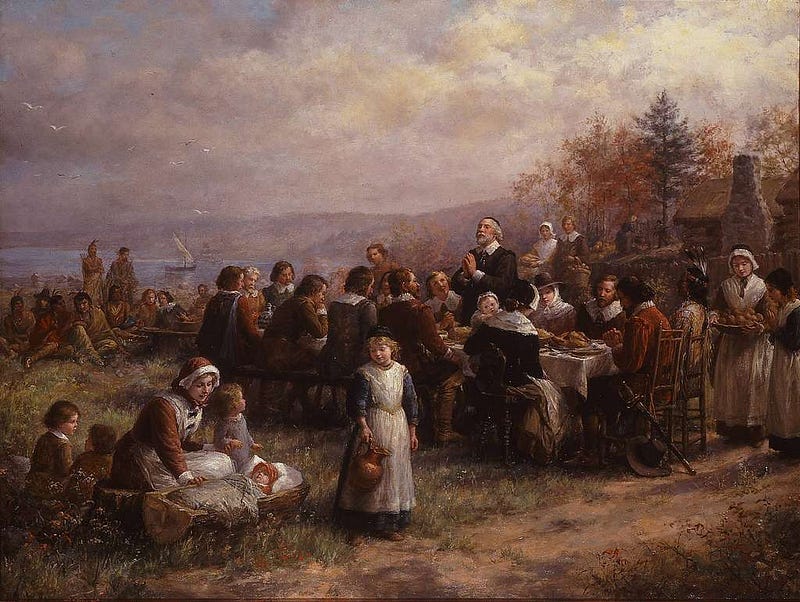
The well-known image of the first Thanksgiving also holds numerous inaccuracies. It portrays Native Americans and Pilgrims in ways that differ from historical reality. The truth is more complex, with Native Americans teaching the newcomers about farming and fertilization.
The patriarchal depiction of the first Thanksgiving reinforces the National Myth, focusing on the gratitude of the Pilgrims and downplaying the role of Native Americans — and the extermination of the Native People.
“Thanksgiving Dinner is a ritual with all the characteristics that Mircea Eliade assigns to the ritual observances of origin myths. (The Myth of the Eternal Return)
1. It constitutes the history of the acts of the founders, The Supernaturals.
2. It is considered to be true.
3. It tells how an institution came into existence.
4. It performs the ritual associated with the myth one experiences knowledge of the origin and claims one’s patriarchy.
5. One lives the myth as a religion.”
When Squanto found his way back after years of slavery and bondage, he found his people dead — and really had no other option but to assist the “Colonizers.”
We need to question these depictions and their accuracy. Michael Dorris asks why the American psyche clings to such myths when they lack authenticity and cross-cultural perspective. European colonists didn’t conquer America through military genius but, in part, due to biological warfare.
And all those “fields” in New England — Enfield and Springfield — well, the Native People actually had those fields plowed, and the Pilgrims gave thanks to God for destroying the tribes to bestow such production fields for their salvation and survival. This is where we get the idea of Providence — and the capital of Rhode Island.
Within three years, a plague wiped out a significant portion of the Native American population, and King Philip’s War was brutal and often overlooked in history classes — the war actually killed a larger percentage of the population than any other American conflict.
Thanksgiving, like Independence Day or Columbus Day, celebrates ethnocentrism. There is nothing wrong about giving “Thanks” and celebrating “Freedom and Individual Liberties.” But what happens when one’s freedom and gratitude intrudes of the life and liberty of others?
As Malcolm X said in 1964: “We didn’t land on Plymouth Rock. Plymouth Rock landed on us” (The Ballot or the Bullet).
It’s crucial to confront the uncomfortable truths and facts of history, the agendas behind these myths, and the many sides of the story that are missing or deleted in our national discourse, our “Holy Days,” and our history textbooks.
For more of Walter Bowne on Illumination, check out: