
Thank You, Senator Cotton
For making me aware of the 1619 Project
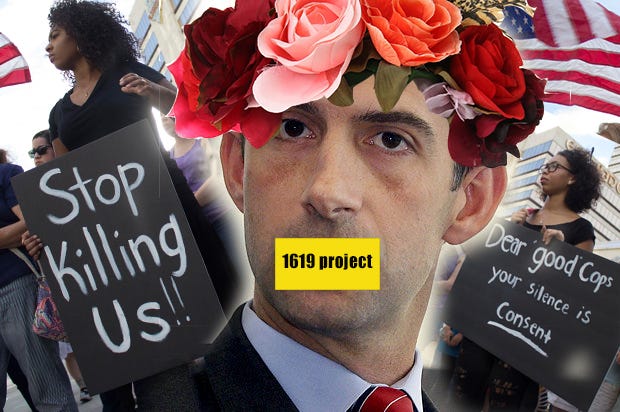
I’d never heard of the 1619 Project before it landed in the news this week when Senator Tom Cotton said slavery was “the necessary evil upon which the Union was built” while advocating to defund schools that teach the 1619 Project.
That led me to this story explaining the Project in the New York Times and to this one which talks about an early edit and uses the word “historiography” — another first for me.
I had to stop mid-story after reading that word just to savor it for a moment. I love the way it combines “history” and “graphy,” which seems to admit on its face that history is written by fallible humans and must be corrected when the occasion demands.
And I can’t think of an occasion that demands it more than this horrific year.
I’ve long been aware that women are dismissed, ignored, and written out of U.S. history. Where’s my Harriet Tubman $20 bill? My monument to Nellie Bly? And events rocking the United States since the murder of George Floyd remind me that Black Americans face the same.
When I read about the Black Lives Matter protests happening across the United States and the federal troops being sent to quash them (over local lawmakers’ objections), I see that the culture is rupturing and changing, and I pray that it will be a change for good. At least racism has become part of the national conversation. It hasn’t always been that way.
When Trevor Noah came to the United States just a few years ago, one of the things that surprised The Daily Show host most was that Americans didn’t talk about racism — pretending instead that it doesn’t exist. In his native country of South Africa, that’s not the case. Hear his take on that eight minutes into this clip.
So it’s good that people in the United States are talking about racism today. That’s a step in the right direction. But more is required. Much more.
‘History is written by fallible humans and must be corrected when the occasion demands.’
We must study our history, analyze our systems, and bring the shadow of prejudice against all types of people — Black, indigenous, women, gay, Latinx, disabled, Muslim, Jewish, older, immigrant…the list goes on and on — out into the sunshine if we want to truly realize the American Dream: that all people are created equal and have unalienable rights to Life, Liberty, and the pursuit of Happiness.
Now, thanks to Senator Cotton, I’ve found an excellent tool to help me do just that.
Now I have a treasure trove of essays by deep thinkers about American history and slavery. They captured me with the first quote on the first screen of the introductory essay by Nikole Hannah-Jones, the woman and New York Times journalist, 2017 MacArthur fellow, winner of a National Magazine Award, a Peabody Award, a George Polk Award, and a Pulitzer Prize, who conceived the 1619 Project in the first place.
“Our democracy’s ideals were false when they were first written. Black Americans have fought to make them true.”
I can’t wait to dig in.
Patsy Fergusson is the Editor of Fourth Wave. For more by this author, try:


