
Tesla's Full Self-Driving
Is It Worth It…Not today, but soon.
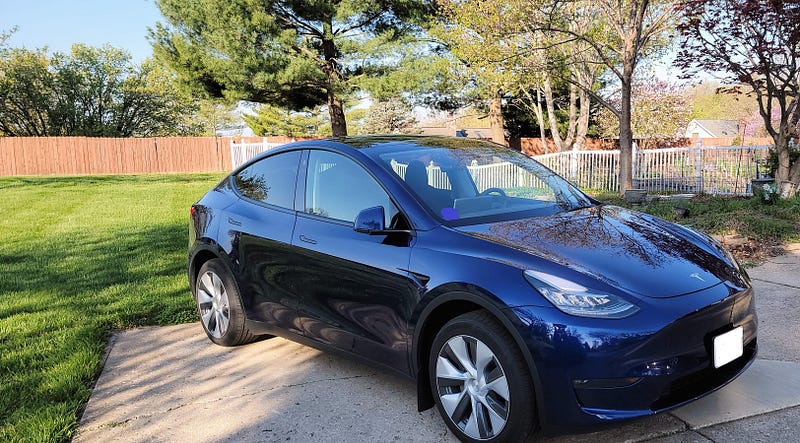
I should have listened to my friend, Dan. He said," Hell the f@#k no, don't buy the Full Self-Driving; it's not worth it." He had bought his third Tesla, and he should know. "Save your money; it's not worth it." But, of course, I didn't listen. I knew that Tesla was close to perfecting the fully automated driving software. The question was, how soon? I was guessing in a year or two. I wanted to have it when it was out. I was afraid of another price hike in the future. I wanted to have it and not pay more for it later. Tesla increased from $10000 to $12000 in January 2022 to $15000 as of September 2022—two yearly price hikes. I was afraid of another price increase. I should have listened to Dan.
Full Self-Driving (FSD) is activated by double depressing the right gear shift. A tiny steering wheel on the top left header of the center console goes from grey to blue when the FSD is activated.
First, I love how the sensors and the camera recreate an animated bird's eye view of your car driving down the street, with all the nearby pedestrians, cars, and trucks mapped out on the center console. Flick the turn signal lever up or down, and the blind spot camera appears on the center console. No more contorting your neck so your head can view your blind spot every time you commit to a lane change. Look at the animation, check your blind spot camera, and watch FSD magically drift to the adjacent lane once free and clear. I smile with delight at how well FSD accomplished the task.
The full self-driving works in simple traffic patterns: straight two-lane roads and perpendicular intersections. The car equipped with FSD stops at stop signs and stoplights. I love the little beep from my Tesla when the traffic light changes from red to green to remind me that the light has changed and I can proceed. The car stays in its lane and does not allow the vehicle to drift side to side within the road. Instead, the car stays precisely in the center of the street as you let FSD take control of the vehicle—no foot on the gas. The only requirement from FSD is to keep both hands on the wheel. Although the weight of your hands on the steering wheel keeps the FSD engaged during your trips, the car will alarm when it senses no hands on the wheel. If you remove your hands from the steering wheel more than three times, FSD mode is turned off and stays inactive for the rest of the trip. After that, the driver must take over and complete the journey.
Now the not-so-good part of FSD.
On several occasions, the FSD encountered a situation it could not interpret. FSD freaks out and beeps loudly and then shuts off in a blink of an eye. I was startled by the beeps and frantically grabbed control of the steering wheel from FSD while on a four-lane highway. The first occasion was a mad driver that weaved from lane to lane. The driver thought he was racing through the Grand Prix. The white Corolla sped by me in the left lane, quickly changed lanes, sped across my lane, and bolted ahead of me in the right lane. The FSD made an unexpected right lane change, assuming the Corolla was about to cause a collision and hit my Tesla. I grabbed the wheel and kept my Tesla in my lane. In all fairness, FSD reacted adequately; it was aware that the right lane was free from any cars and executed a maneuver to avoid a possible collision by jumping into the right lane. But it also alarmed and turned the FSD mode off. A banner appeared on my center console, alerting me to take control of the steering wheel. Did FSD overreact or execute a safer course of action than I would have done? I don't know. If anything unusual happens while in FSD mode, does the FSD turn off and dumps the steering wheel on the driver? Is that how FSD is programmed?
I live in a suburban community that outgrew the farming community it once was fifty years ago. The streets were not designed to crisscross each other at ninety degrees. New suburban streets were built around country roads. There are some bizarre intersections where two lanes are slotted for left turns onto a street that curves and twists. Down the road, about 300 ft, is a highway entrance ramp to the left, and 200 feet to the right is a street that darts off into a windy road. FSD gets confused at the stop light intersection and assumes only one left turn lane exists — -not two. I take over the Tesla steering wheel. Once I finish the turn, I click on the FSD again to turn right, depressing the right turning signal, and FSD fails to execute the right turn. I grab the wheel and make the right turn hastily before driving past my turn. Has FSD not encountered this intersection before on its Tesla Maps? Do several Tesla Trips through this intersection rectify the FSD driving hitch? Do the AI supercomputers running Tesla's FSD need more data? I suspect more encounters through the intersection and down this street will eventually correct the FSD driving algorithm.
FSD stutter and often fails when a highway lane merges with the adjacent lane. Once the dashed white lines disappear, FSD veers close to the outer solid yellow line and fails to merge smoothly onto the other lane. As a result, I frequently have to assume control and veer the car to the merging lane.
Construction zones can be a headache for drivers using FSD. Orange cones demarcating lane changes and mergers may confuse FSD, especially if the painted lanes on the highway say otherwise. In addition, in many cities, construction projects have increased. One day the road is fully operational, but at night after 7 pm, the construction crew is out on the highway converting three-lane highways to one-lane bottlenecks as they resurface the roadway. How can FSD keep the nightly road construction straight if it disappears by day, reappears at night, and disappears entirely in two months?
Tesla will perfect the FSD. FSD depends on how many Tesla vehicles are driving in your community and for how long. The more hours Tesla cars drive down a street or through an intersection, the more traffic data is gathered for that community. The more data collected by Tesla cars, the better the FSD experience will become. As more and more Tesla cars appear on the road, the faster FSD will become a reality.
But the question comes back. Is purchasing FSD worth it? No, at least right now. Will FSD become a reality? Yes. The $15000 is when. It may become a reality soon or two or three years later. But once we know for sure, wait to get the FSD package. In the meantime, there is the monthly subscription option. Barring any price hikes in the monthly subscription, this option may be cheaper than buying the FSD package during your Tesla purchase. It may be worthwhile to purchase the FSD monthly subscription when traveling out of state or on long road trips with the family. The FSD subscription costs $199 per month. If you ordered the Enhanced Autopilot feature with your Tesla purchase, the FSD package drops to $99 monthly. Use the money you save and invest in Tesla instead. I am no financial wizard, but I see the potential in making money with the latter option.
One thing is for sure, FSD is cruise control on steroids. Elon Musk and his Tesla engineers have taken automated driving to the next level many people never dreamed of. It isn't perfect yet, but it is getting closer and closer to becoming a reality. The question is how long the wait will be.
Use my referral link to purchase a Tesla product and get free credits you can redeem for awards like Supercharging miles, merchandise and accessories. https://ts.la/thomas913365
Your membership fee gives you unlimited access to beautiful articles on Medium. If you join, a small portion of your membership fee will go to other writers you chose to read and me. So enjoy! Join by clicking the link below: